
How to Buy Gold: Complete Guide to Gold Investing in 2026
Investing in gold has been one of humanity’s most trusted wealth preservation strategies for thousands of years. Whether you’re looking to buy gold online, purchase gold bullion bars, or invest in gold coins, understanding how to navigate the gold market is important for making informed decisions. With gold prices reaching new highs in 2026, many investors are exploring gold as a hedge against inflation and economic uncertainty.
This comprehensive guide will walk you through everything you need to know about how to buy gold, from choosing between physical gold and paper gold to selecting trustworthy dealers and understanding storage options. The gold market can seem complex at first, but finding a trustworthy platform to buy legitimate gold is your first priority. Whether you’re purchasing gold bars for their lower premiums or gold coins for their liquidity and recognition, working with reputable dealers protects you from counterfeit products and ensures you’re paying fair prices close to the spot gold price.
Table of Contents
Should I Buy Gold Now?
Gold has earned its reputation as the most trustworthy asset class for a reason. Unlike fiat currencies or Bitcoin, gold possesses genuine scarcity combined with practical industrial applications extending far beyond its role as a store of value. Gold is used in electronics, dentistry, aerospace, and medical devices, giving it fundamental demand regardless of market conditions. While Bitcoin advocates point to its 21 million coin limit, gold’s physical scarcity spans millennia of mining history with only about 208,000 tons ever extracted from the earth.
The best approach to gold investing is adding to your position over time through dollar-cost averaging rather than attempting to time the market. Gold typically exhibits lower volatility compared to stocks or cryptocurrencies, making it suitable for steady accumulation. According to data from multiple financial institutions, gold has a near-zero correlation with stocks (averaging 0.004 since 1969), which means it often maintains or increases in value when other assets decline. This makes gold an ongoing portfolio allocation rather than a one-time purchase.
Gold Price Performance: Last 30 Years
Data Source: Based on historical price data from goldprice.org and macrotrends.net
Key Historical Milestones (1995-2025):
- 1995-2000: Gold traded in the $250-$400 range
- 2000-2007: Gradual rise from $272 to $834 per ounce
- 2009: First breach of $1,000 per ounce in October
- 2011: All-time high at $1,774 (decade peak)
- 2015: Decade low at $1,077 per ounce
- 2020: COVID-19 pandemic drives gold to $1,957
- 2023: First breach above $2,000 per ounce
- 2024: Strong performance with 26% annual return
- 2025: Gold surges 25%+ year-to-date, trading above $4,100 per ounce in November
How Much Gold Should I Buy?
Most financial advisors recommend allocating 5-15% of your investment portfolio to gold, with the specific percentage depending on your investor profile and current market conditions. In 2025, many wealth managers have shifted toward recommending higher allocations (up to 10-15%) due to persistent inflation concerns and changing market dynamics where traditional stock-bond correlations have broken down.
| Investor type | Gold allocation | Risk profile | Investment horizon |
|---|---|---|---|
| Conservative | 5-10% | Capital preservation focused | Age 55+ or near retirement |
| Moderate | 7-12% | Balanced growth and stability | Age 35-55, building wealth |
| Aggressive | 10-15% | Higher risk tolerance | Age 20-35, long time horizon |
he dollar-cost averaging approach works well for gold accumulation. Rather than investing a lump sum, consider making regular monthly or quarterly purchases of gold. This strategy smooths out the impact of price volatility and removes the stress of trying to time the market. For example, investing $500 per month in gold over a year means you’ll buy more ounces when prices dip and fewer when prices spike, ultimately achieving a balanced average purchase price.
When determining your gold allocation, consider several factors including your age, risk tolerance, existing portfolio composition, and investment goals. Younger investors with longer time horizons can weather more volatility and might allocate toward the higher end of the range. Those approaching retirement typically prefer the lower end to preserve capital. Your existing portfolio matters too—if you already own gold mining stocks or gold ETFs, adjust your physical gold allocation accordingly to avoid overexposure to a single asset class.
General rule: 5-15% of your investment portfolio should be allocated to gold and precious metals
Types of Gold You Can Buy
Gold investments come in several distinct categories, each with different characteristics, purposes, and cost structures. Understanding these categories helps you choose the right gold products for your investment goals and budget.
Gold Bullion vs Gold Coins
Gold bullion refers to gold bars or ingots produced by refineries and valued primarily for their gold content rather than any collectible attributes. Bullion bars typically carry lower premiums over the spot gold price (usually 3-5% for popular sizes) and come in various weights from 1 gram to 400 ounces. The most common investment sizes are 1 oz, 10 oz, and 1 kilogram bars. Bullion bars are ideal for investors focused purely on gold’s value and seeking the lowest cost per ounce.
Gold coins, on the other hand, are government-issued legal tender with face values and often carry slightly higher premiums (4-7% over spot). However, coins offer advantages including better liquidity, easier authentication, wider recognition among dealers, and fractional sizes for more flexible selling. Popular investment coins like American Gold Eagles, Canadian Maple Leafs, and South African Krugerrands are recognized worldwide and command tight bid-ask spreads. Coins work well for investors who value portability and the ability to sell smaller amounts without breaking up larger bars.
| Feature | Gold Bullion Bars | Gold Coins |
|---|---|---|
| Liquidity | Good, but larger bars harder to sell | Excellent, highly liquid worldwide |
| Premium Over Spot | 3-5% (lower) | 4-7% (slightly higher) |
| Sizes Available | 1g to 400 oz | 1/10 oz, 1/4 oz, 1/2 oz, 1 oz |
| Best For | Large investments, lowest cost/oz | Flexibility, easy selling, beginners |
| Collectible Value | None beyond gold content | Potential for numismatic premium |
Gold Jewelry as Investment
Gold jewelry is generally not recommended as an investment vehicle despite its gold content. Jewelry carries markups of 100-400% above the melt value due to craftsmanship, design, branding, and retail expenses. When you sell jewelry, dealers typically offer only 70-80% of the melt value, meaning you’ll face significant losses even if gold prices increase. Additionally, most jewelry uses 14-karat (58.3% gold) or 18-karat (75% gold) rather than pure gold, further reducing its investment value. Jewelry also incurs maintenance costs for cleaning, insurance, and repairs that investment-grade gold products don’t require.
Gold Rounds vs Gold Coins
Gold rounds look similar to coins but are produced by private mints rather than government facilities, which means they’re not legal tender and lack face values. This distinction matters for pricing and recognition. Rounds typically trade at lower premiums than government coins (2-4% over spot) since they don’t carry sovereign backing or legal tender status. However, the trade-off is that rounds may be slightly less liquid and might face more scrutiny from buyers concerned about authenticity.
Gold coins issued by government mints come with legal tender status and are backed by the issuing country, which provides additional confidence for buyers and sellers. Government coins from major mints (U.S. Mint, Royal Canadian Mint, Perth Mint) enjoy universal recognition and acceptance at precious metals dealers worldwide. While you’ll pay a modest premium for this backing, the added liquidity and ease of resale often justify the extra cost, particularly for investors new to precious metals.
How to Buy Gold?
How to buy gold? The process involves several key steps from selecting products to securing storage. Following a systematic approach ensures you get authentic gold at fair prices from trustworthy sources.
How to buy gold in 5 steps
- Determine your investment budget and goals: Decide how much money you want to allocate to gold based on your overall portfolio strategy. Consider whether you’re investing for long-term wealth preservation, inflation hedging, or portfolio diversification. Starting with 5-10% of your portfolio is common for new gold investors.
- Choose between physical gold and paper gold: Physical gold (bars, coins) gives you direct ownership and no counterparty risk but requires storage and insurance. Paper gold (ETFs, stocks) offers convenience and liquidity but doesn’t provide the same tangible security. Most investors starting with physical gold begin with 1 oz coins for their balance of affordability and liquidity.
- Research and select reputable dealers: Look for dealers with strong industry credentials like membership in the Professional Numismatists Guild or Industry Council for Tangible Assets. Check Better Business Bureau ratings, read customer reviews, and verify the dealer has been in business for several years. Companies like Noble Gold Investments and Augusta Precious Metals have established track records serving thousands of investors.
- Compare prices and premiums across dealers: The spot gold price is universal, but dealer premiums and fees vary. Request quotes from multiple dealers and compare the total out-the-door price including shipping and insurance. Premium differences of 1-2% can add up significantly on larger purchases. Most reputable dealers display their buy and sell prices transparently on their websites.
- Arrange secure delivery and storage: For purchases, ensure your dealer offers insured shipping with signature confirmation and consider timing deliveries when you’ll be home to receive them. Plan your storage strategy in advance—whether that’s a home safe, bank safe deposit box, or professional vault storage. Some dealers like American Hartford Gold offer integrated storage solutions that eliminate the need to transport gold yourself.
Where to Buy Gold Coins?
When buying gold coins, focus on dealers that specialize in government-minted bullion rather than rare numismatic coins unless you’re specifically collecting. Key factors include transparent pricing with premiums clearly disclosed, authentication guarantees, and a strong buyback program. The best dealers provide detailed product descriptions including exact purity, weight, and mint information for every coin they sell.
Reputation and customer service matter significantly in the gold coin market. Look for dealers that offer educational resources, responsive customer support, and fair buyback policies where they’ll repurchase coins at competitive rates. Noble Gold Investments has built a reputation for educational transparency and personalized service, making them a good choice for investors wanting guidance through the purchase process. Goldco is another trusted name particularly for investors interested in adding gold coins to retirement accounts through a Gold IRA, as they specialize in helping customers navigate the IRS requirements for precious metals in retirement portfolios.
Where to Buy Gold Bars
Gold bars require extra attention to authenticity and secure storage due to their higher value per unit. Look for dealers who sell only bars from LBMA-accredited refineries (London Bullion Market Association), which maintains the highest standards for refining and assay. Each bar should come with an assay certificate verifying its weight, purity, and refinery of origin.
Storage considerations become more pressing with gold bars since they’re heavier and worth more per piece than coins. Reputable dealers should offer vault storage options or partner with secure facilities. Augusta Precious Metals stands out for high-net-worth investors purchasing larger quantities of gold bars, offering personalized service and premium storage solutions. Birch Gold Group provides another excellent option for investors seeking education-first approaches to gold bar investing, with specialists who explain the differences between various bar sizes and help match products to investment goals.
Best Gold Coins for Investment
Certain gold coins have emerged as the preferred choices for investors due to their government backing, global recognition, liquidity, and reasonable premiums. The three most popular investment gold coins worldwide are the American Gold Eagle, Canadian Gold Maple Leaf, and South African Krugerrand.
American Gold Eagle
The American Gold Eagle is the official gold bullion coin of the United States and the most widely traded gold coin in America. Introduced in 1986 following the Gold Bullion Coin Act, it features Augustus Saint-Gaudens’ iconic Lady Liberty design on the obverse and a family of eagles on the reverse. The coin’s government backing provides additional confidence for investors, and its legal tender status makes it eligible for inclusion in precious metals IRAs with an IRS exception to the standard 99.5% purity requirement.
Gold Eagles trade with premiums typically ranging from 4-7% over spot gold prices, higher than some competitors but justified by strong U.S. market demand and instant liquidity. American dealers almost universally accept Gold Eagles with tight bid-ask spreads, making them easy to sell whenever needed. The coin’s 22-karat composition (91.67% gold, 3% silver, 5.33% copper) makes it more durable and scratch-resistant than pure gold coins.
- Purity: 91.67% gold (22-karat), 1 troy ounce of gold content
- Available sizes: 1 oz, 1/2 oz, 1/4 oz, 1/10 oz
- Average premium: 4-7% over spot price
Canadian Gold Maple Leaf
The Royal Canadian Mint’s Gold Maple Leaf coin, first minted in 1979, holds the distinction of being one of the purest gold bullion coins available at 99.99% fine gold (24-karat). The coin features Queen Elizabeth II on the obverse and Canada’s iconic maple leaf on the reverse, with advanced security features including micro-engraved radial lines and a laser-marked privy mark to deter counterfeiting.
Maple Leafs typically carry premiums of 3-5% over spot, often representing the lowest premiums among major government-issued coins. This competitive pricing reflects the Royal Canadian Mint’s efficient production capacity and strong global distribution. The coin enjoys worldwide recognition and acceptance, making it an excellent choice for international diversification. Its 24-karat purity also qualifies it for precious metals IRAs under standard IRS rules requiring 99.5% minimum fineness.
- Purity: 99.99% gold (24-karat)
- Available sizes: 1 oz, 1/2 oz, 1/4 oz, 1/10 oz, 1/20 oz
- Average premium: 3-5% over spot price
South African Krugerrand
The Krugerrand holds the historic distinction of being the world’s first modern bullion coin, introduced in 1967 to make gold ownership accessible to private investors. For years, Krugerrands dominated up to 90% of the global gold coin market. The coin features former South African President Paul Kruger on the obverse and a springbok antelope on the reverse, representing South African heritage.
Krugerrands are 22-karat gold (91.67% gold, 8.33% copper) with the copper alloy providing exceptional durability and a distinctive reddish-gold appearance. These coins generally trade at the lowest premiums among major gold coins, often just 2-4% over spot, making them attractive for cost-conscious investors. While Krugerrands aren’t IRA-eligible in the U.S. due to falling short of the 99.5% purity requirement, their global liquidity and recognition remain unmatched in international markets with acceptance in over 60 countries.
- Purity: 91.67% gold (22-karat), 1 troy ounce of gold content
- Available sizes: 1 oz, 1/2 oz, 1/4 oz, 1/10 oz
- Average premium: 2-4% over spot price
Gold Coins Compared
| Feature | American Eagle | Canadian Maple Leaf | Krugerrand |
|---|---|---|---|
| Purity | 91.67% (22K) | 99.99% (24K) | 91.67% (22K) |
| Government Backing | U.S. government | Canadian government | South African government |
| Global Recognition | Excellent in U.S., good globally | Excellent worldwide | Excellent in 60+ countries |
| Typical Premium | 4-7% | 3-5% | 2-4% |
| Sizes Available | 1, 1/2, 1/4, 1/10 oz | 1, 1/2, 1/4, 1/10, 1/20 oz | 1, 1/2, 1/4, 1/10 oz |
| Best For | U.S. investors, IRA eligibility | Lowest premiums, maximum purity | Cost-conscious, international markets |
How to Verify Real Gold Before Buying
Authentication is the foundation of safe gold investing. Counterfeit gold products exist, and taking steps to verify authenticity protects your investment.
- Check for hallmarks and purity stamps: Legitimate gold products display markings indicating purity (like .999 or 24K), the refinery or mint, and often a serial number. These stamps should be clearly struck and match the specifications provided by the manufacturer.
- Request certificates of authenticity: Gold bars from reputable refineries come with assay certificates providing detailed specifications including exact weight, purity, and refinery information. Coins from government mints should include certificates or come in official mint packaging with security features.
- Use acid testing and professional verification methods: Reputable dealers use acid tests and electronic gold testers to verify purity before sale. For larger purchases, consider having independent assayers verify the gold. Some dealers offer third-party authentication services as part of their quality assurance.
- Verify weight and dimensions precisely: Use precision scales to confirm weight matches specifications exactly. Measure dimensions with calipers—gold’s density means counterfeit products using other metals often have slightly different sizes to achieve the correct weight. Reference published specifications from mints and refineries.
- Perform the magnet test: Real gold is not magnetic. Hold a strong magnet near your gold product—if it shows any magnetic attraction, it’s not pure gold or contains significant base metal content. This simple test quickly eliminates obvious fakes.
- Work only with accredited dealers: Buy from dealers who are members of industry organizations like the Professional Numismatists Guild, American Numismatic Association, or Industry Council for Tangible Assets. These organizations require members to follow codes of ethics and provide recourse for disputes.
Red flags to watch for include prices significantly below market rates (if it seems too good to be true, it probably is), sellers unwilling to provide documentation or references, pressure tactics rushing you into decisions, and products without proper hallmarks or in suspicious packaging. Additionally, be wary of online sellers with no physical address, poor reviews, or who request unusual payment methods like wire transfers to foreign accounts. Legitimate dealers welcome questions, provide transparent information, and give you time to make informed decisions.
Best Gold Brokers to Buy Gold in 2026
We evaluated leading gold brokers based on licensing, gold quality assurance, storage capabilities, customer reputation, and transparent pricing. The following companies represent the top choices for different investor needs in 2026.
American Hartford Gold - Best place to buy gold for beginners

American Hartford Gold specializes in making gold investing accessible and straightforward for first-time buyers. The company provides extensive educational resources, personalized guidance from dedicated account executives, and a no-pressure approach that gives beginners time to learn before committing. Their transparent fee structure and clear explanations of premiums help new investors understand exactly what they’re paying for.
- Minimum investment: $10,000 for gold IRA, lower minimums for cash purchases
- Payment methods: Wire transfer, check, and credit card accepted (fees may apply)
- Storage: Partnerships with IRS-approved depositories for IRA accounts, home delivery for cash purchases
- Shipping: Fully insured shipping with signature confirmation on all orders
| Feature | Details |
|---|---|
| Minimum Investment | $10,000 for IRA |
| BBB Rating | A+ with thousands of positive reviews |
| Specialization | Beginner-friendly gold and silver investing |
| Product Selection | Gold/silver coins, bars, IRA-eligible products |
| Storage Options | IRS-approved depositories, home delivery available |
| Buyback Program | Yes, competitive rates with no liquidation fees |
| Best For | First-time gold buyers seeking education and guidance |
Pros
- Excellent educational resources for beginners
- Transparent pricing with no hidden fees
- Strong buyback program
- A+ BBB rating with thousands of positive reviews
Cons
- $10,000 minimum for IRA accounts may be high for some beginners
- Limited product selection compared to larger dealers
Birch Gold Group - Gold broker for beginners
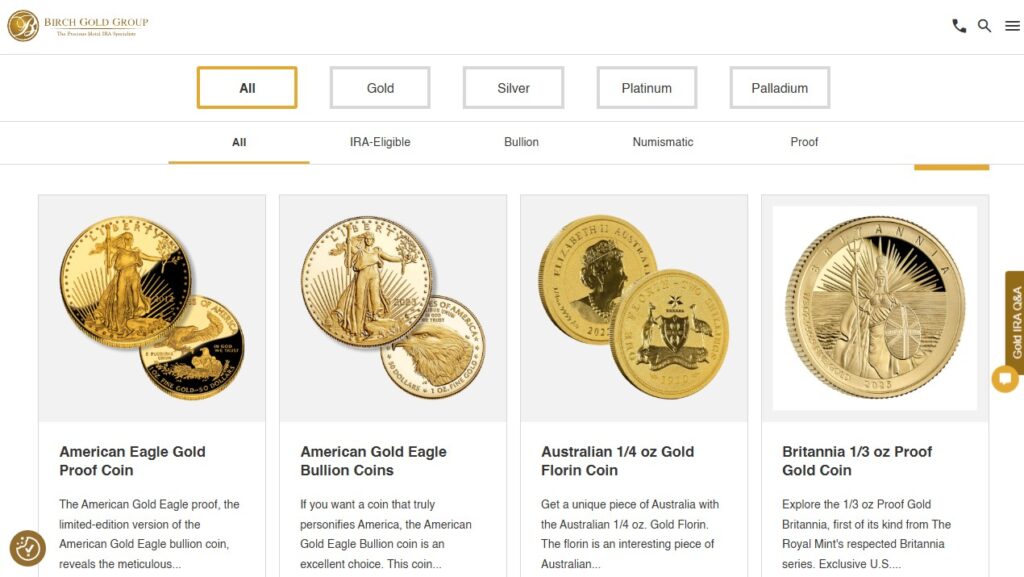
Birch Gold Group takes an education-first approach to precious metals investing, making them another strong choice for beginners. The company assigns experienced precious metals specialists to guide new investors through the process, explaining different products, storage options, and investment strategies without pressure tactics. Their reputation for transparency and customer service has earned them high marks from independent rating agencies.
- Minimum investment: $10,000 for precious metals IRA accounts
- Payment methods: Wire transfer, check, and credit card options available
- Storage: Partnerships with Brink’s Global Services and Delaware Depository for secure IRA storage
- Shipping: Insured delivery with tracking for direct purchases to your home
| Feature | Details |
|---|---|
| Minimum Investment | $10,000 for precious metals IRA |
| BBB Rating | A+ with hundreds of positive reviews |
| Specialization | Education-focused precious metals investing |
| Product Selection | Gold, silver, platinum, palladium products |
| Storage Options | Brink's Global Services, Delaware Depository |
| Buyback Program | Yes, market-rate buyback program available |
| Best For | Beginners wanting comprehensive education and support |
Pros
- Strong focus on investor education
- Experienced precious metals specialists
- Partnership with top-tier depositories
- Over two decades of industry experience
Cons
- Higher minimum investment requirement
- Storage fees apply for IRA accounts
Augusta Precious Metals - Gold broker for high-net individuals

Augusta Precious Metals has built a reputation serving high-net-worth investors with personalized service and premium product offerings. The company stands out for its lifetime customer support, where dedicated account managers remain available to clients throughout their investment journey. Augusta’s emphasis on transparency and education, combined with their white-glove service approach, appeals to investors with substantial portfolios.
- Minimum investment: $50,000 for new IRA accounts, reflecting their focus on serious investors
- Payment methods: Wire transfer and check, with streamlined processes for large transactions
- Storage: Partnerships with Delaware Depository offering segregated storage options
- Shipping: Premium insured shipping with discreet packaging for home delivery orders
| Feature | Details |
|---|---|
| Minimum Investment | $50,000 for new IRA accounts |
| BBB Rating | A+ with zero complaints on record |
| Specialization | High-net-worth individuals, premium service |
| Product Selection | Premium gold and silver investment products |
| Storage Options | Delaware Depository with segregated storage |
| Buyback Program | Yes, premium buyback with dedicated support |
| Best For | Serious investors seeking white-glove service |
Pros
- Exceptional white-glove customer service
- Lifetime support from dedicated account managers
- Perfect BBB record with zero complaints
- Transparent pricing and comprehensive education
Cons
- $50,000 minimum excludes smaller investors
- Premium service may not be necessary for basic purchases
GoldBroker - Best international gold broker

GoldBroker distinguishes itself as a leading choice for international investors seeking secure vault storage across multiple jurisdictions. The company specializes in allocated and segregated storage, meaning clients own specific numbered bars stored in their name in vaults located in Switzerland, Singapore, Toronto, and other secure locations. This international footprint provides geographic diversification and protection from country-specific risks.
- Minimum investment: $3,500 minimum purchase, making it accessible to international investors
- Payment methods: Bank wire transfer in multiple currencies including USD, EUR, GBP, and CHF
- Storage: Allocated and segregated storage in Swiss, Singaporean, and Canadian vaults
- Shipping: Direct-to-vault storage or insured international shipping available
| Feature | Details |
|---|---|
| Minimum Investment | $3,500 minimum purchase |
| BBB Rating | Not BBB accredited (international company) |
| Specialization | International allocated vault storage |
| Product Selection | Gold and silver bars, allocated storage focus |
| Storage Options | Zurich, Singapore, Toronto, Hong Kong, New York |
| Buyback Program | Yes, can sell holdings back at market rates |
| Best For | International investors seeking geographic diversification |
Pros
- True allocated storage with ownership of specific bars
- Multiple vault locations for geographic diversification
- Lower minimum compared to many international dealers
- Regular independent audits verify holdings
Cons
- Storage fees apply (typically 0.5-1% annually)
- May not be optimal for U.S.-only investors seeking IRAs
Goldco - Gold broker with a lot of brand trust

Goldco has built substantial brand recognition and trust through years of focus on precious metals IRAs and retirement planning. The company specializes in helping investors roll over existing 401(k)s and IRAs into gold-backed retirement accounts, with specialists who understand the IRS regulations governing precious metals in retirement accounts. Their reputation and numerous industry awards make them a trusted name for conservative investors prioritizing reliability.
- Minimum investment: $25,000 for IRA accounts, balanced between accessibility and serious investing
- Payment methods: Direct rollover from existing retirement accounts, wire transfer, and check
- Storage: Partnerships with IRS-approved depositories including Brink’s and Delaware Depository
- Shipping: Insured delivery for cash purchases, direct-to-vault for IRA investments
| Feature | Details |
|---|---|
| Minimum Investment | $25,000 for IRA accounts |
| BBB Rating | A+ with strong customer satisfaction |
| Specialization | Gold IRAs and retirement account rollovers |
| Product Selection | Comprehensive IRA-eligible precious metals |
| Storage Options | Brink's, Delaware Depository (IRS-approved) |
| Buyback Program | Yes, comprehensive highest-price guarantee |
| Best For | Retirement-focused investors, 401(k) rollovers |
Pros
- Strong brand reputation and track record
- Excellent expertise in IRA regulations and rollovers
- Comprehensive buyback program
- Multiple industry awards and recognitions
Cons
- $25,000 minimum may be high for some investors
- Primary focus on IRAs, less emphasis on cash purchases
Gold Storage Options Compared
Secure storage is a significant consideration for physical gold owners. Your storage choice affects security, insurance costs, accessibility, and even tax implications if you’re investing through an IRA.
Home Storage
Storing gold at home provides immediate access and eliminates ongoing storage fees, appealing to investors who value having their assets within reach. A quality home safe bolted to the floor or wall in a discrete location offers basic security for moderate gold holdings. The key advantages include complete control over your assets, no third-party dependencies, and zero annual storage costs eating into your returns.
However, home storage carries significant risks and limitations. Homeowner’s insurance typically covers only $1,000-$2,000 in precious metals under standard policies, requiring expensive additional riders for adequate coverage. Your gold becomes vulnerable to theft, fire, and natural disasters. Additionally, IRS regulations prohibit storing IRA-owned gold at home—doing so triggers immediate taxation and penalties. Home storage works best for modest holdings where the convenience outweighs the risks, but serious investors usually choose professional alternatives.
Bank Safe Deposit Box
Bank safe deposit boxes provide affordable, secure storage with typical annual costs of $50-$300 depending on box size and location. Banks offer strong physical security with vault protection, restricted access, and surveillance systems. This option suits investors with moderate gold holdings who don’t need frequent access.
The drawbacks include limited access restricted to banking hours, which can be problematic during bank holidays or emergencies. More importantly, FDIC insurance does not cover safe deposit box contents—the bank isn’t responsible for losses from theft, fire, or natural disasters unless you can prove bank negligence. Banks also pose counterparty risk, as seen when banks failed during the 2008 financial crisis and customers faced delays accessing their safe deposit boxes. Additionally, IRS rules require IRA gold to be stored at approved facilities, making bank boxes ineligible for retirement account gold.
Professional Vault Storage (Allocated vs Segregated)
Professional vault storage through specialized precious metals depositories represents the gold standard (no pun intended) for physical gold security. These facilities operate exclusively for precious metals storage with advanced security systems, insurance, and regulatory oversight. The two main types are allocated storage and segregated storage.
Allocated storage means you own specific numbered bars or coins stored in your name. Your gold is identified, set aside, and not commingled with other clients’ holdings. Segregated storage takes this further by physically separating your gold in a dedicated space within the vault. Allocated and segregated storage provides the highest level of ownership protection—your specific gold is always identifiable and retrievable. Non-segregated (commingled) storage means your gold is pooled with others’ holdings, and you own a claim to a certain amount rather than specific items.
Gold Storage Types Compared
| Storage Option | Security Level | Insurance | Cost | Access | IRS Compliant for IRAs | Best For |
|---|---|---|---|---|---|---|
| Home Storage | Low-Medium | Limited | Free (except safe purchase) | Immediate 24/7 | No | Small holdings, easy access priority |
| Bank Safe Deposit Box | Medium-High | Not FDIC insured | $50-$300/year | Banking hours only | No | Moderate holdings, cost-conscious |
| Professional Vault (Allocated) | Very High | Fully insured | 0.5-1% annually | Appointment required | Yes | Large holdings, IRA gold, maximum security |
| Professional Vault (Segregated) | Maximum | Fully insured | 0.8-1.5% annually | Appointment required | Yes | High-value, complete separation priority |
Common Gold Buying Mistakes to Avoid
Learning from others’ errors can save you significant money and frustration in your gold investing journey.
- Paying Too High Premiums Over Spot Price: Many new investors don’t shop around and end up paying excessive premiums. While some premium is normal (3-7% for coins, 2-5% for bars), premiums above 10% usually indicate overpriced products or excessive dealer markups. Always compare prices across multiple dealers and understand what the current spot price is before buying.
- Buying From Unverified Dealers: Purchasing from unknown online sellers or dealers without proper credentials can result in counterfeit products or complete fraud. Stick with dealers who have industry memberships, good BBB ratings, and years of established business history. If a deal seems too good to be true, it always is in the gold market.
- Purchasing Gold Jewelry as Investment: Jewelry typically sells for 2-4 times its melt value due to craftsmanship and retail markups, but dealers buy it back at only 70-80% of melt value. This means you need gold prices to increase by 150-300% just to break even. Stick with investment-grade bars and coins that trade close to spot price.
- Ignoring Storage and Insurance Costs: Failing to plan for storage expenses can eat into your investment returns. A $50,000 gold holding in professional storage costs $250-$500 annually in fees. Factor these ongoing costs into your investment calculations to understand your true returns.
- Buying Rare Coins Without Expertise: Numismatic (collectible) coins require specialized knowledge to evaluate properly. Their value depends on rarity, condition, and collector demand rather than just gold content. Unless you’re a trained numismatist, stick with bullion coins that trade based on their gold content plus a small premium.
- Not Verifying Authenticity: Accepting gold without proper verification exposes you to counterfeit products. Always verify hallmarks, request certificates of authenticity, check weights and dimensions, and consider third-party assaying for large purchases. The small cost of verification is insignificant compared to the risk of buying fake gold.
- Selling in Panic During Price Dips: Gold prices fluctuate, and temporary dips are normal market behavior. Selling in panic during downturns locks in losses and defeats the long-term wealth preservation purpose of gold investing. Remember that gold is typically a 5-10 year hold, not a short-term trading vehicle.
- Forgetting About Tax Implications: Physical gold is taxed as a collectible with a maximum 28% long-term capital gains rate, higher than stocks. Failing to account for this tax burden can result in unexpected bills when you sell. Keep records of your purchase prices and costs to accurately calculate taxable gains, and consider tax-advantaged options like Gold IRAs.
Is Buying Gold Online Safe?
Yes, buying gold online is safe when you follow proper precautions and work with established, reputable dealers. The convenience of online gold purchasing has made it the preferred method for most investors, offering price transparency, wider selection, and secure delivery right to your door. However, the anonymity of the internet also creates opportunities for fraud, making due diligence necessary.
Safety Measures When Buying Gold Online
- Verify dealer credentials and licensing: Check that dealers are registered with relevant industry organizations and licensed in their state. Look for memberships in the Professional Numismatists Guild, Industry Council for Tangible Assets, or American Numismatic Association. These organizations require members to follow ethical standards and provide dispute resolution.
- Check BBB ratings and customer reviews: The Better Business Bureau provides ratings and complaint histories for businesses. Look for A+ or A ratings with few unresolved complaints. Also read customer reviews on independent sites like Trustpilot, but be aware that some reviews may be manipulated—look for detailed, specific feedback rather than generic praise.
- Look for industry memberships and certifications: Legitimate dealers typically hold memberships in organizations that require vetting and impose ethical obligations. The Professional Numismatists Guild, for instance, requires a $50,000 bond and background checks. Industry Council for Tangible Assets members agree to follow consumer protection guidelines and transparent pricing practices.
- Ensure secure payment methods and shipping insurance: Reputable dealers offer secure payment processing with encryption and multiple payment options. They should also provide fully insured, tracked shipping with signature confirmation requirements. Avoid dealers who only accept wire transfers, cryptocurrency, or money orders—these payment methods offer no recourse if problems occur.
- Understand return and buyback policies: Quality dealers offer return periods (typically 3-7 days) and buyback programs where they’ll repurchase your gold at competitive prices. Read these policies carefully before buying. Dealers who refuse returns or offer buyback prices far below market rates should raise red flags.
- Use reputable established companies only: Stick with dealers who have been in business for at least 5-10 years and have physical addresses and phone numbers. Be wary of dealers operating only through social media or with recently created websites. Established companies have reputations to protect and have survived through market cycles.
Warning signs of scams include prices significantly below market rates (10%+ below spot price is essentially impossible for legitimate dealers), aggressive high-pressure sales tactics, dealers who won’t provide references or documentation, requests for unusual payment methods or payments to personal accounts, and dealers operating without physical addresses or proper licensing. Additionally, be cautious of sellers who push rare coins for investment rather than bullion, promise guaranteed returns, or claim gold is about to be confiscated by the government—these are common fraudulent tactics designed to create urgency and prevent rational decision-making.
Gold Buying Fees and Costs Explained
Understanding the total cost of gold ownership helps you make informed decisions and accurately calculate your investment returns. The price you pay extends well beyond the spot gold price you see quoted in financial news.
- Premium Over Spot Price: This is the primary cost above the raw gold value. Premiums cover manufacturing, distribution, dealer overhead, and profit margins. Typical premiums range from 3-7% for popular coins and 2-5% for bars. Government-minted coins like American Gold Eagles carry higher premiums (4-7%) than generic rounds or bars (2-4%). Premiums increase for smaller denominations—a 1/10 oz coin has a much higher percentage premium than a 1 oz coin due to similar manufacturing costs spread over less gold content.
- Dealer Markup: Beyond the base premium, some dealers add additional markup for profit. Transparent dealers include all costs in their posted prices, while less scrupulous ones may add charges at checkout. Compare “out the door” prices from multiple dealers, not just the advertised spot price plus premium. Markup differences of even 1-2% add up significantly on larger purchases.
- Shipping and Insurance: Physical gold must be shipped securely with full insurance coverage. Typical shipping costs range from $30-$100 depending on order size and delivery speed. Most dealers include free shipping on orders above certain thresholds (commonly $199-$500). Factor shipping into your total cost when comparing dealers—a slightly lower price with expensive shipping may not be the best deal overall.
- Storage Fees: If you use professional vault storage rather than home storage, expect annual fees of 0.5-1% of your holdings’ value for allocated storage or 0.8-1.5% for segregated storage. These fees cover insurance, security, and facility operations. While this represents ongoing expense, the security and IRS compliance (for IRAs) often justify the cost for larger holdings.
- Transaction Fees: Some payment methods carry additional fees. Credit card purchases typically add 3-4% in processing fees, making them expensive compared to wire transfers or checks which usually have minimal or no fees. A few dealers absorb credit card fees, but most pass them to customers. Always check the final price before confirming payment.
| Cost Component | Amount | Notes |
|---|---|---|
| Spot Gold Value | $9,400 | Based on purchasing approximately 2.3 oz at $4,100/oz |
| Premium (5%) | $470 | Typical for popular 1 oz coins |
| Shipping & Insurance | $50 | Fully insured with signature required |
| Payment Fee (Credit Card 3%) | $300 | Waived if paying by wire or check |
| Total Out-the-Door Cost | $10,220 | $10,920 if using credit card |
| Annual Storage (if applicable) | $100 | 1% of value, for professional vault storage |
Gold Investment Taxes Explained
Gold taxation differs from typical investment assets like stocks, and understanding these rules prevents surprises when you sell. The IRS classifies physical gold as a collectible, which carries different tax treatment than securities.
Capital Gains Tax on Gold
Long-term capital gains on physical gold and gold ETFs backed by physical metal are taxed at a maximum rate of 28% for holdings owned more than one year. This rate is higher than the standard 20% maximum for stocks and bonds. The 28% rate applies to your actual profit—the difference between your sale price and your cost basis (purchase price plus associated costs like shipping and fees). Importantly, this 28% rate is a maximum—if your ordinary income tax bracket is lower than 28%, you’ll pay your bracket rate instead. For example, someone in the 22% tax bracket pays 22% on gold gains, not 28%.
Short-term capital gains for gold held one year or less are taxed as ordinary income at your regular income tax rates, which range from 10% to 37% depending on your income. This makes holding gold for at least one year and one day important to qualify for the preferential (though still relatively high) long-term collectibles rate rather than ordinary income rates.
IRS Reporting Requirements
Dealers are required to report certain gold sales to the IRS using Form 1099-B. Reporting triggers include sales of 25 or more ounces of gold bars or 25 or more 1 oz Maple Leafs, Krugerrands, or Mexican Onzas. Sales of 25 or more 1 oz Gold Eagles also require reporting. These reporting requirements aim to track larger transactions and prevent tax evasion. Keep detailed records of all your gold purchases including dates, quantities, prices paid, and associated costs. You’ll need this information to accurately calculate your capital gains when you sell, regardless of whether the dealer reports the transaction.
Tax-advantaged options exist for gold investors. Gold IRAs allow you to hold IRS-approved physical gold in a self-directed IRA, deferring taxes until retirement withdrawals (for traditional IRAs) or avoiding taxes entirely (for Roth IRAs if held 5+ years). Gold IRAs require using an approved custodian, storing gold at an IRS-approved facility, and meeting minimum fineness requirements (99.5% purity for most gold, though American Gold Eagles receive an exception). This tax shelter can significantly improve your after-tax returns compared to holding gold in taxable accounts.
Gold IRA: Should You Consider One?
A Gold IRA (Individual Retirement Account) is a self-directed IRA that holds physical precious metals rather than traditional investments like stocks and bonds. Gold IRAs function like regular IRAs with the same contribution limits and rules, but they allow you to diversify your retirement savings with physical gold, silver, platinum, or palladium. The IRA trustee or custodian holds the physical metals on your behalf in an approved depository—you can’t store IRA gold at home without triggering taxes and penalties.
The main advantage of Gold IRAs is tax-deferred or tax-free growth depending on whether you choose a traditional or Roth Gold IRA. Traditional Gold IRAs allow pre-tax contributions that reduce your current taxable income, with taxes paid upon retirement withdrawals. Roth Gold IRAs use after-tax contributions but offer tax-free withdrawals in retirement. Both types shelter your gold investments from the 28% collectibles tax rate that applies to gold held in taxable accounts. Additionally, Gold IRAs provide protection from gold confiscation fears and offer the security of professional vault storage that meets IRS standards.
Gold IRA Minimum Requirements
- Minimum Investment: Most Gold IRA companies require $10,000-$50,000 minimum investments, significantly higher than self-directed brokerage IRAs. This reflects the costs of setting up precious metals accounts and the economics of small gold purchases.
- Eligible Gold Types: IRS rules require gold to be 99.5% pure (with exceptions for American Gold Eagles at 91.67%). Eligible products include American Gold Eagles, Canadian Gold Maple Leafs, Austrian Gold Philharmonics, and gold bars from approved refiners. Collectible coins, jewelry, and gold below purity standards aren’t allowed.
- Storage Requirements: Gold must be stored at an IRS-approved depository, not at home. Approved depositories include Delaware Depository, Brink’s Global Services, and similar facilities that meet IRS standards for security and insurance. Storage fees typically run 0.5-1% annually.
- Custodian Requirement: You must work with an IRS-approved custodian who specializes in precious metals IRAs. The custodian handles paperwork, facilitates purchases and sales, arranges storage, and ensures IRS compliance. Annual custodian fees range from $75-$300.
Gold IRAs make sense for investors who want precious metals exposure in retirement accounts, are concerned about inflation eroding retirement savings, have maxed out other retirement accounts and want additional diversification, and can meet the higher minimum investment requirements. They’re less suitable for investors who can’t afford the minimums, want frequent trading or easy liquidity, or prefer complete control over their investments without custodian involvement. The fees and minimums make Gold IRAs most practical as part of a larger retirement strategy rather than as your sole retirement vehicle.
Difference Between Owning Physical Gold vs Gold Stocks
Physical gold and gold stocks represent two fundamentally different approaches to gold investing, each with distinct characteristics, risks, and potential returns. Understanding these differences helps you choose the approach that best aligns with your investment goals.
| Feature | Physical Gold | Gold Stocks |
|---|---|---|
| Ownership | Direct ownership of tangible asset | Ownership of company shares |
| Counterparty Risk | None (you own the metal) | Company bankruptcy, management risk |
| Volatility | Relatively stable, tracks gold price | Higher volatility, leveraged to gold price |
| Leverage | 1:1 with gold price | 2-3x leverage to gold price movements |
| Storage Needs | Requires secure storage | None (held in brokerage account) |
Gold Price Today
Tracking the gold price today gives you instant insight into one of the world’s most actively traded commodities. Gold prices fluctuate throughout each trading session based on global economic conditions, currency movements, and market sentiment. Whether you’re considering buying gold, selling your holdings, or simply monitoring your portfolio’s value, accessing today’s current gold price is the first step in making informed decisions about your precious metals investments.
Live Gold Price Chart
How Much is an Ounce of Gold Worth?
How much is an ounce of gold worth? Check it with our live gold price per ounce calculator. Make gold investing decisions based on data, not on gut feeling.
Live Gold Price Per Ounce
Last Updated:
Can I Sell Gold Easily If I Want To?
Yes, selling gold is relatively straightforward, particularly if you own popular investment products like American Gold Eagles, Canadian Maple Leafs, or standard gold bars from reputable refiners. Most precious metals dealers offer buyback programs where they’ll repurchase the gold they sold you at current market rates minus their spread (typically 1-3% below spot for popular coins). Local coin shops and pawn shops also buy gold, though they usually offer less competitive prices. Online dealers often provide the best buyback prices due to lower overhead costs. The entire process typically takes 2-7 business days from when you ship your gold until you receive payment, with most dealers paying immediately upon receipt and verification of your gold. Liquidity is highest for government-minted coins and standard bar sizes (1 oz, 10 oz, 1 kg) from major refiners like PAMP Suisse or Credit Suisse.
Alternatives to Physical Gold
While physical gold offers unique benefits, several alternatives provide exposure to gold’s price movements without the storage and security challenges of owning metal.
Gold ETFs
Gold Exchange-Traded Funds (ETFs) are investment funds that track the price of gold and trade on stock exchanges like regular stocks. The most popular gold ETFs, such as SPDR Gold Shares (GLD) and iShares Gold Trust (IAU), hold physical gold in vaults and issue shares representing fractional ownership. Each share equals a specific amount of gold, so as gold prices rise, share prices increase proportionally.
Gold ETFs offer several advantages including instant liquidity (buy or sell in seconds during market hours), no storage concerns, low minimum investments (just the cost of one share, typically $100-$200), and ability to hold in standard IRA or 401(k) accounts. However, you don’t own physical gold, ETFs charge annual expense ratios (typically 0.25-0.40%), and they’re taxed as collectibles with the same 28% maximum capital gains rate as physical gold. For investors interested in broader investment strategies, visit our comprehensive stock investing guide for more information about building balanced portfolios.
Gold Stocks
Gold mining stocks and gold-focused mutual funds provide leveraged exposure to gold prices while offering potential dividend income. When gold prices rise, mining companies’ profit margins expand dramatically since their production costs are relatively fixed while revenue increases. This can result in mining stocks gaining 2-3 times the percentage increase in gold prices. Major gold miners like Newmont Corporation, Barrick Gold, and Franco-Nevada trade on major stock exchanges and many pay dividends from their operations.
The trade-offs include higher volatility than physical gold, exposure to company-specific risks (management decisions, mining accidents, geopolitical issues), and dependence on stock market functioning. However, gold stocks enjoy the standard 20% maximum capital gains tax rate rather than the 28% collectibles rate, and they can be held in any brokerage account without special custodians. Gold stocks work well for investors comfortable with higher risk seeking leveraged gold exposure and potential dividend income.
Silver & Other Precious Metals
Silver, platinum, and palladium offer additional diversification within the precious metals space, each with unique characteristics. Silver trades at much lower prices ($30-50 per ounce range) making it more accessible for new investors, has strong industrial demand from solar panels and electronics, but exhibits higher volatility than gold. Platinum and palladium are primarily industrial metals used in automotive catalytic converters and jewelry, with prices that can exceed gold during periods of strong industrial demand.
Investors often combine gold with silver at ratios of 60:40 or 70:30 (gold:silver) to capture silver’s growth potential while maintaining gold’s stability. Each precious metal responds to different economic drivers—gold to currency and geopolitical concerns, silver to both investment and industrial demand, platinum and palladium primarily to automotive and industrial production.
Precious Metals Compared
How do gold alternatives like silver, platinum, or palladium perform compared to gold? Find out in the comparison table below:
| Metal | Key Characteristics | Historical Performance | Liquidity | Best Use Case |
|---|---|---|---|---|
| Gold | Store of value, low correlation to stocks, globally recognized | 7.9% average annual return 1971-2024 | Excellent worldwide | Wealth preservation, inflation hedge |
| Silver | Industrial + investment demand, higher volatility, lower price point | 6.5% average annual return 1971-2024 | Very good, slightly less than gold | Growth potential, affordable entry |
| Platinum | Primarily industrial (automotive), rarer than gold, high purity standards | 3.2% average annual return 1971-2024 | Good but lower than gold/silver | Industrial exposure, portfolio diversification |
| Palladium | Automotive catalysts, extreme volatility, supply constrained | 8.1% average annual return 1971-2024 | Moderate, specialized market | Industrial play, risk-tolerant investors |
Frequently Asked Questions About Buying Gold
How do beginners buy gold?
Beginners should start by buying popular 1 oz gold coins like American Gold Eagles or Canadian Maple Leafs from reputable online dealers like American Hartford Gold or Goldco. These coins offer the best balance of affordability, liquidity, and recognition. Start with a modest investment of $2,000-$5,000, verify the dealer has strong BBB ratings and industry credentials, and choose insured shipping or pickup options. Store your gold securely at home in a quality safe or consider a bank safe deposit box for larger holdings.
What will gold be worth in 2030?
Predicting gold's exact price in 2030 is impossible, but analysts' forecasts range from $5,000 to $10,000 per ounce based on continued inflation, growing central bank demand, and geopolitical uncertainty. Some conservative forecasts project $5,000-$6,000, while more bullish analysts suggest $8,000-$10,000 if inflation remains elevated and the dollar weakens. Historical patterns show gold has increased approximately 400% during inflationary decades like the 1970s. However, gold should be viewed as a long-term wealth preservation tool rather than a short-term speculation, regardless of specific price predictions.
Should I buy gold bars or gold coins?
Buy gold coins if you prioritize liquidity, flexibility, and easier authentication, especially for investments under $20,000. Coins offer fractional sizes, worldwide recognition, and instant resale value. Choose gold bars for larger investments above $20,000 where the lower premiums (2-5% vs 4-7% for coins) save significant money. Bars are ideal for serious investors focused purely on gold content with secure long-term storage. Many investors use a combination—coins for liquidity and bars for bulk holdings.
Is it better to buy gold online or locally?
Online dealers typically offer better prices with 1-3% lower premiums than local coin shops due to lower overhead costs and higher volume. Online purchasing also provides wider selection, transparent pricing, and ability to compare multiple dealers instantly. However, local dealers allow you to inspect gold before buying, avoid shipping delays, and build personal relationships. Use online dealers for large purchases where price matters most, and local dealers when you want immediate possession or are buying small amounts where convenience outweighs slight premium differences.
How much gold can I buy without reporting to the IRS?
You can buy unlimited amounts of gold without any reporting requirements—purchases aren't reported to the IRS. However, cash purchases over $10,000 trigger currency transaction reports (CTRs) under anti-money laundering laws. Sales trigger IRS reporting when selling 25+ oz of gold bars, 25+ 1 oz Maple Leafs/Krugerrands, or other quantities specified in IRS rules. Dealers file Form 1099-B for reportable sales. Regardless of reporting, you're legally required to report all capital gains on your tax return.
What purity of gold should I buy?
Buy 24-karat (99.99% pure) gold like Canadian Maple Leafs or Austrian Philharmonics for maximum gold content and universal IRA eligibility. Alternatively, 22-karat gold (91.67% pure) like American Gold Eagles or Krugerrands offers better durability and scratch resistance while containing the same troy ounce of gold. Both purities work well for investment—24K provides maximum purity while 22K adds durability through small amounts of copper or silver alloy. Avoid anything below 22K (91.67%) for investment purposes.
Can I store gold in a bank safe deposit box?
Yes, bank safe deposit boxes provide secure, affordable storage costing $50-$300 annually depending on size and location. However, FDIC insurance doesn't cover safe deposit box contents, access is limited to banking hours, and IRS rules prohibit storing IRA-owned gold there. Bank safe deposit boxes work well for moderate amounts of personally-owned gold ($10,000-$50,000 value) where the security-to-cost ratio is favorable. For larger holdings or IRA gold, use professional vault storage at IRS-approved depositories.
How do I know if my gold is real?
Verify gold authenticity by checking hallmarks stamped on the product (like .999 or 24K), performing a magnet test (real gold isn't magnetic), measuring exact weight and dimensions against published specifications, and requesting certificates of authenticity from the seller. For valuable purchases, use professional verification through acid tests or electronic gold testers at coin shops. Buy from reputable dealers with industry memberships to minimize counterfeiting risk—authentic gold from established dealers rarely requires additional testing.
What's the difference between buying gold and investing in gold mining stocks?
Physical gold provides direct ownership of tangible metal with no counterparty risk and maximum crisis protection, but requires storage and earns no dividends. Gold mining stocks offer leveraged exposure to gold prices (typically 2-3x price movements), potential dividend income, better tax treatment (20% vs 28% capital gains rate), and instant liquidity, but carry company-specific risks and higher volatility. Physical gold suits conservative investors seeking stability, while gold stocks appeal to those comfortable with higher risk seeking amplified returns. Many investors hold both for balanced gold exposure.
Should I buy gold now or wait for prices to drop?
Use dollar-cost averaging by investing fixed amounts monthly or quarterly rather than timing the market. Gold's purpose is long-term wealth preservation and portfolio diversification, not short-term trading. Attempting to time gold purchases often results in missed opportunities or buying less gold than planned. Start a regular investment schedule—for example, buying $500 of gold monthly—which averages your purchase price over time and removes emotional decision-making. The best time to start is now, but spread purchases over 6-12 months to smooth volatility.