Iran War Rocks Oil Markets: What Investors Must Know
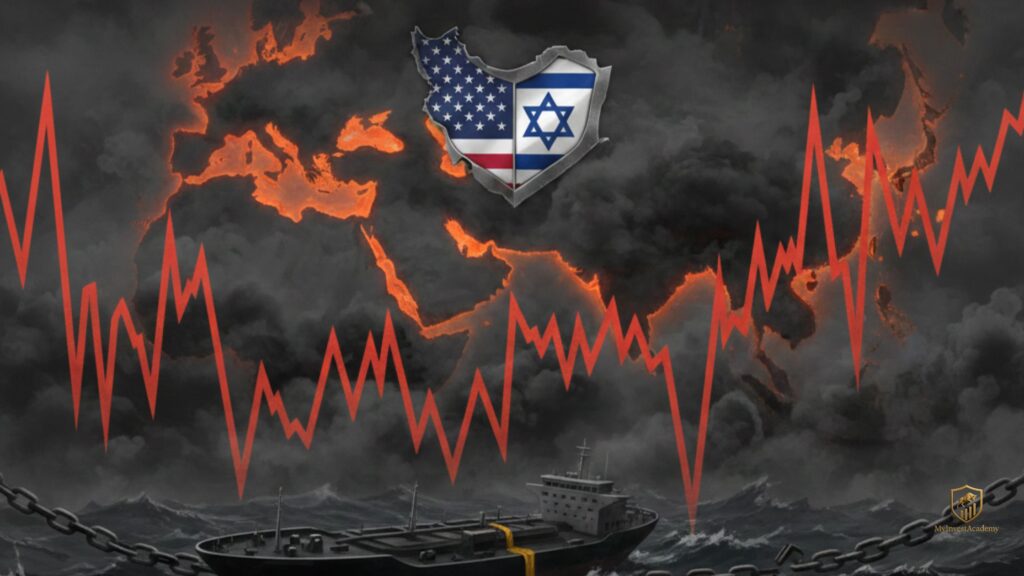
Over the weekend, the United States and Israel launched coordinated military strikes on Iran, killing Supreme Leader Ayatollah Ali Khamenei. Markets opened Monday in full reaction mode. Stocks fell, the dollar climbed, and oil recorded its biggest surge in four years. Gold briefly crossed $5,400 an ounce. The CBOE Volatility Index jumped to its highest level of 2026.
Oil Prices Rise as a Reaction to the War in Iran
Brent crude jumped more than 8% to $78.94, while WTI rose 7.3% to $71.92 per barrel by Monday morning. The trigger is simple: the Strait of Hormuz. About 20% of global oil consumption passes through the strait, and tanker traffic has effectively come to a halt. Maersk suspended all vessel crossings through the waterway. When that exit ramp closes, prices move fast.
Exxon Mobil and Chevron gained about 4%, while ConocoPhillips surged more than 5%. Land-based U.S. oil producers are in a different position entirely. Companies like Texas Pacific Land Corp (TPL) operate deep in the Permian Basin, far removed from Middle East supply chains. When global oil prices spike due to overseas disruption, domestic producers often benefit without carrying the same geopolitical risk. That makes them worth watching closely right now.
Barclays analyst Amarpreet Singh told clients: “The potential effect on oil markets is hard to overstate.”
Stocks Slide
The S&P 500 dropped 1.1%, following losses in Europe and Asia. Airlines and cruise operators sank, while energy and defense shares jumped. Germany’s DAX plunged 2.5%, France’s index slid 2.1%, and Japan’s Nikkei dropped 1.4%. This is a broad, global sell-off.
The damage is not spread evenly. Travel stocks, consumer discretionary, and companies with heavy exposure to international shipping are taking the hardest hits. Energy and defense are on the other side of that trade. Knowing which stocks sit in which camp matters more than ever right now.
Outlook for 2026
Analysts flagged a base case of a conflict lasting at least one week, with partial de-escalation driven by diplomacy rather than military resolution. A sustained Strait closure remains low probability but would represent an unprecedented supply shock.
Wells Fargo strategists mapped out scenarios ranging from quick de-escalation to a prolonged Hormuz closure. In their worst-case scenario, the S&P 500 could drop to 6,000. Their base case still targets 7,500 by year-end. JP Morgan raised its gold price target to $6,300 per ounce by December 2026. Some analysts have warned oil could top $100 a barrel if the Strait stoppage is prolonged. European natural gas markets have already surged more than 20%. The range of outcomes here is wide, and the fog is thick.
What This Means for Investors
This situation is moving fast and the uncertainty is real. Historically, geopolitical oil shocks fade quickly, but if this episode lasts longer, markets may see extended volatility. That “if” is doing a lot of heavy lifting right now.
Nobody knows how long this conflict lasts, whether the Strait reopens in days or months, or how Iran’s leadership vacuum plays out. Markets are trying to price in how long this lasts and how much it curbs the global economy. That pricing process is far from finished.
What is clear: different sectors are reacting very differently. Staying informed, understanding your exposure, and avoiding impulsive decisions is the most sensible posture in a market where the situation can change with a single news headline.