Texas Pacific Land Corp: King of Royalties
In the world of value investing, few assets command as much respect—and confusion—as Texas Pacific Land Corporation (NYSE: TPL). It is often described not merely as a company, but as an “ETF on the Permian Basin” with a call option on the future of energy and infrastructure. While traditional Energy & Exploration (E&P) stocks fight against capital expenditure (CapEx) cycles and depletion, TPL sits comfortably upstream, collecting checks on every barrel produced, every drop of water sold, and increasingly, every gigawatt of power transmitted across its massive land holdings.
Is TPL just an overpriced land bank, or is it the ultimate inflation hedge? Let’s dive into the “King of Royalties.”
Disclaimer: This article is for educational and informational purposes only and does not constitute financial, investment, or professional advice. Always perform your own due diligence before making any financial decisions.
What is Texas Pacific Land Corp?
Texas Pacific Land Corporation is one of the oldest and most unique listed entities on the NYSE. Originally formed in 1888 as a trust to bail out a bankrupt railroad, it is one of the largest private landowners in the state of Texas.
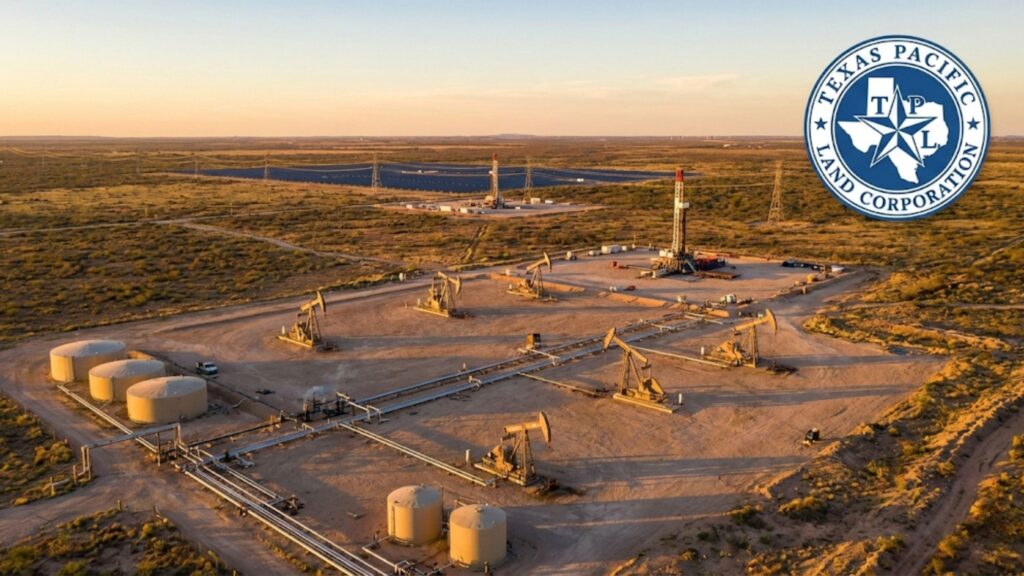
TPL owns approximately 880,000 acres of land in West Texas, primarily concentrated in the Permian Basin—the most prolific oil and gas region in the United States. Unlike an oil producer that must spend millions to drill holes in the ground, TPL simply owns the ground. They grant permission to majors like Chevron and Exxon to drill, and in return, TPL takes a cut of the revenue (a royalty) and charges fees for the water and surface use required to get the job done.
Recent corporate actions, including the 3-for-1 stock split executed in December 2025, have made shares more accessible, but the core capital-light DNA remains unchanged.
$TPL business model in a glance
TPL operates through two primary segments: Land and Resource Management (Royalties & Surface) and Water Services and Operations. The beauty of the model is the “triple-dip” revenue stream:
Royalties: A percentage of oil/gas revenue with zero drilling costs.
Water: Selling sourced water to drillers and treating produced water (recycling).
Surface: Fees for pipelines, power lines, solar farms, and essentially any infrastructure crossing their land.
Key Performance Indicators (Trailing 12-Month / Recent Estimates)
| Metric | Value | Insight |
| Market Cap | ~$23.7 Billion | Large-cap status, commanding a premium valuation. |
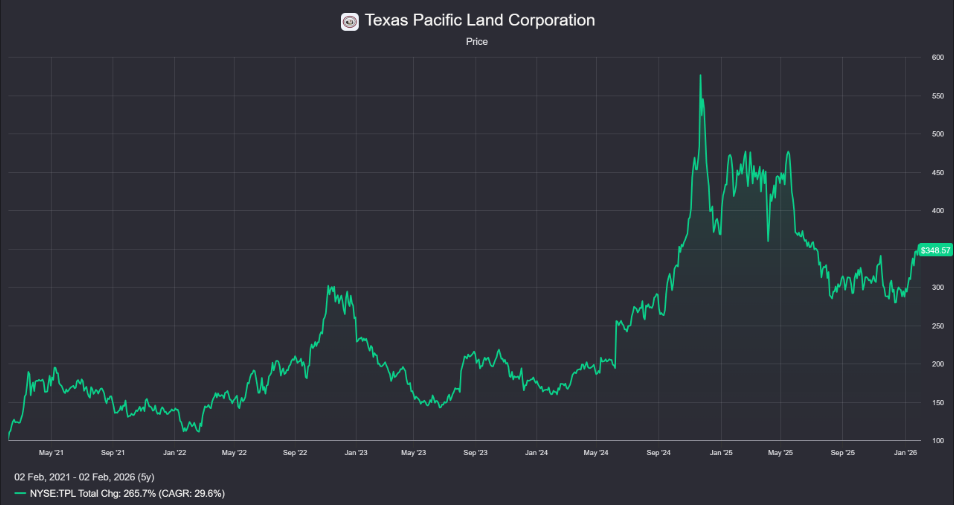
| Stock Price | ~$350.00 | Post-split (3-for-1 effective Dec 2025). |
| Net Profit Margin | ~60% | Exceptionally high compared to standard E&P (~10-20%). |
| Daily Production | ~36.3 kboe/d | consistently growing without TPL spending CapEx. |
| Cash Position | Net Cash | “Fortress balance sheet” with zero debt. |
| Dividend Yield | ~0.6% | Low yield, but complemented by aggressive share buybacks. |
| Return on Equity | ~38% | Demonstrates elite capital efficiency. |
Why the PE premium matters less for a business like Texas Pacific Land Corp
Value investors often balk at TPL’s Price-to-Earnings (P/E) ratio, which frequently hovers between 40x and 50x—more akin to a tech high-flyer than an energy stock. However, valuing TPL strictly on near-term earnings misses the structural advantages of its moat.
The "Zero CapEx" Advantage
A typical oil company trades at a low P/E (e.g., 8x-12x) because its earnings are “heavy.” They must constantly reinvest 60-70% of their cash flow just to keep production flat. TPL’s earnings are “light.” Because they don’t pay for drilling, nearly $0.80 of every $1.00 in revenue drops to the bottom line as Free Cash Flow (FCF). A 40x P/E on pure, unencumbered cash flow is far cheaper than it appears relative to capital-intensive peers.
The Inflation Hedge
TPL’s land is a tangible asset that cannot be printed. As inflation drives up the cost of oil, steel, and water, TPL’s revenues rise, but its costs (which are minimal) do not. This operating leverage makes it a premier defensive asset during inflationary periods.
Infinite Optionality
You are paying for options that aren’t on the balance sheet yet. In the 1900s, the land was for cattle. In the 2000s, for oil. In the 2020s, it is for data centers, solar farms, and produced water recycling. TPL essentially holds a perpetual call option on whatever economic activity happens in West Texas.
$TPL Outlook for 2026
As we move through 2026, the thesis for TPL is evolving from a pure oil play into a broader infrastructure and digital real estate play.
Data Center Pivot: Late 2025 saw TPL announce a strategic partnership with Bolt Data & Energy to develop large-scale data center campuses. With access to land, cheap energy (natural gas), and water (cooling), TPL is uniquely positioned to serve the AI boom.
Earnings Growth: Analysts from KeyCorp and others have forecasted FY2026 earnings to approach $7.80 – $8.00 per share (post-split basis). This growth is driven by sustained Permian activity and the maturation of their water business.
Consolidation: The Permian Basin is consolidating (e.g., Exxon buying Pioneer). This is good for TPL, as it puts their acreage in the hands of the most efficient, well-capitalized operators who will drill consistently regardless of minor oil price fluctuations.
The Bottom Line: For 2026, watch the “Surface Income” line item. If TPL successfully monetizes its land for data centers and renewables, the stock could undergo a further re-rating, justifying its premium multiple.
Conclusion
Texas Pacific Land Corp is a rare breed in the market: a royalty company with the margins of a software firm and the hard-asset security of real estate. While the valuation is steep, the quality of the cash flows and the “infinite duration” of its land portfolio make it a core holding for value investors seeking compounders rather than deep-value cigar butts.
TPL is not just an oil stock; it is a landlord for the energy transition. For investors willing to look past the P/E headline, TPL remains the King of Royalties.
References
Texas Pacific Land Corp Investor Relations – The official source for TPL financial reports, SEC filings, and press releases.
EIA Short-Term Energy Outlook (STEO) – Authoritative government forecasts on U.S. crude oil production and Permian Basin activity.