U.S. Stocks Fall Sharply as Jobs Report Signals Labor Market Contraction and Oil Prices Climb
U.S. equity markets closed sharply lower on Friday after the February jobs report showed an unexpected contraction in employment, compounding pressure from rising oil prices tied to the widening conflict in the Middle East.
Markets Post Worst Week Since October
U.S. equity markets closed lower on Friday, March 6, capping the worst week for Wall Street since October, as investors weighed a deteriorating labor market against rising oil prices tied to escalating conflict in the Middle East.
The S&P 500 fell 90.69 points, or 1.3%, to close at 6,740.02. The Dow Jones Industrial Average dropped 453.19 points, or 0.9%, to finish at 47,501.55, having declined nearly 950 points at its intraday low before partially recovering. The Nasdaq Composite fell 361.31 points, or 1.6%, to end at 22,387.68. The Dow has now fallen into negative territory for 2026.
Jobs Report Comes in Well Below Expectations
The February nonfarm payrolls report, released Friday morning, showed a net loss of 92,000 jobs, a sharp reversal from January’s gain of 126,000 and well below analyst expectations of approximately 56,000 new positions. The unemployment rate ticked up to 4.4%.
January retail sales, also released Friday, declined 0.2% month-over-month, modestly better than the 0.3% drop analysts had forecast but adding to concerns about the strength of consumer spending, which is the primary driver of the U.S. economy.
Oil Prices Add Pressure
Crude oil prices rose above $90 per barrel during Friday’s session, reaching their highest level since 2023. The move followed statements from Qatar’s energy minister suggesting that conflict involving Iran could force Gulf exporters to halt production and potentially push prices toward $150 per barrel. Maritime traffic through the Strait of Hormuz, a critical passage for global oil shipments, has been significantly disrupted.
The combination of falling employment and rising energy costs has renewed concerns among economists and market participants about stagflation, a condition in which economic growth stagnates while inflation remains elevated. The Federal Reserve, which typically responds to a weakening labor market by cutting interest rates, faces a more complicated decision if inflation is simultaneously increasing.
“A negative payrolls number combined with a big jump in oil prices will have traders worrying about stagflation risks,” said Brian Jacobsen, chief economic strategist at Annex Wealth Management.
Sector Performance
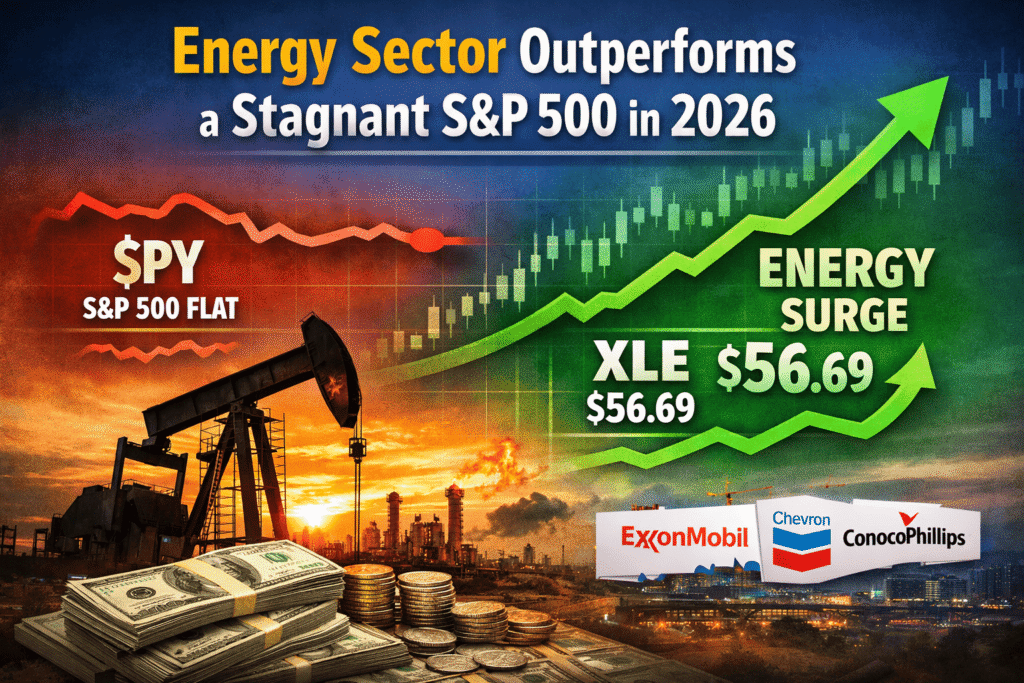
Energy stocks were among the few areas to post gains on the day, with Exxon Mobil (XOM: NYSE), Chevron (CVX: NYSE), and Occidental Petroleum (OXY: NYSE) all trading higher as oil prices rose. Software stocks also held up relatively well over the course of the week.
Technology shares faced selling pressure. Nvidia (NVDA: NASDAQ) fell 1.4%, Microsoft (MSFT: NASDAQ) declined 0.7%, Apple (AAPL: NASDAQ) dropped 0.8%, and both Alphabet (GOOGL: NASDAQ) and Meta Platforms (META: NASDAQ) lost more than 1%. Tesla (TSLA: NASDAQ) fell 1.1%.
Among notable individual movers, Gap (GAP: NYSE) declined sharply after the retailer lowered its adjusted earnings forecast and projected a full-year sales decline of 2.5%, citing weaker consumer spending. Rumble (RUM: NASDAQ) fell to a 52-week low after reporting a revenue decline of 10.5% year-over-year in its fourth quarter.
For the week, all 11 S&P 500 sectors finished lower. Materials declined approximately 7%, while Consumer Staples, Health Care, and Industrials each fell roughly 5%. Energy was the sole sector with meaningful gains for 2026, up more than 25% year-to-date.
What Investors Are Watching Next
Market participants will be closely focused on inflation data in the coming week, including the Consumer Price Index (CPI) report due Wednesday. If inflation shows signs of easing alongside the weakening labor market, it could increase the likelihood of a Federal Reserve interest rate cut at its March 18-19 meeting. If inflation remains elevated, the Fed may hold rates steady, leaving both goals, controlling inflation and supporting employment, in conflict.
Traders modestly increased their bets on a near-term rate cut following Friday’s jobs data, though bond markets were volatile throughout the session, with 10-year Treasury yields ending the day up two basis points at 4.16%.