
-
Mark Verwoert
- February 24, 2026
Educational content only – not financial advice. Trading CFDs and leveraged products involves significant risk and most retail accounts lose money. Never trade more than you can afford to lose. This page may contain affiliate links through which we earn a commission at no cost to you.
Best Day Trading Platform 2026
The best day trading platform of 2026 is not a universal answer. The right choice depends entirely on what you trade, where you are based, and how you trade it. Our team has opened live accounts, deposited real capital, and executed trades across all of these platforms on iOS, Android, and desktop. This hands-on experience establishes our first-hand authority clearly. We test how each platform handles execution under real market pressure. We calculate what each one costs when you factor in spreads and overnight fees. We also identify which regulatory protections apply to your money depending on where you live. These are the three things most comparison articles skip.
Quick Day Trading Platform Comparison at a Glance
| Platform | Best For | Min. Deposit | Fees / Spreads | Max Leverage (Retail) | Key Regulator(s) | Rating |
| Interactive Brokers | Overall best for active traders | $0 | From $0 (Lite) / tiered Pro | Varies by market | SEC, FINRA, FCA, ASIC | ⭐⭐⭐⭐⭐ |
| eToro | Beginners & copy trading | $50–$200* | $0 commission on stocks | 1:30 (EU/UK retail) | FCA, CySEC, ASIC | ⭐⭐⭐⭐ |
| TradeStation | Automated & active traders | $0 | $0 per trade (TS GO) | Varies | FINRA, SEC | ⭐⭐⭐⭐⭐ |
| XTB | European day traders | $0 | $0 up to €100k/month | 1:30 (retail) | FCA, CySEC, KNF | ⭐⭐⭐⭐ |
| XM Trading | Scale & accessibility | $5 | Spread-based, from 0.6 pips (Ultra Low) | Up to 1:30 (EU) / 1:1000 (offshore) | CySEC, ASIC, DFSA | ⭐⭐⭐⭐ |
| Plus500 | UK retail CFD traders | $100 | Spread-based, $0 commission | 1:30 (retail) | FCA, CySEC, ASIC | ⭐⭐⭐⭐ |
| Pepperstone | Forex ECN trading | $0 | From 0.0 pips + $3.50/lot (Razor) | 1:30 (retail) | FCA, ASIC, CySEC | ⭐⭐⭐⭐⭐ |
| Vantage Markets | Award-winning CFD execution | $50 | From 0.0 pips + $3/lot (Raw ECN) | 1:30 (ASIC/FCA) | FCA, ASIC, VFSC | ⭐⭐⭐⭐ |
| CMC Markets | CFD & forex breadth | $0 | From 0.5 pips EUR/USD; stock CFD: $0.02/share min $10 | 1:30 (retail) | FCA, ASIC, MAS, BaFin | ⭐⭐⭐⭐⭐ |
| Saxo Bank | Professional investors | $0 (Classic) | Spread-based; $3 ticket fee <50k units/month | 1:30 (retail) | FCA (Denmark-licensed bank) | ⭐⭐⭐⭐⭐ |
*eToro minimum deposit varies by country. Fees and commissions change often, please make sure to confirm the data yourself through the officlal website of each platform.
Risk Warning & Disclosure: The content on this page is for educational and informational purposes only and does not constitute financial advice. Trading CFDs, forex, and other leveraged products carries a high risk of rapid loss – the majority of retail accounts lose money trading these products. You should not trade with capital you cannot afford to lose, and you should seek independent financial advice if you are unsure whether trading is right for your circumstances. This page may contain affiliate links, meaning we may earn a commission if you open an account through a link on this page, at no additional cost to you.
What Makes a Day Trading Platform Different from a Regular Broker?
Not every broker is built for day trading. A day trading platform separates itself from a regular investment account through several specific features. These platforms offer real-time Level 2 quotes, sub-second order execution, and advanced order types. They provide bracket orders, OCO, and trailing stops. Traders get access to leverage, margin, and intraday charting tools. Forex and CFD platforms feature tight spreads that do not widen during volatile sessions. We selected the platforms on this page specifically because they meet these requirements. We did not choose them just because they allow trading. For general investing, you might want to look at our guide on the best stock broker.
What are Level 2 Quotes? Level 2 shows the full order book. It displays every bid and ask price across all market participants. It does not just show the best available price. This depth of information changes decision-making entirely for a day trader reading momentum in a stock or currency pair. Several platforms on this page include it free. Others charge for it or do not offer it at all.
Best Day Trading Platforms in 2026 - Reviews
Our team goes beyond the feature checklist. We opened real accounts, deposited real capital, and tested each platform under live market conditions across devices. These reviews cover what matters when the market is moving. We test how fast orders execute, how readable the charts are under pressure, and how easy it is to get your money back out. You will find the best day trading platform for your specific needs below.
Interactive Brokers: The Best Day Trading Platform of 2026
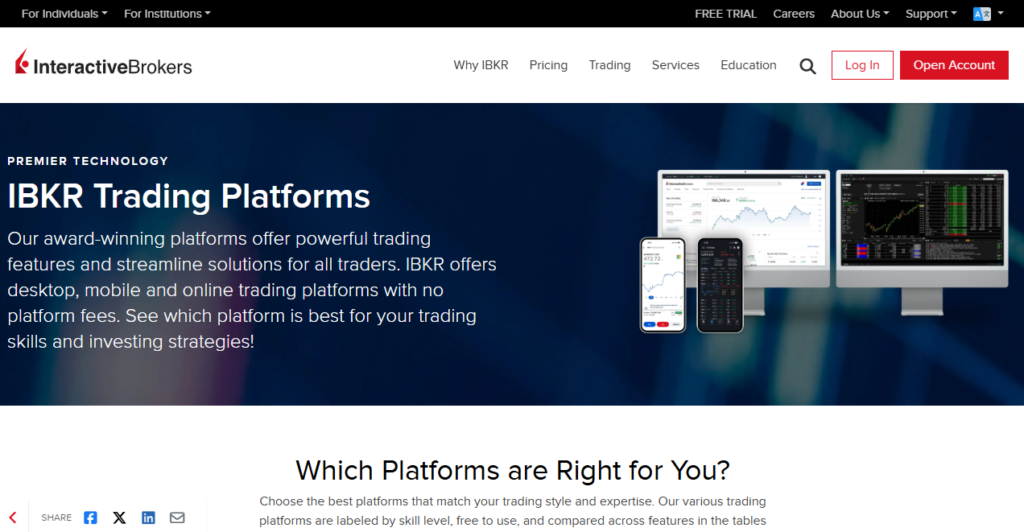
Interactive Brokers earns the top spot on this list for a simple reason. Professional and institutional traders rely on it. Nothing else at the retail level comes close to its combination of execution quality, margin rates, and global market access. Its Trader Workstation desktop platform offers direct market access. It features smart order routing across 150+ global markets and real-time risk management tools. Most retail platforms simply do not have these features. Our team tested IBKR Pro across the desktop TWS application, the newer IBKR Desktop interface, and the mobile app. Order fills were consistently close to or better than the quoted price even during peak volatility. The complexity is real. This is not a beginner’s platform. However, the cost savings on margin alone tend to justify the learning curve within a few weeks for any serious day trader.
Minimum investment: $0 to open an account
Fractional shares: Yes, available on U.S.-listed stocks via IBKR
Payment methods: ACH bank transfer, wire transfer, check
Commissions: $0 on US stocks and ETFs (IBKR Lite); tiered from $0.0005 per share on IBKR Pro
- Sign-up bonus: 0.25% rate reduction on margin loans for new IBKR Pro accounts. Verify current offer on the official website
Dealbreaker: Interactive Brokers will frustrate you before it helps you if you are a first-time trader who wants to place live trades within an hour of signing up. Its power is undeniable. Unlocking it takes time and intentional learning.
eToro: Best Day Trading Platform for Beginners
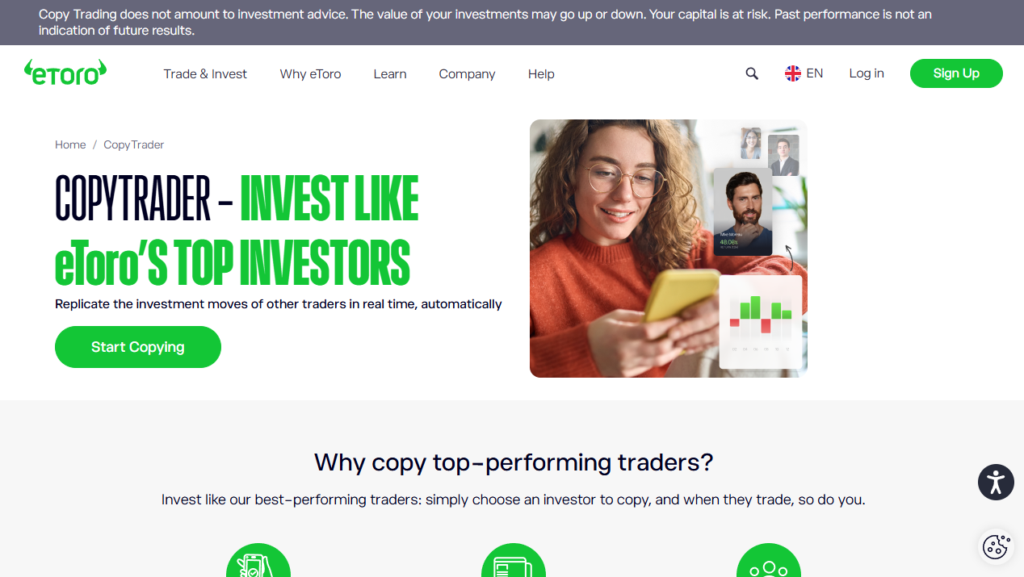
eToro built its reputation on social and copy trading. That foundation makes it uniquely useful for a beginner stepping into day trading for the first time. You can browse, follow, and automatically copy the trades of verified active traders. This feature removes some of the pressure of making every decision alone. No other platform on this list offers this at the same level of accessibility. Our lead investigator tested eToro’s interface across mobile and web. He found it the most immediately intuitive of any platform reviewed. Stock trading is commission-free. The platform is regulated across multiple jurisdictions including the FCA, CySEC, and ASIC. A demo account with $100,000 in virtual funds is available from day one. The tradeoff for all of this simplicity is a limited depth of technical tools compared to the professional platforms on this list.
Minimum investment: $50–$200 depending on country of residence.
Fractional shares: Yes. Buy stocks from as little as $10
Payment methods: Bank transfer, credit/debit card, PayPal, Skrill, Neteller
Commissions: $0 on stocks and ETFs. Forex and CFD trading is spread-based. $5 withdrawal fee applies. Verify current fee schedule on their website
Sign-up bonus: Vary per region
Dealbreaker: eToro is not where you go when you want to scalp a stock using bracket orders and Level 2 data. It is where you go when you are learning the mechanics of day trading and want guardrails while you find your footing.
TradeStation: Best Day Trading Platform for Automated Strategies
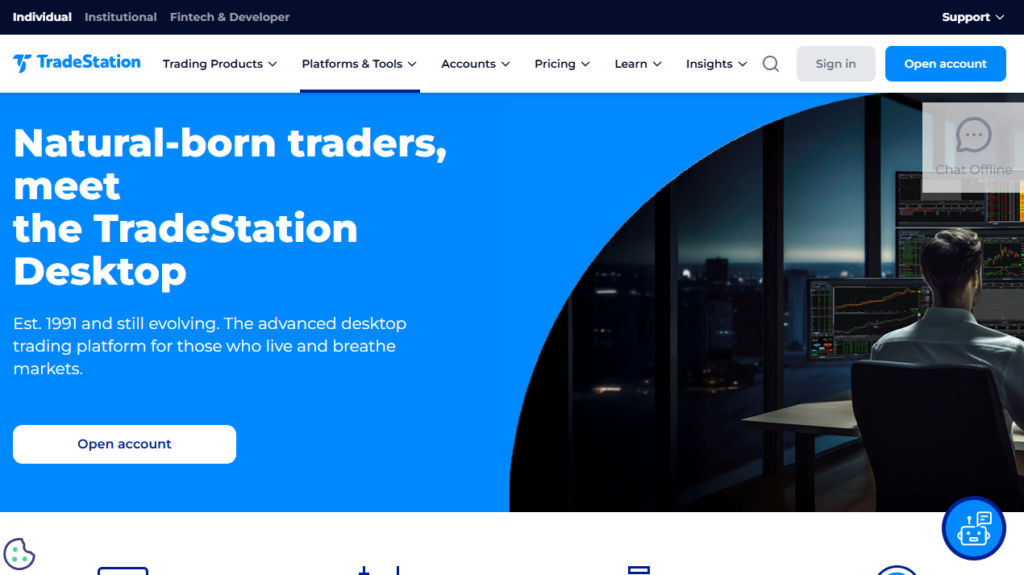
TradeStation is built for one type of trader. It serves someone who wants to go deeper than clicking a buy button. Its EasyLanguage scripting environment lets you build, backtest, and automate rules-based trading strategies without a formal coding background. RadarScreen is a real-time market scanner running across hundreds of symbols simultaneously. This tool provides a genuine competitive advantage for momentum and breakout traders who need to find setups quickly. We tested TradeStation’s desktop platform on a high-volatility morning session. We found the order execution fast, customizable hotkeys responsive, and the charting environment among the most powerful available to retail traders. The limitation is clear. You will use a fraction of what you are paying for if you are not willing to invest time in learning the platform.
Minimum investment: $0 for TradeStation Equities. $500 minimum for TradeStation Crypto
Fractional shares: No
Payment methods: ACH bank transfer, wire transfer, check
Commissions: $0 per trade on stocks and ETFs under the TS GO plan.
Sign-up bonus: Up to $3,500.
Dealbreaker: TradeStation’s most powerful features will go completely unused if you trade by gut feel and want to open a chart and click buy. This platform rewards preparation and systematic thinking over improvisation.
XTB: Best European Day Trading Platform
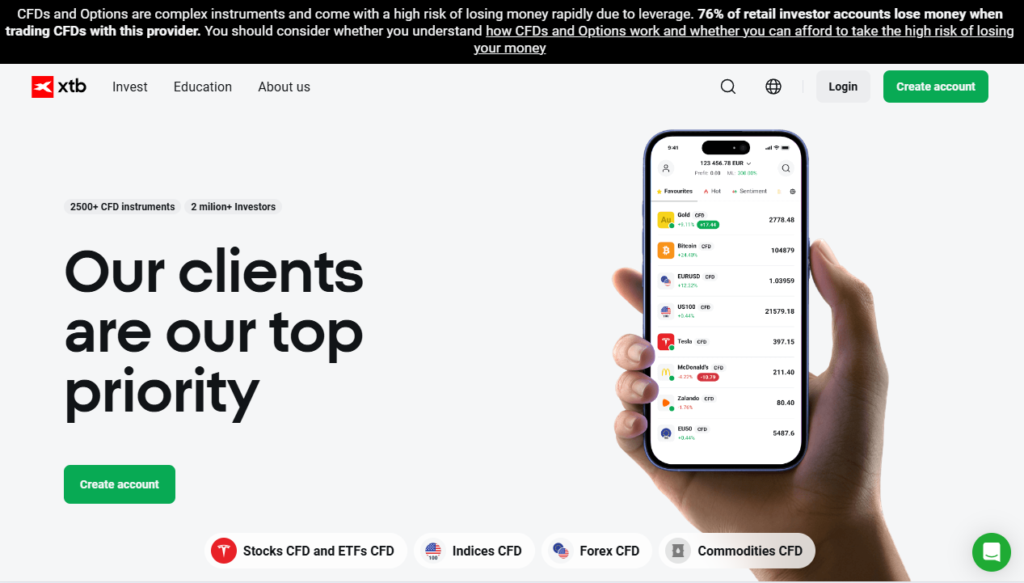
XTB has grown from a Polish CFD broker into one of Europe’s most regulated and widely used trading platforms. Its xStation 5 proprietary interface is genuinely one of the smoothest web-based trading environments currently available. Regulated by the FCA, CySEC, and Poland’s KNF among others, it covers over 3,000 instruments including real stocks, ETFs, and CFDs across major European and US exchanges. XTB covers a lot of ground for European traders who want commission-free stock investing up to €100,000 per month. It offers a clean, fast platform and solid customer support without charging you for the privilege of opening an account. Our team found xStation 5 fast and well-organized during testing. It features a particularly strong set of built-in educational tools that help less experienced traders understand what they are looking at.
Minimum investment: $0. No minimum deposit required
Fractional shares: Yes. Available from €10 per position
Payment methods: Bank transfer, debit/credit card, PayPal (in EU), Skrill
Commissions: $0 commission on stocks and ETFs up to €100,000 per month traded. 0.2% fee beyond that threshold. CFD trading is spread-based with no separate commission. Currency conversion is a 0.5% fee
Sign-up bonus: XTB does not currently offer a standard sign-up bonus
Dealbreaker: XTB is not available to you if you are a US-based trader. The 0.5% currency conversion fee and overnight swap charges on CFDs can erode returns for active traders who hold positions overnight frequently.
XM Trading: Trusted by 15 Million Traders
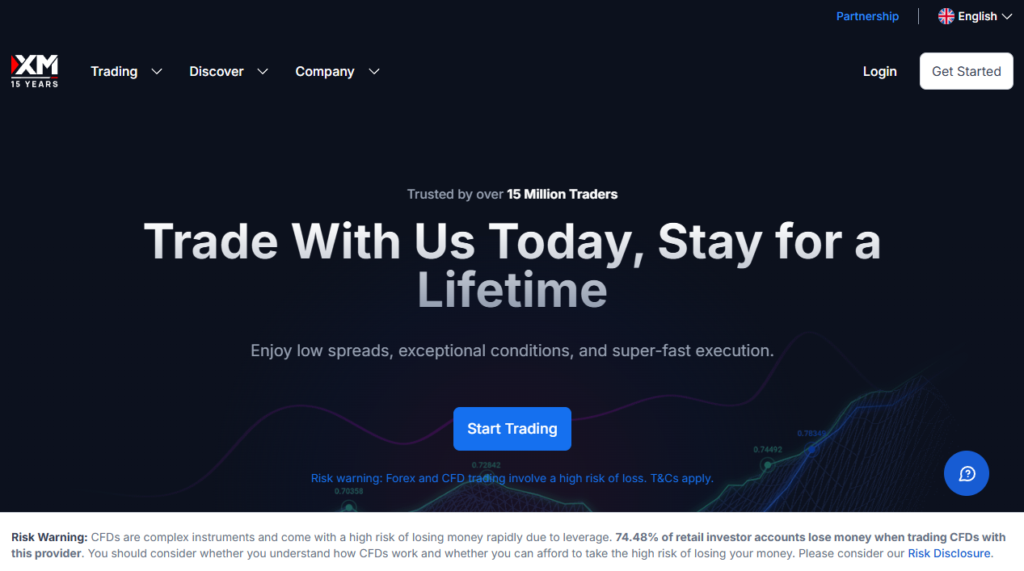
XM has built its global reputation on one thing done very well. It offers accessibility. The platform features a $5 minimum deposit and free deposits and withdrawals on most methods. It requires no minimum commission on standard and ultra-low accounts. It supports over 1,400 instruments via MT4 and MT5. These are the platforms that the overwhelming majority of the world’s forex and CFD traders already know. XM removes almost every barrier to entry. Regulated by CySEC, ASIC, and DFSA, it operates multiple entities to serve traders across different regulatory jurisdictions. Our team tested XM’s mobile app and found it genuinely impressive. It features fast execution, a built-in economic calendar, live Reuters news, and a clean interface that matches the capabilities of the web platform. The tradeoff is that XM does not accept US or Canadian clients. Standard account spreads also run wider than the industry average.
Minimum investment: $5 for Standard and Ultra Low accounts. $10,000 for the XM Global Shares account
Fractional shares: No. XM offers CFD-based instruments, not direct fractional share ownership
Payment methods: Credit/debit card, bank transfer, Skrill, Neteller. Region-specific local payment methods available
Commissions: $0 commission on Standard and Ultra Low accounts. XM Zero account offers spreads from 0.0 pips with a per-trade commission
Sign-up bonus: XM periodically offers deposit bonuses for new accounts. Verify availability by region
Dealbreaker: XM’s standard account is not your best option if you are an experienced trader who prioritizes the tightest possible spreads and execution quality above all else. The platform earns its reputation on accessibility, not on best-in-class execution for high-frequency strategies.
Plus500: Best UK Day Trading Platform
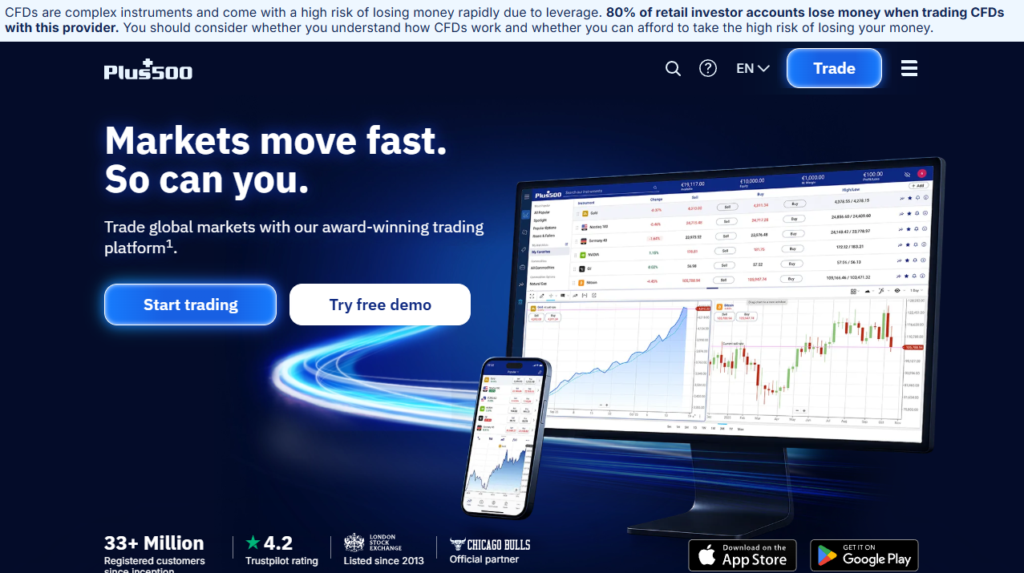
Plus500 is one of the most straightforward CFD platforms on the market. That simplicity is deliberate. Listed on the London Stock Exchange’s FTSE 250, regulated by the FCA, CySEC, ASIC, and MAS among others, and serving over 26 million customers globally, it offers a proprietary web and mobile platform. It is built around making CFD trading on stocks, indices, commodities, forex, and crypto as friction-free as possible. There are no commissions. All costs are built into the spread. The platform includes a guaranteed stop-loss order feature not offered by every competitor. Our team found the mobile app clean and fast, with clear risk management tools and a one-tap guaranteed stop-loss. This feature is genuinely useful for traders who want to cap downside on volatile positions. The limitation is what is absent. There is no MT4, no community tools, no advanced order scripting, and no depth for traders who want to go beyond straightforward CFD execution.
Minimum investment: $100 via credit/debit card or e-wallet. $500 via bank wire transfer
Fractional shares: No. Plus500 offers CFDs, not direct share ownership
Payment methods: Credit/debit card, bank transfer, PayPal, electronic wallets
Commissions: $0 commission on all CFD trades. Spreads from 0.6 on major forex. 0.7% currency conversion fee on non-account-currency trades. Inactivity fee of $10/month after 3 months of no login
Sign-up bonus: Plus500 does not typically run deposit bonus promotions
Dealbreaker: Plus500 is not the platform for you if you want advanced charting, automated strategies, or direct share ownership alongside your CFD trading. It is optimized for straightforward CFD execution and nothing more.
Pepperstone: Best Forex & CFD Day Trading Platform for Execution
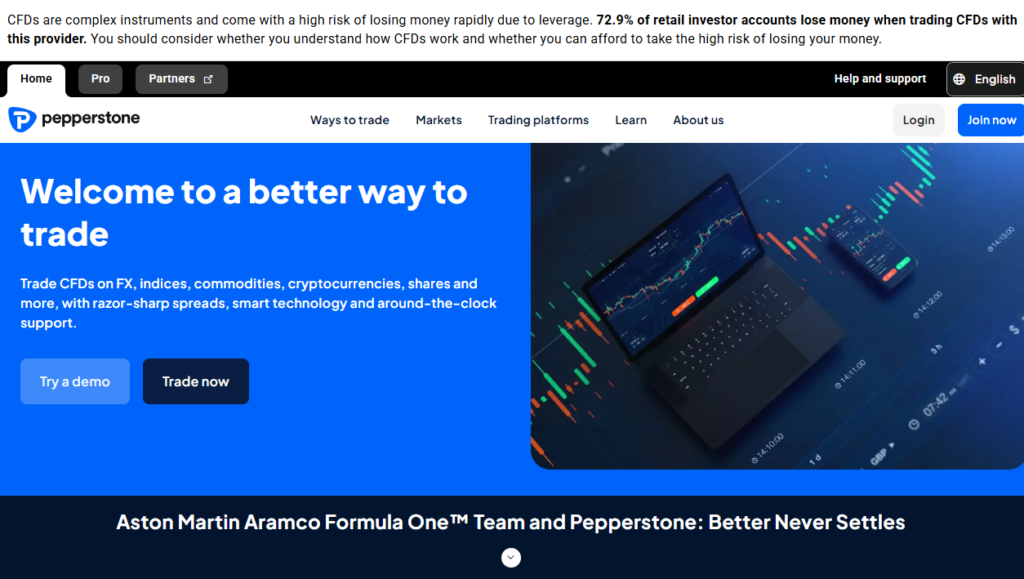
Pepperstone was founded in Melbourne by professional traders. They were dissatisfied with execution quality and cost structures at incumbent brokers. That founding ethos is still visible in how the platform is built. Its Razor account offers spreads starting from 0.0 pips on major forex pairs with a commission of $3.50 per lot per side. This makes it one of the most cost-effective options available for forex day traders who are serious about execution costs. Regulated by FCA, ASIC, CySEC, BaFin, DFSA, and CMA, Pepperstone carries an unusually broad regulatory footprint for a non-bank broker. Our expert tested across MT4, MT5, cTrader, and TradingView. All are available at no extra cost. He found order fills consistently tight with execution latency averaging around 30ms under normal conditions. No minimum deposit makes it accessible at any account size.
Minimum investment: $0. No minimum deposit required
Fractional shares: No. Pepperstone is a CFD and forex broker. No direct fractional share ownership
Payment methods: Bank transfer, credit/debit card, PayPal, Apple Pay, Google Pay, Neteller, Skrill, POLi, BPAY
Commissions: Standard account is spread-based, no commission. Razor account from 0.0 pips + $3.50 per lot per side
Sign-up bonus: Pepperstone does not run standard deposit bonuses
Dealbreaker: Pepperstone is not the right environment if you are primarily a stock trader who wants to own shares rather than trade CFDs. Its value is almost entirely concentrated in the quality of forex and CFD execution.
Vantage Markets: Award-Winning CFD Broker
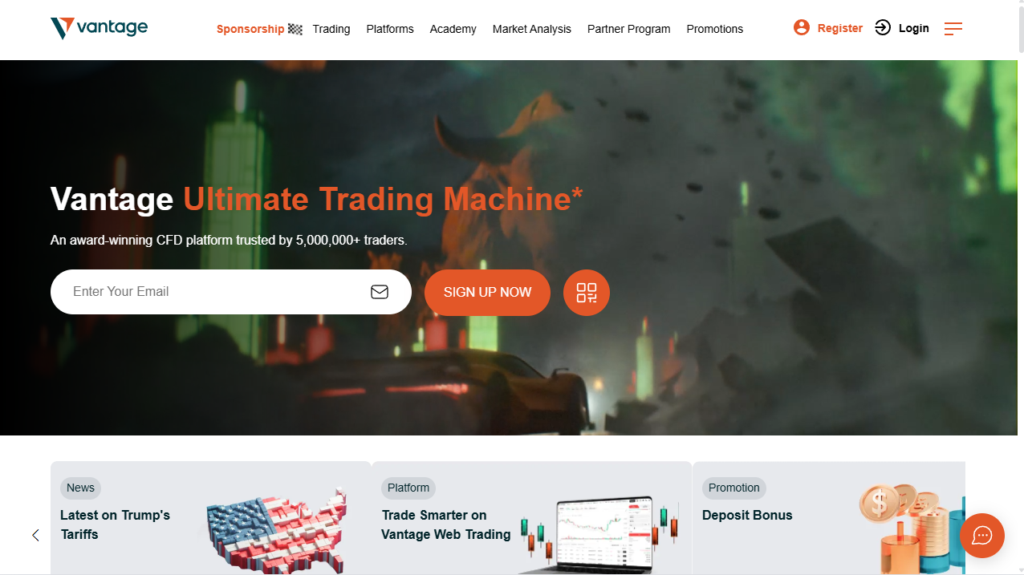
Vantage Markets has steadily built its reputation among active CFD traders for ECN execution quality, transparent pricing, and a solid multi-platform offering. It covers MT4, MT5, TradingView, and its own ProTrader interface. With a $50 minimum deposit for Raw ECN access, Vantage offers institutional-grade pricing conditions at a retail entry point. The Pro ECN account is available from $10,000. It brings that commission down to $1.50 per side per lot, making it one of the most competitive structures available for high-volume traders. Regulated by FCA, ASIC, and VFSC, the broker maintains segregated client funds and provides negative balance protection on all retail accounts. We tested execution on the Raw ECN account. We found fills consistently clean across both the MT5 and TradingView interfaces.
Minimum investment: $50 for Standard STP and Raw ECN accounts. $10,000 for Pro ECN account
Fractional shares: No. Vantage is a CFD broker
Payment methods: Bank card, bank wire transfer, Skrill, Neteller, USDT, Bitcoin, Ethereum
Commissions: Standard STP from 1.1 pips, no commission. Raw ECN from 0.0 pips + $3/lot per side. Pro ECN from 0.0 pips + $1.50/lot per side
Sign-up bonus: Multiple bonusses available dependable on the deposited money
Dealbreaker: Vantage Markets is not available to US residents. Its educational content will not satisfy a trader who is still building their foundational knowledge. It is built for traders who already know what they are doing and want the best possible execution cost structure.
Regulatory Map: What Protects Your Money Depends on Where You Are
Regulatory protection is not uniform. It depends entirely on which entity you open your account with and which country you are in.
US Traders
US retail clients face the most specific regulatory environment. Only Interactive Brokers and TradeStation on this list are registered US broker-dealers with FINRA. US clients of these platforms are covered by SIPC for up to $500,000 in securities. Most of the international CFD and forex brokers on this list do not accept US clients. Always verify current country availability directly on each broker’s website.
UK Traders
Brokers regulated by the FCA must hold client funds in segregated accounts. Eligible clients are covered by the Financial Services Compensation Scheme for up to £85,000 per person in the event of broker insolvency. Leverage for retail clients on major forex pairs is capped at 1:30 under FCA rules. CMC Markets, Pepperstone, XTB, Saxo Bank, Plus500, and Vantage all hold FCA authorisation. Verify FCA registration numbers on the FCA Register at fca.org.uk before publishing.
EU Traders
EU-regulated brokers fall under MiFID II, administered by national regulators such as CySEC and BaFin. Client compensation schemes vary by country but typically cover €20,000 to €100,000. Leverage restrictions for retail clients mirror UK rules. These caps are 1:30 on major forex, 1:20 on indices, and 1:5 on equities. XTB, XM, Plus500, and Pepperstone all hold CySEC authorisation
Australian Traders
ASIC-regulated brokers must segregate client funds. The compensation scheme structure differs from the UK model. Leverage caps for retail clients are set by ASIC at 1:30 on major forex pairs. Pepperstone, Vantage, CMC Markets, and Interactive Brokers hold ASIC authorisation.
Pattern Day Trading Rule: A US-Specific Requirement Every Trader Should Understand
This section is strictly for US readers trading via IBKR and TradeStation.
What Is the PDT Rule?
Under FINRA Rule 4210, any US-based trader using a margin account who executes four or more day trades within five consecutive business days is designated a Pattern Day Trader. This designation occurs if those trades represent more than 6% of their total trades in that period. Once designated, they must maintain a minimum account equity of $25,000 to continue day trading.
How It Affects Platform Choice
Brokers like Interactive Brokers and TradeStation both enforce the PDT rule for US margin accounts. Both provide real-time account equity tracking. Platforms that offer cash accounts allow unlimited day trades but subject traders to settlement constraints. Futures trading is regulated by the CFTC rather than FINRA. It is not subject to the PDT rule at all.
Is the $25,000 Requirement Changing?
In 2025, the FINRA Board of Governors approved amendments proposing to replace the fixed $25,000 minimum with a risk-based intraday margin requirement. As of early 2026, these changes are pending SEC approval and the $25,000 rule remains in effect. Monitor FINRA.org for status updates.
This Rule Does Not Apply Outside the US
The PDT rule has no equivalent in the UK, EU, and Australia. Retail leverage restrictions are the more relevant regulatory constraint to understand in these areas.
Day Trading by Strategy: Which Platform Fits Your Approach?
No single platform is best for every type of day trader. The right choice depends on your strategy first, your geography second, and your capital third.
| Trading Style | What You Need From a Platform | Best Match on This List |
| Scalping (fast, high-frequency) | Sub-second execution, direct market access, tight spreads, hotkeys | Interactive Brokers (TWS), Pepperstone (Razor ECN) |
| Momentum / breakout trading | Real-time scanner, Level 2 data, fast chart rendering | TradeStation (RadarScreen), CMC Markets (Next Generation) |
| Options day trading | Options chain responsiveness, probability tools | Interactive Brokers |
| Forex day trading | Tight ECN spreads, fast fill rates, multi-platform support | Pepperstone, Vantage Markets, CMC Markets (FX Active) |
| CFD index / commodity trading | No-commission spreads, guaranteed stop-loss, mobile execution | Plus500, CMC Markets |
| Copy trading / beginner day trading | Social portfolio visibility, clean UI, protected entry | eToro |
| Automated / algorithmic trading | Scripting capability, backtesting, API access | TradeStation (EasyLanguage), Interactive Brokers |
| Professional multi-asset trading | Banking-grade environment, real asset ownership, research depth | Saxo Bank |
The common mistake is choosing a platform based on name recognition or a sign-up bonus rather than matching it to your specific strategy and jurisdiction. A scalping setup on MT5 through Pepperstone and a momentum trading setup on TradeStation’s RadarScreen are two entirely different workflows. Use the table above as your decision-starting point, then verify the specific account type and regulatory entity that applies to your country.
Paper Trading: Practice Day Trading Before You Risk Real Capital
Paper trading is simulated trading using virtual money, but with live, real-time market data. It gives you the ability to test a strategy, learn the mechanics of a platform’s order entry interface, and understand how a market moves without financial risk.
Of the platforms reviewed on this page, the following offer paper trading:
Interactive Brokers: Full paper trading account available, using live data
TradeStation: Simulated trading environment with real-time data
eToro: $100,000 virtual portfolio demo account; unlimited duration
XM Trading: $10,000 demo account; practice MT4/MT5 with virtual funds
XTB: Demo account available on xStation 5 with real-time pricing
Vantage Markets: Unlimited demo account; no expiry date
CMC Markets: Demo account with £10,000 in virtual funds
Saxo Bank: Demo access available across SaxoTraderGO and SaxoTraderPRO
Pepperstone note: Demo accounts at Pepperstone are active for 30 days only.
Plus500 note: An unlimited free demo account is available with no time restrictions.
Day Trading Taxes: What Your Platform Won't Tell You
Disclaimer up front: This section is for general educational purposes only. Tax treatment varies significantly by country, account type, and trading activity level. Consult a qualified tax professional before making any decisions about your tax filing status.
UK Day Traders
In the UK, profits from day trading CFDs and spread betting are treated differently. Spread betting profits are generally not subject to Capital Gains Tax or stamp duty. CFD trading profits are subject to CGT. Traders who trade with sufficient frequency and regularity may be classified as professional traders, changing their tax treatment.
European Traders
Tax treatment varies significantly across EU member states. German traders face flat Abgeltungssteuer on investment gains. Dutch traders pay wealth tax on the value of assets rather than realised gains. Seek country-specific advice before trading at scale.
US Traders (IBKR and TradeStation)
Short-term capital gains are taxed at ordinary income rates. The wash-sale rule disallows certain loss deductions for traders who repurchase the same security within 30 days. Very active traders may qualify for “Trader in Securities” status under IRS rules. They may be eligible for the Section 475(f) mark-to-market election. Consult a CPA familiar with active trader taxation before the end of each tax year.
How We Select the Best Day Trading Platforms
Our editorial team have hand-tested the platforms. What follows is not a theoretical checklist. It is a description of the actual testing process used to build these reviews. The criteria below reflect what matters when a market opens and a decision needs to be made in seconds.
Execution Speed and Order Routing
For a day trader, execution is the product. We timed order fills across each platform during high-volume sessions and compared fill prices against quoted prices. Platforms that use Payment for Order Flow route orders in a way that may not always maximize fill quality. ECN brokers like Pepperstone and Vantage route directly to liquidity providers. This generally produces tighter fills for high-frequency strategies. Both approaches are disclosed on each broker’s website. We reviewed those disclosures as part of our testing.
Platform Stability Under Pressure
A day trading platform that lags during a volatile session is not a day trading platform. We tested each platform’s interface responsiveness during high-volume market conditions and reviewed any publicly available uptime disclosures. CMC Markets is one of the few brokers that publishes execution quality data. We noted this in the review as a differentiating transparency standard.
Spreads, Commissions, and Overnight Costs
Zero commission on stocks or CFDs is no longer a differentiator. It is the baseline. What varies significantly across this list is the spread, the overnight financing fee on positions held past 5pm New York time, and any currency conversion charge for multi-currency accounts. We compared total cost-per-trade across account types and volume levels for each broker.
Advanced Order Types
Day trading requires bracket orders, one-cancels-other (OCO) orders, trailing stops, and in some cases conditional orders. We tested whether each platform supports these natively. We also checked how intuitively they can be accessed and configured during active trading.
Research Tools and Charting
We assessed the number of technical indicators, chart timeframes, and drawing tool quality available on each platform’s charting interface. We also noted whether real-time data is free or requires a paid subscription. This is a cost that is often buried and adds up quickly for active traders.
Paper Trading Availability
We confirmed which platforms offer a paper trading mode. We checked whether it uses live market data and whether there is a time limit on demo account usage. This is a non-trivial feature for traders who are developing a strategy and want to test it before deploying real capital.
Regulatory Standing and Licensing
Every platform on this list is regulated by at least one tier-1 financial authority. Regulatory status for each broker was verified using the official regulator’s public register.
Customer Service Quality
We contacted each broker’s support team across multiple channels and assessed response time and resolution quality. For day traders who encounter a platform issue during market hours, a 15-minute wait for live chat support can cost real money. We noted which brokers offer 24/5 phone support versus chat-only.
Execution Quality
Brokers that advertise zero commissions almost always make money somewhere else. They profit on the spread, on overnight financing rates, or through PFOF arrangements. We explained clearly in each review where each broker’s revenue model sits, so readers understand the true cost of trading.
Ease of Withdrawal
We tested how long it actually takes to withdraw funds from each platform after a trading session. We included any holding periods, verification steps, or minimum withdrawal amounts. E-wallet withdrawals are typically same-day or next-day across most platforms. Bank transfer withdrawals range from 1–5 business days depending on the broker and jurisdiction. We noted any withdrawal fees in each review.
How to Open a Day Trading Account In 4 Steps
Step 1: Match the platform to your strategy and country. Use the strategy table above. Confirm that the broker you want is authorised to accept clients in your jurisdiction before providing any personal information.
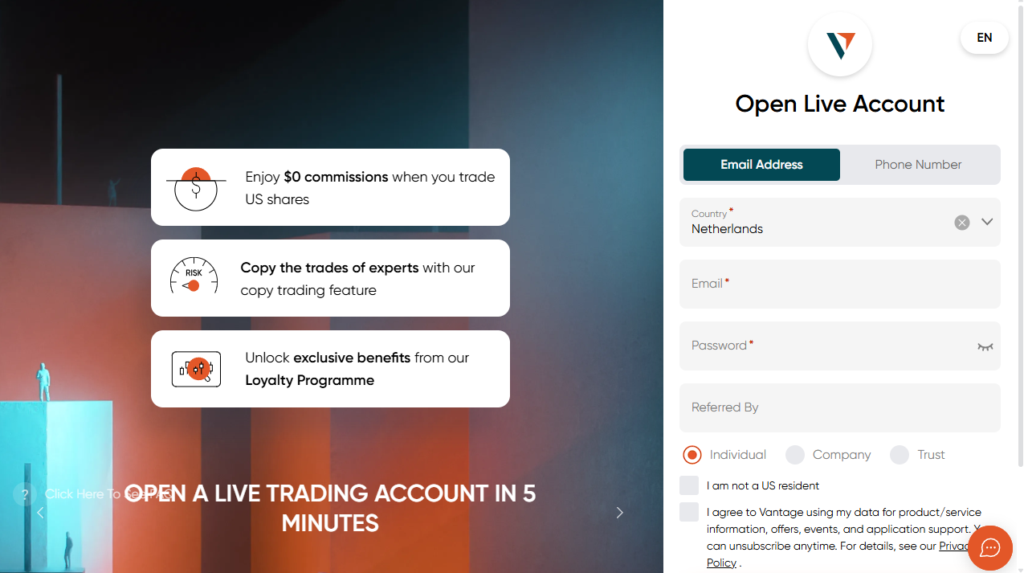
Step 2: Gather your documents. All regulated brokers are required to verify your identity under AML/KYC regulations. You will typically need a government-issued ID and a recent proof of address. Have these ready to photograph clearly before you start the sign-up process.
Step 3: Select the right account type. Most brokers on this list offer multiple account types. For forex/CFD platforms, this often means choosing between a spread-only standard account and a commission-plus-tight-spread ECN account.
Step 4: Fund the account, configure your platform, and use the demo first. Deposit the minimum amount you need for your chosen account type. Before placing a live trade, spend time on the platform’s paper trading or demo mode to learn the order entry interface.
Conclusion
After testing every platform on this list with real accounts and real capital, Interactive Brokers stands out as the best day trading platform of 2026. Its combination of direct market access, industry-leading margin rates, smart order routing across 150+ global markets, and the improved IBKR Desktop interface gives serious traders more firepower than any other retail platform currently available. For those newer to day trading, eToro earns its place as the best option for beginners. Commission-free stock trading, a clean interface, and the ability to follow and copy experienced traders makes it a practical starting point rather than just a watered-down version of something better. TradeStation sits in its own category for traders who want to go beyond manual execution. If you are building rules-based strategies, backtesting setups, or scanning hundreds of instruments in real time through RadarScreen, nothing on this list matches it for systematic day trading. The right platform ultimately comes down to your strategy, your experience level, and where you are based. But if you need a starting point, those three names cover the full spectrum from professional-grade execution to first-trade-ready accessibility.
Frequently Asked Questions about Day Trading Platforms
The best platform for day trading depends on your strategy and location. Interactive Brokers leads on execution quality, margin rates, and global market access . eToro is the most beginner-friendly. TradeStation is best for automated strategies. Pepperstone and Vantage Markets are the strongest options for forex ECN execution. CMC Markets offers the widest instrument range. Saxo Bank is best for professional investors.
Only if you are a US-based trader using a margin account who executes four or more day trades in five business days. Non-US traders are not subject to this rule. US traders can also avoid it by using a cash account or trading futures.
A Contract for Difference is a derivative instrument that tracks the price of an underlying asset without you owning the underlying asset directly. CFDs allow leverage, which amplifies both gains and losses. Most international brokers on this list offer CFDs rather than direct share ownership.
On regulated platforms in the UK, EU, and Australia, retail client leverage on major forex is capped at 1:30. A position worth £30,000 can be opened with £1,000 in margin. If the position moves 3.3% against you, you can lose your entire margin.
What percentage of day traders are profitable?
Desktop-based platforms generally provide faster execution than web-only or mobile interfaces. Interactive Brokers' direct market access and smart order routing consistently produces the tightest fills based on published execution quality data
This depends on which regulatory jurisdiction your account falls under. UK clients are covered by the FSCS up to £85,000. EU clients are covered by national investor compensation schemes, typically up to €20,000. US clients at FINRA-registered broker-dealers are covered by SIPC for up to $500,000.
Yes. Several platforms on this list are built specifically with mobile trading in mind . eToro's mobile app is the most beginner-accessible. For serious technical analysis and order management, a desktop or laptop remains the preferred environment for most active traders.
Spread betting and CFDs both allow traders to speculate on price movements without owning the underlying asset. In the UK and Ireland, spread betting profits are generally exempt from Capital Gains Tax and stamp duty. CFD profits are subject to CGT.
Day trading is legal in all major jurisdictions covered by this review. It is regulated by FINRA and the SEC in the US. It falls under FCA and MiFID II regulation in the UK and EU.
Disclaimer & Important Information
General Disclaimer: This Is Not Financial Advice
All content published on this page – including platform reviews, comparison tables, fee summaries, strategy guidance, and any other information — is intended for general educational and informational purposes only. Nothing on this page constitutes, or should be construed as, financial advice, investment advice, trading advice, or a recommendation to buy, sell, or hold any financial instrument or to open an account with any broker or trading platform.
The information provided reflects the research, testing, and personal opinions of our editorial team at the time of writing. It does not take into account your individual financial situation, investment objectives, risk tolerance, experience level, or any other personal circumstances that would be relevant to a financial decision. Every trader’s situation is different, and what works for one person may not be appropriate for another.
Before making any decision to trade financial products – including stocks, CFDs, forex, options, futures, or any other instrument – you should seek independent financial advice from a qualified and regulated financial adviser who is licensed in your jurisdiction and who is aware of your personal circumstances.
We are not financial advisers. We are not licensed to provide financial advice. Reading this content does not create any advisory relationship between you and us.
Affiliate Disclosure: How This Site Is Funded
This website may contain affiliate links. This means that if you click on a link to a broker or trading platform featured on this page and subsequently open an account, we may receive a commission or referral fee from that broker at no additional cost to you.
The existence of affiliate relationships does not influence our editorial positions, platform ratings, or the factual accuracy of the information we present. Our reviews are based on hands-on testing with real accounts and real capital, and we apply the same evaluation criteria to every platform regardless of whether an affiliate relationship exists.
We are committed to transparency: where an affiliate relationship exists with a broker listed on this page, that relationship is covered by this disclosure. We recommend that you treat any financial content you read online — including ours — with appropriate critical thinking, and that you conduct your own independent research before making any trading or investment decision.
CFD and Leveraged Product Risk Warning
Contracts for Difference (CFDs), forex, spread betting, and other leveraged derivatives are complex financial instruments that carry a high risk of rapid financial loss due to the use of leverage. The majority of retail investor accounts lose money when trading these products.
The following risk disclosures are published by the brokers reviewed on this page and are required under FCA and ESMA regulations. These figures represent the percentage of retail client accounts that lose money when trading CFDs with each provider. These disclosures are updated periodically by each broker — verify current figures on each broker’s official website before relying on any figure published here:
- eToro: CFD risk disclosure — verify on etoro.com
- XTB: 76% of retail investor accounts lose money — verify on xtb.com
- XM Trading: 70–80% of retail investor accounts lose money — verify on xm.com
- Plus500: 82% of retail investor accounts lose money — verify on plus500.com
- Pepperstone: 81.8% of retail investor accounts lose money — verify on pepperstone.com
- Vantage Markets: Verify current figure on vantagemarkets.com
- CMC Markets: 64% of retail investor accounts lose money — verify on cmcmarkets.com
- Saxo Bank: Verify current figure on home.saxo
These are not hypothetical figures. They reflect the actual trading outcomes of real retail accounts at each provider. You should consider whether you understand how CFDs and leveraged products work and whether you can afford to take the high risk of losing your entire invested capital — or more, without negative balance protection — before trading these instruments.
Our Methodology
This review follows a three-pillar framework designed to make our conclusions transparent and reproducible.
Pillar 1: Hands-On Testing (The Experience Factor) Our team opened live accounts and deposited real funds at every platform listed on this page. Testing was conducted across iOS, Android, and desktop. We executed real trades across different order types and assessed fill quality. We also tested withdrawal speed and ease on each platform.
Pillar 2: The Scoring Rubric (The Expertise Factor) Each platform was evaluated against a proprietary 50-point checklist. This covers Execution Quality (25%), Platform Tools and Charting (20%), Spreads, Commissions, and Overnight Costs (20%), Regulatory Standing and Client Protection (15%), Customer Service (10%), and Withdrawal Speed and Ease (10%). We evaluated more than 10 brokers before narrowing to the 10 reviewed on this page.
Pillar 3: Verification (The Trust Factor) Spread rates, commission structures, minimum deposits, and sign-up bonuses are verified against each broker’s official fee disclosure pages on a quarterly basis. Regulatory status is confirmed against the FCA Register, ASIC’s register, FINRA BrokerCheck, and equivalent official registers for each jurisdiction.
The Who: Led by Mark Verwoert, professional investor for different holding companies.
The How: We evaluated 10+ platforms using a proprietary 50-point checklist across live accounts on iOS, Android, and desktop.
The Why: Our goal is to find the best balance between cost, execution quality, and regulatory trust for retail traders at every experience level.
References
- FINRA.org — Pattern Day Trading, Rule 4210: https://www.finra.org/investors/investing/investment-products/stocks/day-trading
- FINRA.org — FINRA BrokerCheck (broker verification): https://brokercheck.finra.org
- IRS.gov — Publication 550 (Investment Income and Expenses, including wash-sale rule)
- IRS.gov — Topic No. 429 (Traders in Securities)
- FCA Register (UK regulatory verification): https://register.fca.org.uk
- ASIC Financial Services Register (Australian regulatory verification): https://connectonline.asic.gov.au
- Each broker’s official fee/commission page (IBKR, eToro, TradeStation, XTB, XM, Plus500, Pepperstone, Vantage Markets, CMC Markets, Saxo Bank) — link directly to the fee schedule page, not the homepage
- CMC Markets — Execution Quality Disclosure (if publicly available on their site)
- ForexBrokers.com — 2026 Annual Awards (referenced for Saxo Bank mobile and CMC Markets accolades)
