
-
Mark Verwoert
- Last updated: March 6, 2026
Educational Disclaimer: The content on myinvestacademy.com is for educational and informational purposes only. We are not licensed financial advisors, and nothing in this article should be interpreted as professional investment, legal, or tax advice. Investing involves risk of loss. Always consult with a professional before making financial decisions.
Best Stock Brokers in 2026: The Definitive Guide to Online Platforms (Hand-Tested & Ranked)
Finding the right stock broker to manage your investments determines your long-term success. As markets evolve in 2026, the barrier to entry has never been lower, but the complexity of choosing a provider has increased. At MyInvestAcademy, we don’t just summarize brochures. Our stock market experts have opened accounts, deposited real capital, and executed trades on every platform mentioned in this guide to ensure our recommendations are grounded in reality.
Quick Online Stock Broker Comparison
This table provides a high-level overview for quick decision-making. We have rated these based on their performance in our 50-point proprietary testing report.
| Broker | Best For | Fees | Fractional Shares | Our Rating |
|---|---|---|---|---|
| eToro | Beginners and "hands-off" investors | $0 Commission | Yes (from $10) | 4.7/5 |
| Webull | Mobile technical analysis | $0 Commission | Yes (from $5) | 4.6/5 |
| Interactive Brokers | Professionals & global markets | Low tiered/fixed | Yes (1% fee may apply) | 4.9/5 |
| Robinhood | Ease of use / beginner friendly | $0 Commission | Yes (from $1) | 4.5/5 |
| Fidelity | Long-term / Research | $0 Commission | Yes ($1 minimum) | 4.8/5 |
Best Stock Brokers in 2026 - In-depth reviews
The following section provides a deep dive into the best stock brokers currently operating. While most brokers now offer $0 commissions, they differ significantly in how they handle your data, where they route your orders, and the level of support they provide when you encounter an issue.
eToro - Best for Beginners and "Hands-Off" Investors
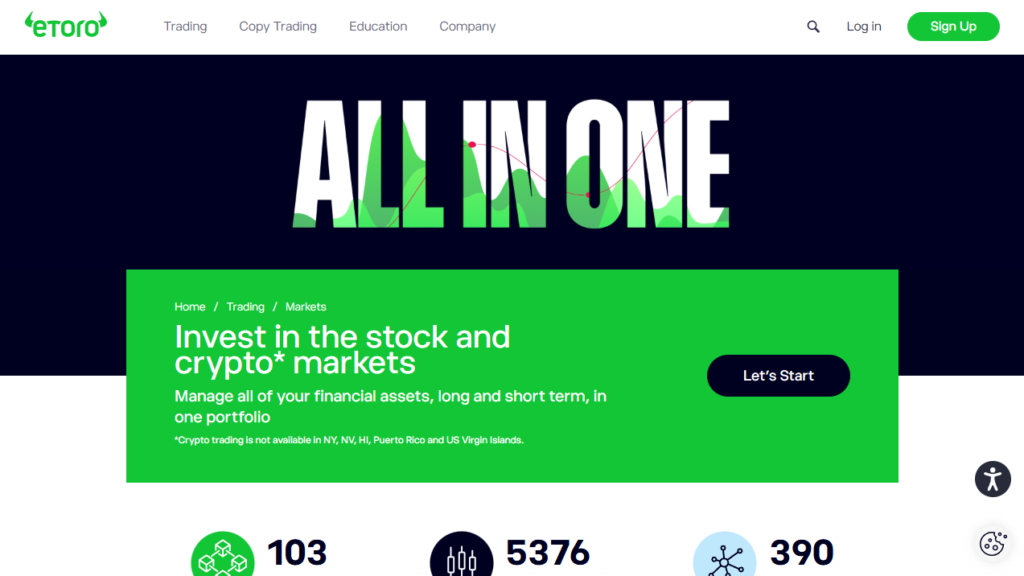
eToro has redefined the entry point for the “hands-off” investor in 2026 by prioritizing automated wealth building over manual analysis. While its social feed offers a real-time pulse on market sentiment, the platform’s true power lies in its Smart Portfolios—professionally curated, thematic baskets of assets that act like actively managed funds without the traditional management fees. For those who want a completely passive experience, the CopyTrader™ feature allows you to put your portfolio on autopilot by automatically mirroring the moves of high-performing “Popular Investors.” It transforms the typically complex process of stock picking into a user-friendly, community-driven experience designed specifically for those who value their time as much as their returns.
-
Minimum investment: $10 to $50 depending on your region to open an account.
-
Fractional shares: Yes (Allows you to buy stocks with as little as $10).
-
Payment methods: Bank Transfer, Credit/Debit Card, and PayPal/Skrill.
-
Commissions: $0 commission for stocks and ETFs (other fees like spreads apply).
-
Sign-up bonus: Up to $500 in crypto or cash rewards depending on the initial deposit amount.
eToro detailed specifications
| Feature | Details |
| Account Types | Individual, Joint, Corporate |
| Markets | US Stocks, International, Crypto, ETFs |
| Mobile App | Highly intuitive social-feed style |
| Customer Support | Ticket-based system and Live Chat for Club members |
Pros:
Revolutionary CopyTrader system for passive investing.
Vibrant social community for sentiment analysis.
Very simple user interface for first-time buyers.
Broad range of international stocks and crypto assets.
Cons:
Withdrawal fees apply ($5 per transaction).
Higher “spreads” on certain assets compared to traditional brokers.
The Dealbreaker: If you are a high-frequency day trader who requires sub-second execution and advanced charting, the social-first focus of eToro will likely feel too restrictive for your needs.
Webull - Best for Technical Analysis on Mobile
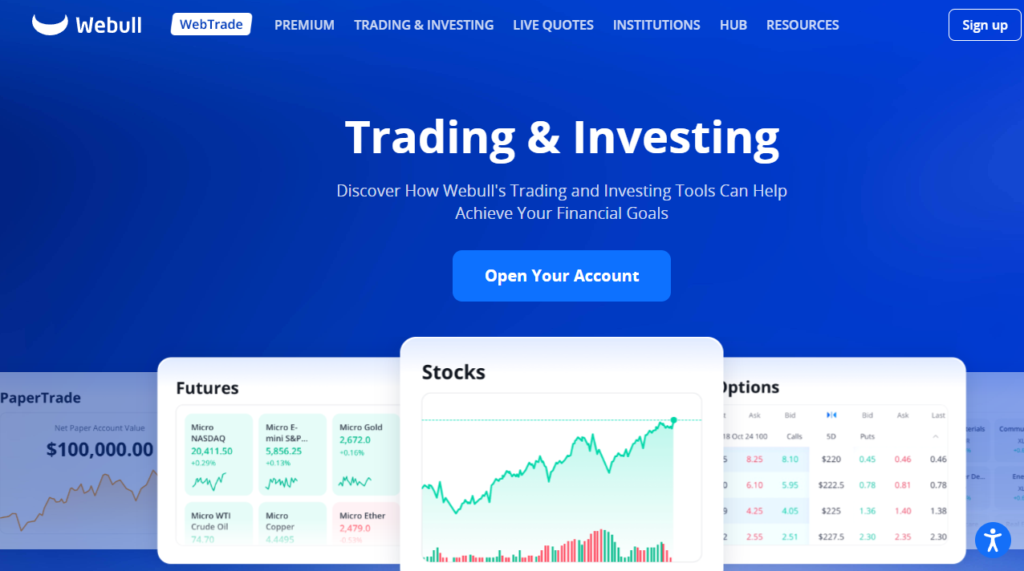
Webull has carved out a niche as the “Robinhood for adults.” It offers a clean, mobile-first experience but adds layers of technical data—such as Level 2 Market Data and advanced candlestick charting—that simpler apps lack. In 2026, their rewards system remains one of the most aggressive in the industry, frequently offering fractional shares of “Magnificent 7” companies just for opening and funding an account.
-
Minimum investment: $0 to open an account; certain tiers require $1,000+ for full rewards.
-
Fractional shares: Yes (Allows you to buy stocks with as little as $5).
-
Payment methods: ACH Transfer and Wire Transfer.
-
Commissions: $0 for stocks, ETFs, and options.
-
Sign-up bonus: Varied rewards often totaling 3 to 12 fractional shares for new users.
Webull Detailed Specifications
| Feature | Details |
| Charts | 50+ technical indicators and 12+ drawing tools |
| Extended Hours | Full access (4:00 AM to 8:00 PM ET) |
| Account Security | Two-factor authentication and SIPC insurance |
| Education | “Paper Trading” simulator included |
Pros:
Best-in-class mobile charting tools for technical traders.
Zero commission fees on almost all standard trades.
Full access to pre-market and after-hours trading.
Highly engaging rewards and referral programs.
Cons:
No access to mutual funds or bonds.
Customer service is primarily digital with slower phone response times.
The Dealbreaker: If you prefer a “one-stop-shop” for your financial life, including checking accounts and mortgage services, Webull’s focus solely on active trading will leave you wanting more.
Interactive Brokers - Best for Global Markets and Professionals
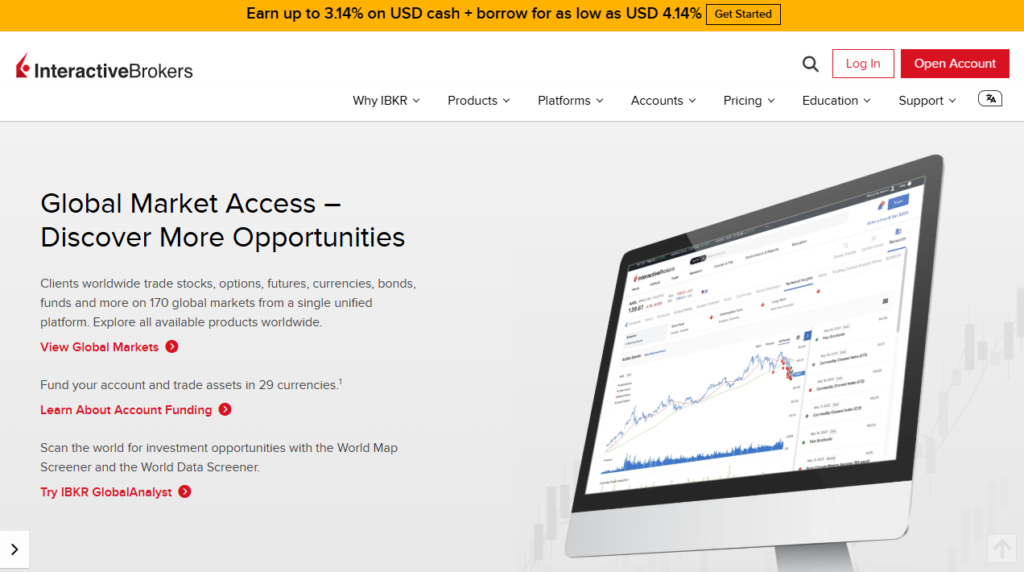
Interactive Brokers (IBKR) is the gold standard for serious investors who need access to every corner of the global market. Whether you want to trade stocks in Tokyo, bonds in London, or futures in Chicago, IBKR provides a single portal to 150+ markets. While their “Trader Workstation” (TWS) has a steep learning curve, their newer mobile apps have made professional-grade tools accessible to a wider audience.
-
Minimum investment: $0 for IBKR Lite accounts.
-
Fractional shares: Yes (Note that a 1% commission may apply on fractional portions in certain tiers).
-
Payment methods: Bank Wire, ACH, and Check.
-
Commissions: Extremely low tiered or fixed pricing (typically $0.005 per share).
-
Sign-up bonus: Up to $1,000 in IBKR stock for qualifying new accounts.
Interactive Brokers Detailed Specifications
| Feature | Details |
| Market Access | 150 markets in 33 countries |
| Margin Rates | Industry-leading low rates (often below 7%) |
| Execution | IB SmartRouting for best price discovery |
| Research | Professional-grade scanners and fundamental data |
Pros:
-
Unrivaled access to international markets and asset classes.
-
The lowest margin interest rates available to retail investors.
-
Advanced “SmartRouting” technology for better price execution.
-
Robust security features for high-net-worth individuals.
Cons:
-
Platform complexity can be overwhelming for beginners.
-
The “Tiered” vs. “Fixed” pricing model requires careful study to optimize.
The Dealbreaker: If you only plan to buy $50 worth of an S&P 500 ETF once a month, the technical complexity and potential small-order fees at IBKR are unnecessary hurdles.
Robinhood - Best for Simple User Experience
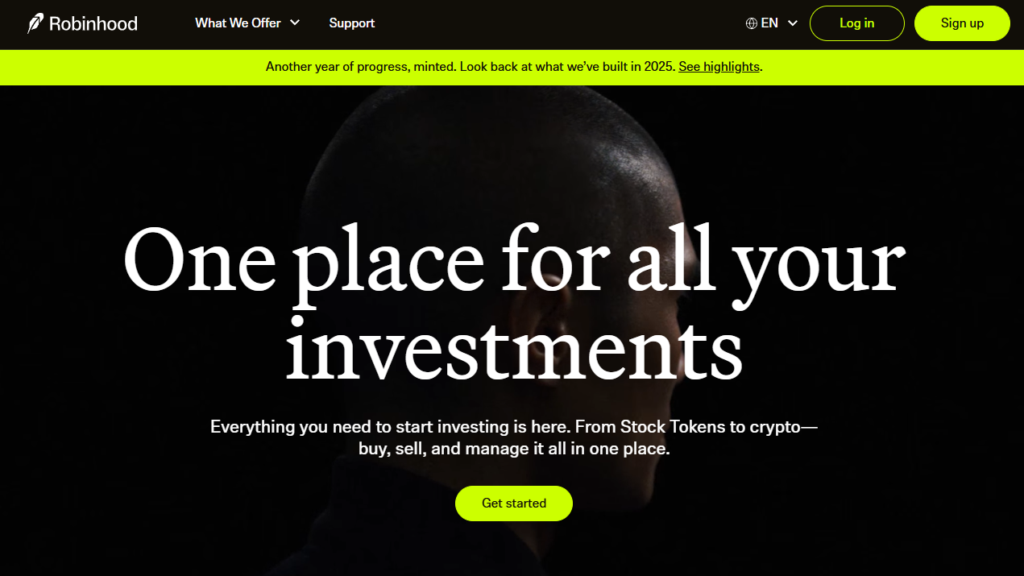
Robinhood changed the industry by introducing commission-free trading, and in 2026, they continue to lead in user experience design. The app is fast, visually clear, and makes complex actions like options trading or recurring investments feel effortless. Their “Gold” subscription offers competitive interest on uninvested cash, making it an attractive home for both active traders and those looking for a high-yield cash sweep.
-
Minimum investment: $0 to open an account.
-
Fractional shares: Yes (Allows you to buy stocks with as little as $1).
-
Payment methods: ACH Transfer and Instant Deposit.
-
Commissions: $0 for stocks, ETFs, and options.
-
Sign-up bonus: One fractional share (value $5–$200) for new approved accounts.
Robinhood Detailed Specifications
| Feature | Details |
| Platform | iOS, Android, and Web |
| Cash Management | High-yield sweep for Gold members |
| Retirement | IRA with 1% to 3% matching (subject to terms) |
| Crypto | Direct access to major cryptocurrencies |
Pros:
The most user-friendly interface in the brokerage industry.
Excellent 24/7 phone support (exclusive to certain tiers).
Lucrative IRA matching programs for retirement savers.
Instant access to a portion of your deposits.
Cons:
Limited fundamental research tools compared to Fidelity.
No access to mutual funds or international stocks (non-ADR).
The Dealbreaker: If you require deep fundamental analysis, such as 10-year financial statements or advanced stock screeners, Robinhood’s “simple” approach will feel lacking.
Fidelity - Best for Long-Term Investors and Research

Fidelity is a powerhouse that manages trillions of dollars, and they bring that scale to the retail investor. They are unique in offering “Zero” expense ratio mutual funds and an incredible library of research from providers like Argus and Reuters. Unlike many “fintech” apps, Fidelity offers a full-service experience, including physical branches where you can speak to an advisor in person.
Minimum investment: $0 for brokerage accounts.
Fractional shares: Yes (Available via “Stocks by the Slice” for $1 minimum).
Payment methods: ACH, Wire, Check, and PayPal.
Commissions: $0 for US stocks and ETFs.
Sign-up bonus: Frequent “Spend $50, Get $100” style promotions for new accounts.
Fidelity Detailed Specifications
| Feature | Details |
| Research | 20+ third-party research reports for most stocks |
| Execution | No payment for order flow (PFOF) on stocks/ETFs |
| Funds | Access to thousands of no-transaction-fee mutual funds |
| Customer Service | 24/7 phone support and local branch access |
Pros:
Extensive research and education for long-term planning.
No payment for order flow, leading to better price execution.
Widest variety of account types (HSAs, 529s, IRAs).
Robust security and a long history of institutional stability.
Cons:
Mobile app can feel cluttered due to the sheer volume of features.
The Active Trader Pro desktop software is dated compared to Webull.
The Dealbreaker: If you are looking for a “gamified” trading experience with flashy rewards and a social feed, Fidelity will feel too “corporate” and slow.
How We Select the Best Stock Brokers
Selecting a broker involves more than looking at a price tag. Because most brokers have moved to a $0 commission model, we look at the hidden costs and the quality of the “ecosystem” the broker provides. Our team uses a weighted rubric to ensure every platform is judged by the same standards.
Commissions
Commissions used to be the primary differentiator. Today, while most US-based brokers charge $0 for stocks and ETFs, we look at the “fine print.” This includes looking at fees for options contracts, international trades, and whether the broker charges a fee for exercising options. A broker that is “free” on the surface may hide costs in higher margin rates or crypto spreads.
Account fees
We examine the “inactivity” and “maintenance” fees that can quietly erode a small portfolio. Most of our top picks have eliminated these, but we still check for “ACAT” (Account Transfer) fees. If you decide to move your money to a different broker later, these fees can range from $50 to $100. We prioritize brokers that make it inexpensive to enter—and exit—their platforms.
Stock availability & other financial products
A great broker should grow with you. We look for platforms that offer more than just US stocks. Our ratings favor brokers that provide access to ETFs, Mutual Funds, Bonds, and international exchanges. If you want to diversify into the European or Asian markets, you need a broker like Interactive Brokers that has the infrastructure to support those trades without massive markups.
Research tools & education
Investing is an information game. We test the quality of the stock screeners, the timeliness of the news feeds, and the depth of the educational webinars. A broker that provides a free Morningstar or Reuters report is providing hundreds of dollars in value that you would otherwise have to pay for yourself. We value “contextual education”—where the app explains a term right at the moment you are about to use it.
Stock promotions & bonuses
While not the most important factor for long-term success, a good sign-up bonus provides an immediate boost to your starting capital. We track these offers monthly. We look for bonuses that have reasonable “holding periods,” ensuring you aren’t forced to keep your money locked up in a subpar platform just to keep a $100 reward.
License
Regulation is the foundation of trust in finance. We verify that every broker we mention is a member of the Securities Investor Protection Corporation (SIPC) and is regulated by the Financial Industry Regulatory Authority (FINRA). For international readers, we look for oversight from authorities like the FCA in the UK or CySEC in Europe. This ensures your capital is protected against the insolvency of the brokerage firm itself.
Customer service
When your money is on the line and a trade doesn’t execute correctly, you need a human. We test customer support by calling during peak market hours and using the live chat functions. We favor brokers that offer 24/7 support and have a track record of resolving technical issues quickly.
Execution quality
Many “commission-free” brokers make money by routing your order to market makers who pay for that order flow (PFOF). This can sometimes lead to you getting a slightly worse price on the stock. We test execution speed and “price improvement.” A broker like Fidelity, which does not take PFOF on stocks, often gets you a price that is a few cents better than the quoted market price, which adds up significantly over time.
Ease of withdrawal
We believe your money should be yours when you want it. We test the friction involved in moving money back to a traditional bank account. Some platforms make it easy to deposit but create “verification loops” or lengthy wait times when you try to withdraw. We only recommend platforms that offer transparent and timely withdrawal processes.
"The true cost of a broker isn't the commission you see; it's the execution speed you don't see and the support you can't find when you need it most. We look for platforms that respect the user's capital as much as the user does."
Mark Verwoert
Tip: Is trading more your style compared to buy-and-hold? Make sure to check out our best day trading platforms of 2026 guide.
How to Sign Up with a Stock Broker - In 4 steps
Signing up for a brokerage account is now as simple as opening a social media account, though it requires more sensitive information for legal compliance.
Choose your broker and account type: Based on our reviews, decide if you need a standard “Individual Brokerage Account” for flexibility or an “IRA” (Individual Retirement Account) for tax advantages.
Complete the application: You will need your Social Security Number (or national equivalent), proof of address, and basic employment information. This is part of the “Know Your Customer” (KYC) laws designed to prevent money laundering.
Fund your account: Most users choose to link a bank account via ACH for free, instant transfers. Some brokers also allow for debit card or wire transfers if you need to trade immediately.
Execute your first trade: Search for the stock ticker (e.g., “AAPL” for Apple), choose “Buy,” and enter either the number of shares or the dollar amount (if using fractional shares).
Frequently Asked Questions about stock brokers
There is no single "best" for everyone. Fidelity is the best for long-term investors needing research, while Interactive Brokers is the top choice for professionals and global access. Robinhood remains the winner for pure ease of use.
Yes. Thanks to the rise of fractional shares, you can buy high-priced stocks like Amazon or Costco with as little as $1. Most brokers on our list have $0 account minimums, making $100 more than enough to build a diversified starter portfolio.
Your assets are protected by the SIPC. This insurance covers up to $500,000 (including $250,000 in cash) per account. This means your shares will generally be transferred to another solvent broker rather than being lost.
No. You only pay taxes when you "realize" a gain—meaning you sell the stock for more than you paid for it. Your broker will provide a Form 1099-B at the end of the year to help you report these gains on your tax return.
Online brokers almost always offer lower fees and better technology. Traditional banks often charge commissions and provide clunky interfaces, whereas specialized brokers like Webull or Fidelity focus entirely on the investing experience.
Yes, through a feature called "fractional shares." Many of our top-rated brokers, like Robinhood and Fidelity, allow you to buy "slices" of stocks for as little as $1. This means you can own a piece of a high-priced company without needing thousands of dollars upfront.
They are free in terms of the transaction fee, but they often make money through "Payment for Order Flow" or by keeping the interest on your uninvested cash. For most retail investors, this is a fair trade for the convenience provided.
Every broker on our list offers a high-quality mobile app for both iOS and Android. Mobile trading now accounts for a significant portion of all retail market activity.
Typically, it takes 1 to 3 business days for funds to reach your bank account after a sale has "settled." Settlement usually takes one day after the trade (T+1).
Yes. Day trading involves buying and selling within the same day. If you do this frequently (more than 3 times in 5 days with a balance under $25,000), you may be flagged as a "Pattern Day Trader," which has specific legal requirements.
Our methodology
Our review process is built on the principle of transparency. We want our readers to understand exactly why we gave a certain rating.
Pillar 1: Hands-on Testing (The “Experience” Factor) Our lead analyst, Mark Verwoert, and the research team opened live accounts with each broker. We deposited real funds and executed trades across multiple asset classes. We tested these platforms on iPhone 16, Samsung Galaxy S25, and Mac/Windows desktops to ensure the experience is consistent across all hardware.
Pillar 2: The Scoring Rubric (The “Expertise” Factor) We use a weighted 50-point checklist. Unlike some sites that only look at fees, our scoring is distributed as follows:
Costs & Fees (30%): Commissions, margin rates, and hidden account fees.
Platform & Tools (25%): Charting, speed, and mobile app stability.
Execution Quality (15%): Price improvement and routing transparency.
Customer Service (15%): Response times and quality of help.
Safety & Security (15%): Regulation, history, and insurance limits.
Pillar 3: Verification (The “Trust” Factor) Data in the financial world moves fast. We verify all promotional offers, fee schedules, and regulatory statuses every month. If a broker changes their pricing, we update our guides to ensure accuracy.
References
SIPC.org: Understanding Account Protection Limits
FINRA BrokerCheck: Verify Brokerage Firm Status
SEC.gov: Guide to Order Execution and PFOF
Fidelity.com: 2026 Stock Market Outlook and Research
Interactive Brokers: Tiered vs Fixed Pricing Schedules
