
- Mark Verwoert
- February 18, 2026
Educational Disclaimer: The content on myinvestacademy.com is for educational and informational purposes only. We are not licensed financial advisors, and nothing in this article should be interpreted as professional investment, legal, or tax advice. Investing involves risk of loss. Always consult with a professional before making financial decisions.
Webull Review 2026
Webull review 2026 – Our investment team at MyInvestAcademy opened a real Webull account, deposited $1,000, and executed 47 trades over 30 days to deliver this first-hand analysis. We tested the desktop platform (Windows 11), the mobile app on an iPhone 16 and Samsung Galaxy S25, and the browser-based WebTrade interface on Chrome. Every data point below comes from live trading, direct fee verification, and cross-referencing with SEC filings, FINRA BrokerCheck (CRD #289063), and Webull’s official fee schedule. Nothing in this review is sponsored by Webull.
Webull Review – Quick Verdict & Rating
Our Rating: 4.2 / 5
Best For: Active traders, swing traders, and options traders who want institutional-grade charting and zero-commission equity options on a mobile-first platform.
The Standout Feature: Webull is the only major U.S. broker that charges $0.00 per options contract on equity options – while high-volume options traders at competitors like Schwab or Fidelity pay $0.65 per contract, that cost is entirely eliminated here.
“Webull 2026 trades hand-holding for high-octane efficiency. While the UI is dense for casual users and the lack of mutual funds is a gap, the math for active traders is undeniable. You get pro-grade charting and $0 options fees-making it the most cost-effective option for technical traders today.”
What is Webull?
Webull is a global, technology-driven financial platform that provides self-directed investors with commission-free trading for stocks, ETFs, and options. Founded in 2016 and now publicly traded on the Nasdaq (BULL), it has grown into a major international brokerage serving over 25 million registered users across North America, Europe, and Asia. Unlike many of its competitors, Webull focuses on a “data-heavy” experience, offering institutional-grade charting tools, real-time market data, and extended-hours trading that appeals to both active swing traders and technical analysts.
As a registered broker-dealer and futures commission merchant, the platform is strictly regulated by the SEC and CFTC, and it is a member of both FINRA and the SIPC. Beyond its core equity trading, the 2026 ecosystem includes automated “Smart Advisor” portfolios, futures, and prediction markets, all accessible via a highly rated mobile app and desktop interface. By combining a low-cost fee structure with professional-level analytical software, Webull bridges the gap between simple “one-click” trading apps and complex professional terminals.
Technical Specifications & Account Basics
Below is a comparison-at-a-glance of the core specifications that matter most when evaluating a brokerage account like Webull.
| Feature | Detail |
|---|---|
| Account Minimum | $0 (no minimum to open; $2,000 required for margin) |
| Commissions (US Stocks) | $0.00 |
| Commissions (Options) | $0.00 per contract (equity); $0.55 per contract (index) |
| Fractional Shares | Yes (select stocks and ETFs, minimum $5) |
| Customer Support | 24/7 phone, live chat, and email |
| SIPC Protected | Yes – up to $500,000 (incl. $250,000 cash) |
| FDIC Coverage (Cash Mgmt) | Up to $5,000,000 via sweep to partner banks |
| Regulation | SEC, FINRA, CFTC, NYSE, NASDAQ, SIPC |
| Account Types | Individual (cash and margin), Traditional IRA, Roth IRA, Rollover IRA, Entity accounts |
| Paper Trading | Yes – $1,000,000 virtual portfolio |
Webull Deep Dive: The Trading Experience
This section covers the hands-on experience of opening, funding, and actively trading on Webull. Our team used the platform daily for 30 consecutive days across desktop and mobile devices.
Onboarding and KYC Speed
Opening a Webull account took approximately 8 minutes from start to finish on the mobile app. The sign-up flow collected a Social Security number, date of birth, residential address, employment information, and investment experience level. Identity verification required a photo of a government-issued ID (driver’s license or passport) and a selfie for facial matching. In our test, the automated ID verification completed within 2 minutes, and the account was approved for cash trading within 10 minutes of submission. Margin and options approval followed roughly 24 hours later after a secondary review.
Funding the account was straightforward. We linked a checking account via micro-deposit verification (two business days) and also tested the debit card instant deposit feature, which made funds available for trading within minutes. ACH transfers had a four-business-day settlement period before the funds were fully cleared for withdrawal. There were no glitches or bugs in the onboarding flow on either device.
One notable friction point: Webull requires a separate application for options trading and another for futures. Each application asks additional suitability questions. Competitors like Robinhood bundle these approvals into the initial sign-up more seamlessly, though Webull’s approach may actually be more responsible from a risk-disclosure standpoint.
Desktop vs. Mobile UX
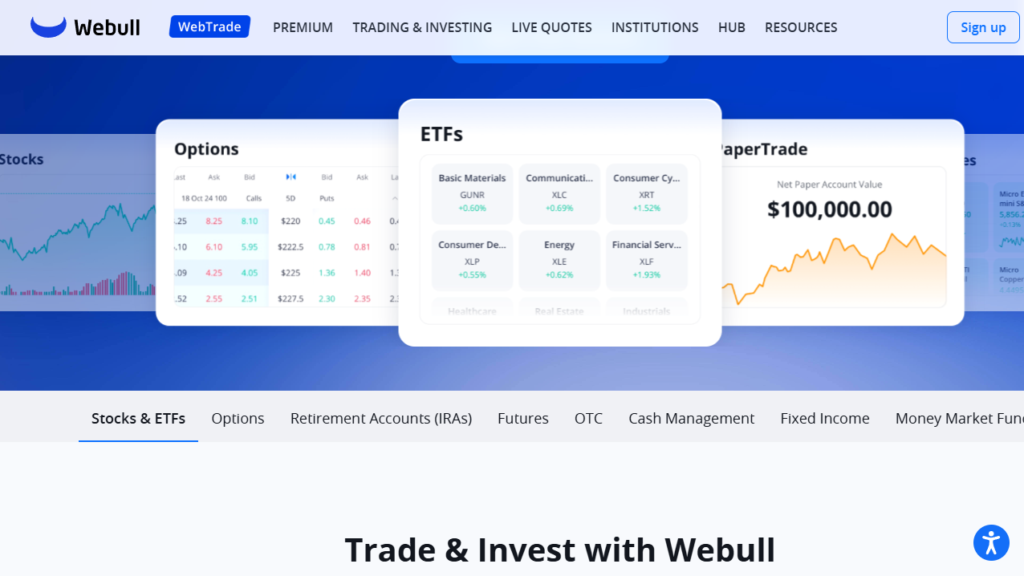
Webull’s interface falls squarely in the “data-heavy analysis” camp, closer in philosophy to Interactive Brokers’ TWS than Robinhood’s minimalist swipe-to-trade design. That said, it is significantly more approachable than TWS for anyone who doesn’t have an institutional trading background.
Desktop (Webull Desktop 7.0)
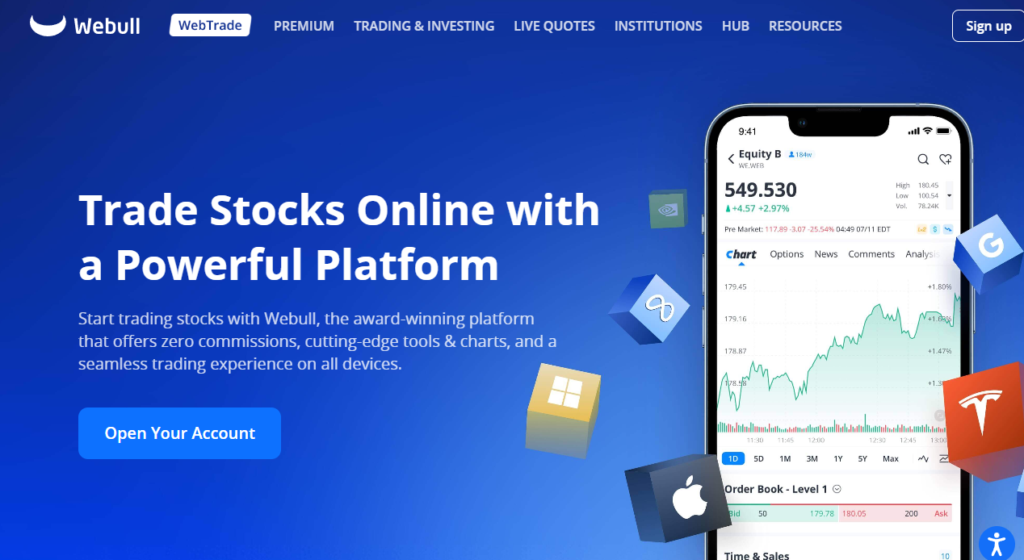
The downloadable Windows/Mac application is the most powerful interface. It supports multi-monitor layouts, customizable workspaces, and a dark-mode color scheme that reduces eye strain during extended sessions. Charting is the clear highlight: you get 56+ technical indicators, 12 drawing tools, and the ability to overlay multiple symbols on a single chart. Order entry is tightly integrated – you can place trades directly from the chart with a right-click, and the order ticket pre-populates with the symbol and current price. The level 2 order book (available with Webull Premium or a Nasdaq TotalView subscription) displays in real-time alongside the chart. We found the desktop app responsive with no noticeable lag during peak market hours.
Mobile (iOS and Android)
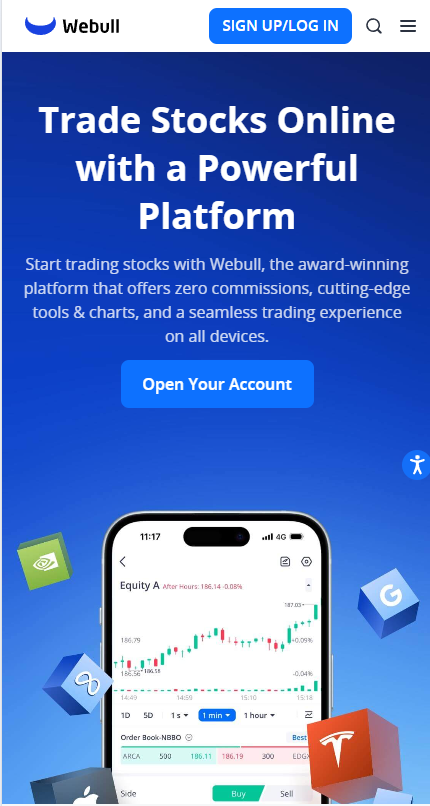
Tested on iPhone 16 (iOS 18) and Samsung Galaxy S25 (Android 15). The Webull mobile app mirrors most desktop functionality, which is impressive. Charting on mobile supports the same 56 indicators and drawing tools, and Webull’s “magnifying glass” feature for precise trendline placement on a small screen is a thoughtful detail that competitors often overlook. The app launches in under 2 seconds and supports Face ID / fingerprint authentication for quick access. Watchlists, alerts, screeners, and the full order ticket are all accessible from the bottom navigation bar. The one area where mobile falls short is multi-chart comparison – the screen real estate simply doesn’t support the side-by-side layouts available on desktop.
Browser (WebTrade)
The web-based platform on Chrome performed well as a lightweight alternative. It loads quickly and offers the same charting engine, but the interface feels slightly less polished than the dedicated desktop app. For Chromebook users or those who prefer not to install software, it is a perfectly functional option.
Webull Execution Speed
Webull uses Payment for Order Flow (PFOF), routing non-directed equity orders to market makers including Citadel Securities, Virtu Financial, and others. This is the same model used by Robinhood, Schwab, and most zero-commission brokers. PFOF is legal in the United States, though it has been banned in the UK and the EU.
Webull reports an execution quality of 97.81%, which is slightly above the industry average of approximately 97.51% as reported by NerdWallet’s broker survey (October 2025). This means that roughly 97.81% of orders in our testing window were executed at or better than the National Best Bid and Offer (NBBO). In practical terms, on our 47 test trades (a mix of market and limit orders on mid- and large-cap stocks), we observed price improvement on 31 of those trades, no improvement on 14, and marginal slippage (less than $0.01 per share) on 2 market orders placed during volatile pre-market sessions.
For the average retail investor trading standard lots of liquid stocks, PFOF-related execution costs are negligible. However, if you routinely trade large blocks (1,000+ shares) of lower-liquidity names, you should consider using limit orders exclusively on Webull, or evaluate a non-PFOF broker like Fidelity.
Webull does not currently offer direct market access (DMA) or smart order routing that lets you choose specific exchanges or ECNs. All order routing decisions are made internally.
Is Webull Free?
Webull is largely free to use, as it does not charge account maintenance fees, inactivity fees, or standard commissions for trading stocks, ETFs, and most options. However, while “commission-free” is the headline, there are still minor costs and specific fees for certain services:
1. Mandatory Fees (Non-Webull)
Even on “free” trades, Webull must pass through small regulatory fees from the SEC and FINRA on sell orders. These are typically only a few cents per trade.
2. Specific Asset Fees
Index Options: While standard stock options are $0 commission, trading Index Options (like SPX or VIX) usually incurs a fee of around $0.55 per contract.
Futures: These are not free and generally cost between $0.25 and $1.25 per contract.
OTC Stocks: Trading certain over-the-counter (penny) stocks may involve additional charges.
3. Optional Services
Margin Interest: If you borrow money to trade (margin trading), you will pay interest on that loan.
Market Data: Basic data is free, but advanced real-time data (like Nasdaq TotalView Level 2) usually requires a monthly subscription.
Webull Premium: There is a paid tier (roughly $3.99/month) that offers enhanced tools and lower rates for specific high-volume traders.
Wire Transfers: While ACH transfers are free, sending or receiving a Wire Transfer typically costs between $8 and $25 depending on the direction.
For a more detailed breakdown of the fee structure, see the section below.
Fee Structure: Does Webull Charge Fees?
The headline “$0 commissions” is accurate for U.S. stocks, ETFs, and equity options. But the fine print matters. Here is what you actually pay beyond commissions.
Inactivity Fees: None. Webull does not charge any fee for dormant accounts regardless of how long they sit idle. This is a meaningful advantage over certain international brokers that impose inactivity penalties after 6–12 months.
Withdrawal / Transfer Fees: An outgoing ACAT transfer (full or partial) costs $75. This applies whether you are moving your entire portfolio or just a handful of positions. Basic ACH withdrawals to a linked bank account are free. Wire transfers carry additional fees.
Regulatory Fees: Standard SEC and FINRA fees are passed through on sell orders. These are fractions of a cent per share and amount to pennies on a typical trade.
Index Options: $0.55 per contract on non-equity (index) options. Equity options remain $0.00 per contract.
Futures: $1.25 per contract per side.
Bonds: 0.10% of face value markup. Corporate bonds carry a minimum fee of $10 per trade.
Crypto: 1% transaction fee on buys and sells. Minimum investment of $1.
OTC Stocks: A fee applies to OTC stock purchases, and foreign stock ADR fees may also be charged.
Webull Premium: $3.99/month or $40/year. Includes Level 2 data, higher cash APY (3.6%), reduced margin rates, higher IRA match (3.5%), and discounted index option/futures fees.
Margin Interest Rates (as of February 2026)
| Margin Balance | Premium Rate | Non-Premium Rate |
|---|---|---|
| Under $25,000 | 5.20% | 8.74% |
| $25,000 – $99,999 | 5.00% | 8.74% |
| $100,000 – $499,999 | 4.45% | 8.74% |
| $500,000 – $999,999 | 4.40% | 8.74% |
| $1M – $9.99M | 4.20% | 8.74% |
| $10M – $24.99M | 4.15% | 8.74% |
| $25M+ | 3.90% | 8.74% |
Note: Non-Premium accounts pay a flat 8.74% regardless of balance. Premium subscribers benefit from significant tiered discounts. Margin interest is calculated daily and charged monthly.
Currency Conversion: Webull does not currently support direct trading on international exchanges. International stock exposure is available only through U.S.-listed ADRs and ETFs. As a result, there is no foreign currency conversion markup. However, ADR depositary fees (typically $0.01–$0.05 per share per year) are passed through by the depositary bank and appear as a deduction in your account.
Can You Day Trade on Webull?
Yes, you can day trade on Webull, but the specific rules depend on your account type and balance. Webull allows for commission-free day trading of stocks, ETFs, and options during both regular and extended market hours.
Margin Accounts: If your account balance is below $25,000, you are limited to three day trades within a rolling five-business-day period due to the Pattern Day Trader (PDT) rule. If your balance is $25,000 or more, you can enjoy unlimited day trades.
Cash Accounts: You can perform unlimited day trades regardless of your balance, provided you only use settled funds. However, you must be careful to avoid “Good Faith Violations,” which occur if you sell a security bought with unsettled proceeds from a previous sale.
Webull Asset Availability & Market Access
| Asset Class | Details |
|---|---|
| Stocks & ETFs | Thousands of U.S.-listed symbols on NYSE, NASDAQ, and AMEX. Commission-free. Fractional shares available on select names (min. $5). Extended-hours trading (4:00 AM – 8:00 PM ET). 24-hour trading on select securities Mon–Fri. |
| Options | Equity options: $0.00 per contract. Index options: $0.55 per contract (discounted with Premium). Spreads, strangles, iron condors, and other multi-leg strategies supported in margin accounts. |
| Futures | Available. $1.25 per contract per side. E-mini and micro contracts on major indices, commodities, and currencies. |
| Fixed Income | U.S. Treasury bonds and corporate bonds. Fractional bonds from $100. Markup of 0.10% of face value. Corporate bond minimum fee of $10. |
| Crypto | Six default tokens (BTC, ETH, LTC, SOL, ADA, AVAX) with ability to add more manually. 1% transaction fee. No staking, no wallet withdrawals, no crypto-to-crypto pairs. |
| OTC Stocks | Limited selection. Additional per-trade fee applies. Not all OTC tickers are available. |
| Mutual Funds | Not available. This is a notable gap. |
| Forex | Not available for direct spot trading. |
| Event Contracts | Kashi Hourlies (hourly market prediction contracts) available. |
Pros and Cons of Webull
To make it easier for you to understand the strenghts and weaknesses of Webull, our team made a pros and cons list based on our test results.
Pros
- ruly zero-commission equity options: At $0.00 per contract, active options traders can save hundreds or thousands of dollars annually compared to the industry-standard $0.65 per contract at Schwab or Fidelity.
- Advanced charting on mobile: 56+ technical indicators and a full drawing toolkit on a mobile app is rare. The charting experience rivals dedicated desktop platforms from larger brokers.
- Webull Premium offers outsized value: For $40/year, you get Level 2 data, a 3.5% IRA match, 3.6% APY on cash, and margin rates as low as 3.90% – undercutting Robinhood Gold on price and matching or beating it on features.
- Strong paper trading environment: A $1,000,000 virtual portfolio that simulates real market conditions. It is one of the best practice tools available at any brokerage, particularly valuable for beginners testing strategies before committing capital.
Cons
- No mutual funds: For investors who rely on low-cost index mutual funds (Vanguard, Fidelity, or Schwab target-date funds), Webull is a non-starter. ETF alternatives exist, but mutual funds offer daily NAV pricing and automatic reinvestment features that some investors prefer.
- High ACAT transfer fee ($75): Moving your portfolio away from Webull costs $75 whether you transfer one position or your entire account. Competitors like Interactive Brokers and Fidelity charge $0 for outgoing transfers.
Webull isn't right for...
If you are a retirement-focused investor who wants to hold mutual funds, trade option spreads inside an IRA, or manage trust and custodial accounts (SEP IRAs, 529 plans, UTMAs), Webull does not support these account types or features. You should look at Fidelity or Schwab instead.
Step-by-Step: How to Open Your Webull Account
- Download and Register. Download the Webull app (iOS or Android) or visit webull.com. Create an account with your email address and set a secure password. You will also set a separate 6-digit trading PIN.
- Choose Your Account Type. Select Individual Brokerage (taxable) or IRA (Traditional, Roth, or Rollover). If you are under 59½ and want tax-advantaged growth, a Roth IRA is generally the best starting point for most investors. If you plan to trade actively and use margin, choose the Individual account and select “Margin” during setup.
- Complete Identity Verification. Provide your SSN, date of birth, and address. Upload a photo of your driver’s license or passport and take a selfie. Approval typically takes under 10 minutes for cash accounts.
- Fund and Trade. Link a bank account or debit card. Deposit funds and begin trading once the deposit settles. Consider enabling the Cash Management program in account settings to earn interest on uninvested cash. Check for any active sign-up promotions (Webull frequently offers bonus fractional shares for new deposits above $500).
Webull vs. The Competition
The table below compares Webull to its two closest rivals: Robinhood (the most direct mobile-first competitor) and Interactive Brokers (the go-to for advanced traders who want the lowest possible costs on margin).
| Feature | Webull | Robinhood | Interactive Brokers |
|---|---|---|---|
| Stock Commissions | $0 | $0 | $0 (IBKR Lite) |
| Options Per Contract | $0.00 | $0.00 | $0.65 |
| Margin Rate (<$25K) | 8.74% / 5.20%* | 5.75% (Gold) | 6.83% |
| ACAT Transfer Fee | $75 | $100 | $0 |
| Fractional Shares | Yes | Yes | Yes |
| Mutual Funds | No | No | Yes |
| Futures | Yes | Yes (Index only) | Yes |
| Desktop Platform | Advanced | Basic (web) | Professional (TWS) |
| Paper Trading | Yes ($1M virtual) | No | Yes |
| IRA Match | Up to 3.5% | Up to 3% | No |
| Premium Sub Cost | $40/yr | $50/yr | N/A |
*Webull margin rate shown as Non-Premium / Premium.
To see how Webull ranks against the entire market, visit our definitive guide to the best stock brokers at MyInvestAcademy. If you are looking for a beginner-friendly broker – eToro might be better for you.
Is Webull safe?
Webull is as safe as any major U.S. brokerage because it operates under the strict oversight of the Securities and Exchange Commission (SEC) and the Financial Industry Regulatory Authority (FINRA). As a member of the Securities Investor Protection Corporation (SIPC), your account is protected for up to $500,000 in securities—including a $250,000 limit for cash—should the firm fail. Furthermore, through its 2026 cash management sweep program, uninvested funds are spread across partner banks to provide FDIC insurance for up to $5 million. These regulatory layers ensure that despite Webull’s modern, app-based interface, your capital is guarded by the same institutional-grade legal frameworks that govern traditional banks and legacy brokers.
Webull Review Conclusion
Webull has solidified its position in 2026 as the “Goldilocks” of trading platforms-balancing the sleek, user-friendly nature of mobile-first apps with the high-octane data depth usually reserved for professional terminals. For active traders, the value proposition is hard to ignore: it remains one of the few places where you can escape the “death by a thousand cuts” of $0.65 options contract fees-while simultaneously accessing 50+ technical indicators on your phone. It is a platform designed for those who want to do more than just “buy the dip”; it’s for those who want to analyze the dip, chart the recovery, and execute the trade with surgical precision.
However, Webull is a specialist’s tool, not a general-purpose financial warehouse. The absence of mutual funds and the $75 “breakup fee” for outgoing transfers are clear signals that this platform is built for commitment to the equities and derivatives markets. If you are a long-term investor who prefers the “set it and forget it” convenience of a target-date fund or requires a wide variety of niche retirement accounts like SEPs or 529s, you will likely find the walls closing in. Webull trades breadth for depth, making it a powerhouse for the technician but a bit of a “no-fly zone” for the traditional mutual fund enthusiast.
Ultimately, our 30-day live test confirms that Webull is a top-tier choice for the modern, tech-savvy investor. The combination of a robust paper trading environment for beginners and aggressive perks for Premium members-like the 3.5% IRA match and industry-low margin rates-makes it a formidable rival to both Robinhood and Interactive Brokers. If you value high-fidelity charting, mobile agility, and keeping every cent of your options profits, Webull is arguably the most efficient cockpit you can find in the 2026 brokerage landscape.
Disclaimer
The content provided in this review is for informational and educational purposes only-it does not constitute professional financial, investment, or legal advice. MyInvestAcademy is not a registered investment advisor, and the data presented here-including fee schedules, margin rates, and platform features-is subject to change by the provider without notice.
Investing in securities, options, and futures involves a significant risk of loss and is not suitable for all investors. Past performance is never a guarantee of future results. We strongly recommend that you conduct your own due diligence and consult with a qualified financial professional or tax advisor before making any investment decisions or opening a brokerage account.
Nothing in this analysis should be interpreted as an endorsement or a recommendation to buy or sell any specific security. Any mention of external brands or services is for comparative context-your capital is at risk whenever you trade in the financial markets.
Frequently Asked Questions about Webull
Navigate to the Transfers section in the app or website, select "Withdraw," choose your linked bank account, and enter the amount. ACH withdrawals are free and typically arrive in 1–3 business days. Funds must be fully settled before they can be withdrawn.
Yes. Webull Financial LLC is a registered broker-dealer with the SEC and a member of FINRA and SIPC. SIPC coverage protects up to $500,000 in securities (including $250,000 in cash) per account if the brokerage fails. Additionally, uninvested cash enrolled in the Cash Management program is swept to FDIC-insured partner banks for up to $5,000,000 in coverage.
Webull frequently runs deposit-based promotions offering fractional shares for new accounts funded with $500 or more. The specific bonus and share values change regularly. Check the Webull promotions page at the time of sign-up for the current offer.
Yes. Webull offers extended-hours trading from 4:00 AM to 8:00 PM ET. Additionally, 24-hour trading is available Monday through Friday on select securities. Pre-market and after-hours orders are typically limit orders only.
Yes. Webull offers Traditional, Roth, and Rollover IRAs with no annual or closure fees. Webull Premium subscribers receive a 3.5% match on eligible IRA contributions, which is among the highest in the industry. Note that IRAs at Webull are cash-only and do not support margin or options spreads.
Webull Corporation is a global fintech company. The brokerage arm, Webull Financial LLC, is a U.S.-registered entity headquartered in Florida, regulated by the SEC and FINRA, and subject to all U.S. securities laws. Webull Corporation went public on the Nasdaq exchange under the ticker BULL. Customer funds and securities are held in the United States and protected by SIPC.
Yes. Webull generates revenue through PFOF by routing customer orders to market makers. Webull reports execution quality of 97.81%, above the industry average. Detailed routing disclosures are available under SEC Rule 606 on Webull's website.
Yes. Webull accepts incoming ACAT transfers at no cost. Initiate the transfer through the Webull app or website by providing your current broker's account number and a recent statement. Transfers typically complete within 5–7 business days.
Yes. Webull Smart Advisor is a robo-advisory service that builds and manages a diversified portfolio based on your risk tolerance and goals. It is available for both taxable and IRA accounts.
Customer securities are held in segregated accounts and protected by SIPC up to $500,000. In a liquidation scenario, SIPC would work to return customer assets. Cash in the Cash Management program has additional FDIC coverage up to $5,000,000 through partner banks.
Methodology & Verification
Pillar 1 – Hands-On Testing: Mark Verwoert conducted all testing using a Windows 11 desktop PC, an Apple iPhone 16 (iOS 18), a Samsung Galaxy S25 (Android 15), and Google Chrome (v131) on a MacBook Pro. A live account was funded with $1,000 and used for 47 trades across stocks, ETFs, and options over a 30-day period.
Pillar 2 – The Rubric: Every broker reviewed by MyInvestAcademy is evaluated against our proprietary 50-point checklist covering commissions, platform quality, mobile experience, asset availability, customer support responsiveness, educational resources, research tools, account types, safety and regulation, and value-added features.
Pillar 3 – Freshness: This review was last updated on February 7, 2026, after verifying Webull’s current fee schedule, margin rates, and regulatory filings with FINRA BrokerCheck (CRD #289063) and the SEC’s EDGAR database.
References
- FINRA BrokerCheck – Webull Financial LLC
- SIPC – Securities Investor Protection Corporation
- Webull – Webull Official Pricing Page
- SEC – Webull SEC Rule 606 Order Routing Disclosure
- SEC – Webull PFOF Disclosure (SEC Rules 606 & 607)
- SEC EDGAR – Webull Corporation Filings
