
-
Mark Verwoert
- Last updated: August 29, 2026
Educational Disclaimer: The content on myinvestacademy.com is for educational and informational purposes only. We are not licensed financial advisors, and nothing in this article should be interpreted as professional investment, legal, or tax advice. Investing involves risk of loss. Always consult with a professional before making financial decisions.
Best S&P 500 ETFs in 2026: VOO vs SPY vs IVV Compared
The S&P 500 has delivered average annual returns of around 10% over nearly 90 years. Buying into it through a low-cost ETF is one of the most straightforward wealth-building strategies available to any retail investor. But there are dozens of S&P 500 ETFs on the market, and picking the wrong one can cost you more than you realise, especially over a 20 or 30-year holding period.
This guide covers the five best S&P 500 ETFs available right now: VOO, IVV, SPY, SPLG, and RSP. We explain how we selected them, give an honest review of each one, compare them side by side, and answer the questions we see asked most often by investors.
How We Select the Best S&P 500 ETFs
Not all S&P 500 ETFs are equal. They track the same index, but differences in fees, fund structure, liquidity, and tax efficiency can meaningfully affect your real-world returns. Here is what we look at before recommending any fund.
Expense Ratio
The expense ratio is the annual fee a fund charges, expressed as a percentage of your investment. It is deducted automatically from the fund’s performance each year. At $10,000 invested, a 0.03% expense ratio costs you $3 per year. A 0.0945% ratio costs $9.45. That gap looks small until you compound it over three decades. We prioritise ETFs with expense ratios below 0.10%.
Assets Under Management (AUM)
A fund with higher AUM is less likely to close, easier to trade, and signals broader institutional trust. Every ETF on this list now holds more than $85 billion in assets. VOO alone had close to $1 trillion in ETF net assets by July 2026, making it the largest fund in this comparison.
Liquidity
Liquidity determines how easily you can buy or sell shares without affecting the price. It shows up in the bid-ask spread: the tighter the spread, the less you lose on each trade. SPY remains by far the most actively traded fund in this comparison and has the deepest options market. IVV and VOO are also highly liquid for retail investors, while SPYM and RSP are generally better suited to buy-and-hold investing than frequent trading.
Tracking Difference
Tracking difference measures how closely an ETF replicates the actual S&P 500 return. A lower tracking difference is better. IVV is consistently rated as the closest tracker among the three major funds. A fund with poor tracking can quietly drag your returns even if its expense ratio looks competitive.
Fund Structure and Tax Efficiency
SPY operates as a Unit Investment Trust (UIT). Under this structure, dividends paid by underlying holdings cannot be reinvested back into the fund. They sit in cash until a quarterly distribution. This creates a small but real cash drag on performance. VOO and IVV are open-end funds, which means they can reinvest dividends immediately and engage in securities lending for additional income. For long-term, taxable account investors, this structural difference matters.
Share Price and Accessibility
Share price matters less than it once did because many brokers now support fractional shares. For investors who still buy whole shares, however, there is a meaningful difference. VOO currently trades around $710 per share and SPY around $770, while SPYM trades closer to $90. That makes SPYM easier to buy in smaller increments without fractional investing.
Top 5 Best S&P 500 ETFs
The funds below were selected based on expense ratio, AUM, liquidity, fund structure, and tracking precision. Four of them track the S&P 500 in the traditional market-cap weighted way. One takes a different approach worth knowing about. All five are accessible through standard brokerage accounts with no minimum investment beyond the share price.
1. VOO: Vanguard S&P 500 ETF
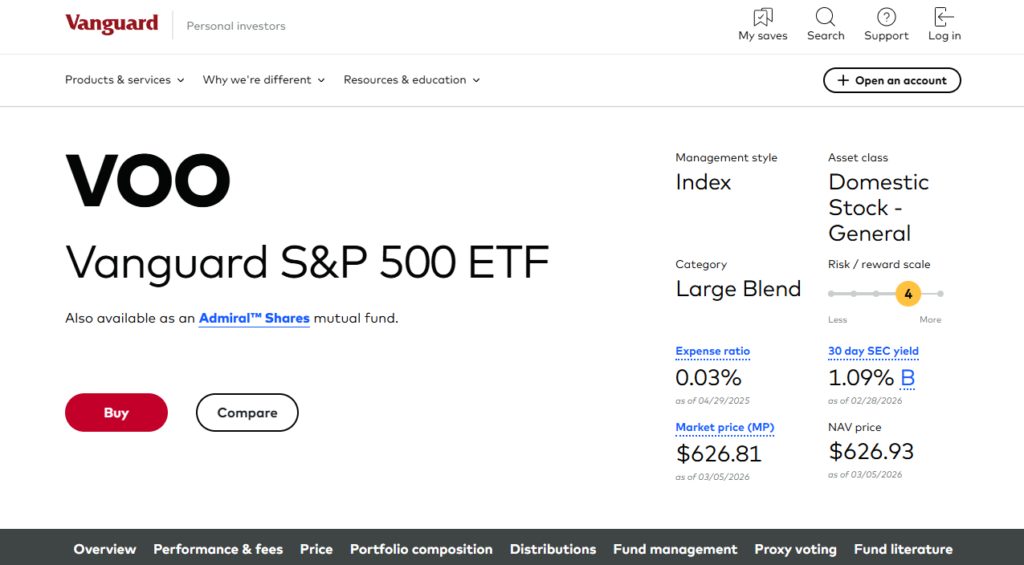
VOO is the most recommended S&P 500 ETF (and the overall best ETF to buy) for long-term retail investors, and it is easy to see why. Launched by Vanguard in 2010, VOO had approximately $997 billion in ETF net assets by July 2026. Its expense ratio remains just 0.03%, meaning you pay $3 per year on every $10,000 invested.
Vanguard operates under a unique investor-owned model. There are no external shareholders to satisfy, which structurally aligns the company’s interests with those of fund holders. As an open-end fund, VOO reinvests dividends automatically and can participate in securities lending, both of which contribute to tighter tracking and marginally better long-run performance versus SPY. Morningstar awards VOO its top Gold Medalist rating. Since inception, VOO has delivered an annualised return of approximately 14.9% through July 2026, closely tracking the performance of its benchmark after fees.
Pros:
- Industry-lowest expense ratio at 0.03%, tied with IVV
- Largest S&P 500 ETF in this comparison with close to $1 trillion in net assets
- Open-end fund structure with dividend reinvestment and securities lending
- Morningstar Gold Medalist rating
- Investor-owned structure through Vanguard’s unique model
Cons:
- Lower daily trading volume than SPY, less suitable for active traders or options strategies
- Holdings only updated monthly rather than daily
- Share price around $710 may make fractional shares useful for smaller investors
2. IVV: iShares Core S&P 500 ETF
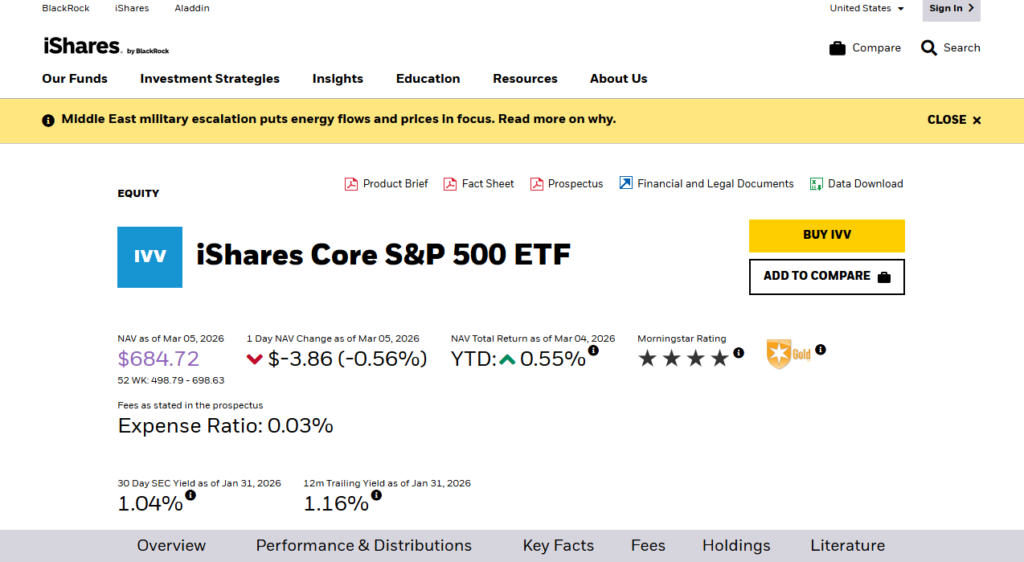
IVV is managed by BlackRock, the world’s largest asset manager, with approximately $15.3 trillion under management as of June 2026. It has tracked the S&P 500 since 2000 and currently holds around $887 billion in assets. Its expense ratio matches VOO at 0.03%, and it operates as an open-end fund with dividend reinvestment and securities lending.
Where IVV stands out is tracking precision. It is consistently cited as having the tightest tracking difference relative to the actual S&P 500 index, which matters when the whole point of the fund is to replicate the index as closely as possible. IVV also updates its holdings daily, which gives it a transparency edge over VOO’s monthly updates. For investors using a taxable brokerage account, IVV’s potential capital gains exposure sits at just 2%, making it one of the most tax-efficient S&P 500 ETFs available.
Pros:
- 0.03% expense ratio, identical to VOO
- Tightest tracking difference of the three main S&P 500 ETFs
- Daily holdings transparency
- Strong tax efficiency in taxable accounts
- Open-end fund with dividend reinvestment and securities lending
Cons:
- Smaller AUM than VOO at roughly $887 billion, though still one of the largest ETFs in the world
- Managed by a for-profit firm, unlike Vanguard’s investor-owned structure
- Less name recognition among casual retail investors than VOO or SPY
3. SPY: SPDR S&P 500 ETF Trust
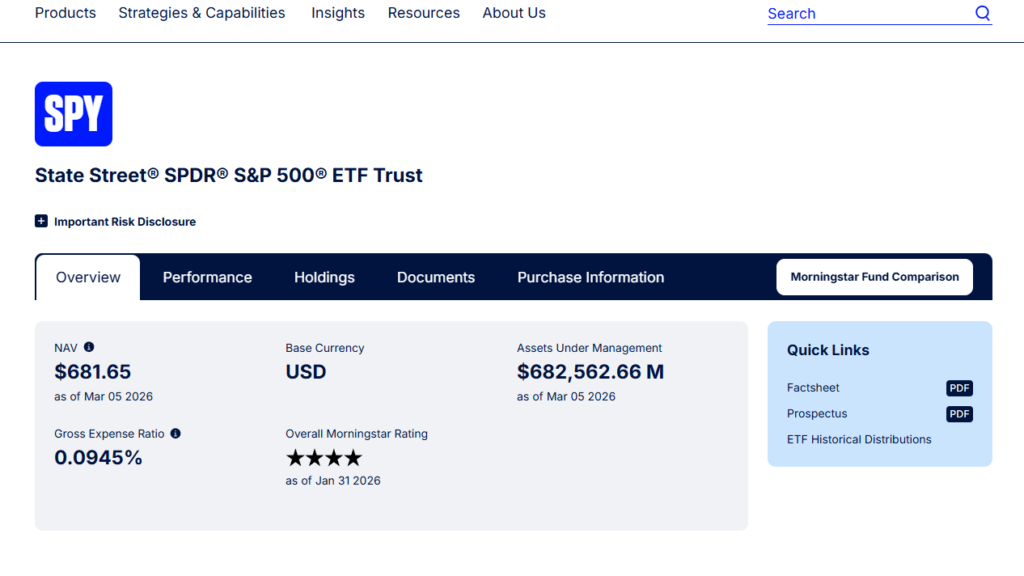
SPY is the original. It launched in January 1993 as the very first US-listed ETF, and it has been the most traded ETF in the world ever since. With average daily dollar volume exceeding $62 billion, SPY’s liquidity is in a different class from everything else on this list. That makes it the go-to for institutional investors, hedge funds, and anyone running options strategies or needing to move large positions quickly.
SPY still holds more than $800 billion in assets, making it one of the largest ETFs in the world. It has nevertheless been overtaken by both VOO and IVV in assets, as long-term investors have increasingly favoured lower-cost alternatives.
Pros:
- Highest liquidity of any ETF in the world, averaging $62 billion in daily dollar volume
- The deepest options market of any ETF, essential for hedging and income strategies
- Over 30 years of track record
- Tight bid-ask spreads enable large trades with minimal slippage
- Available on every major brokerage platform
Cons:
- Expense ratio of 0.0945%, more than three times higher than VOO or IVV
- UIT structure prevents dividend reinvestment and securities lending
- Long-term holders give up a meaningful amount in fees over decades
- Has lost its AUM ranking to both VOO and IVV due to the fee disadvantage
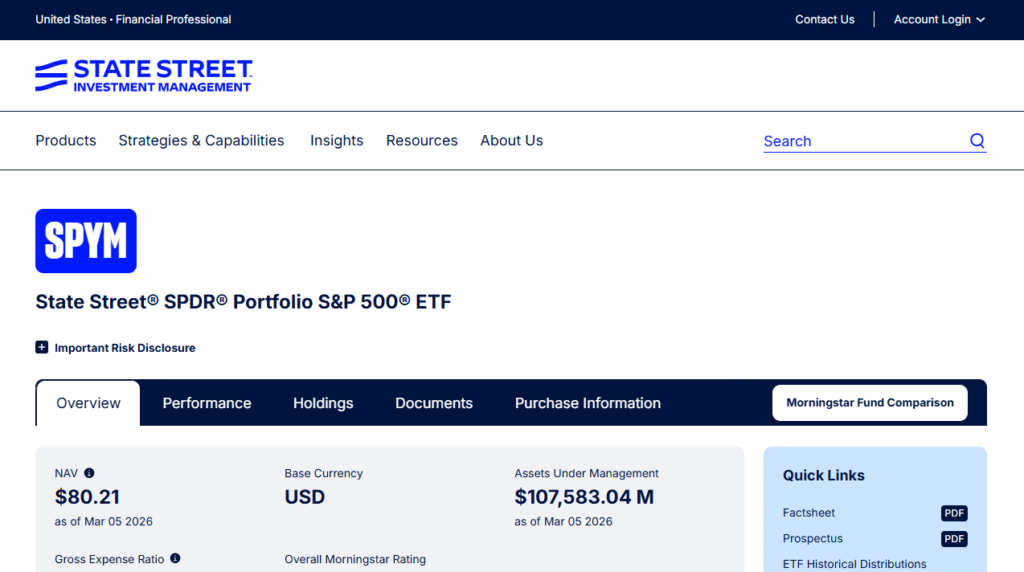
4. SPYM: SPDR Portfolio S&P 500 ETF
5. RSP: Invesco S&P 500 Equal Weight ETF
SPYM is one of the most overlooked ETFs in the S&P 500 category. Also managed by State Street Global Advisors, it tracks the exact same index as SPY but operates as an open-end fund at a dramatically lower cost. At 0.02%, SPYM has the lowest expense ratio of any major S&P 500 ETF on the market.
SPYM is also considerably more accessible on a per-share basis, trading around $90 compared with roughly $710 for VOO and $770 for SPY. That can be useful for investors whose brokers do not support fractional shares. The fund has also grown rapidly, with assets under management reaching roughly $171 billion by August 2026.
Pros:
- Lowest expense ratio of any major S&P 500 ETF at 0.02%
- Lower share price of around $90, useful for investors without fractional share access
- Open-end fund structure with dividend reinvestment, unlike SPY
- Identical index exposure to SPY at significantly lower cost
- Growing AUM and increasing community recognition
Cons:
- Lower daily trading volume than VOO, IVV, or SPY
- Thin options market relative to SPY
- Smaller AUM than VOO, IVV, or SPY, although the fund has grown to around $171 billion
- Less established brand recognition
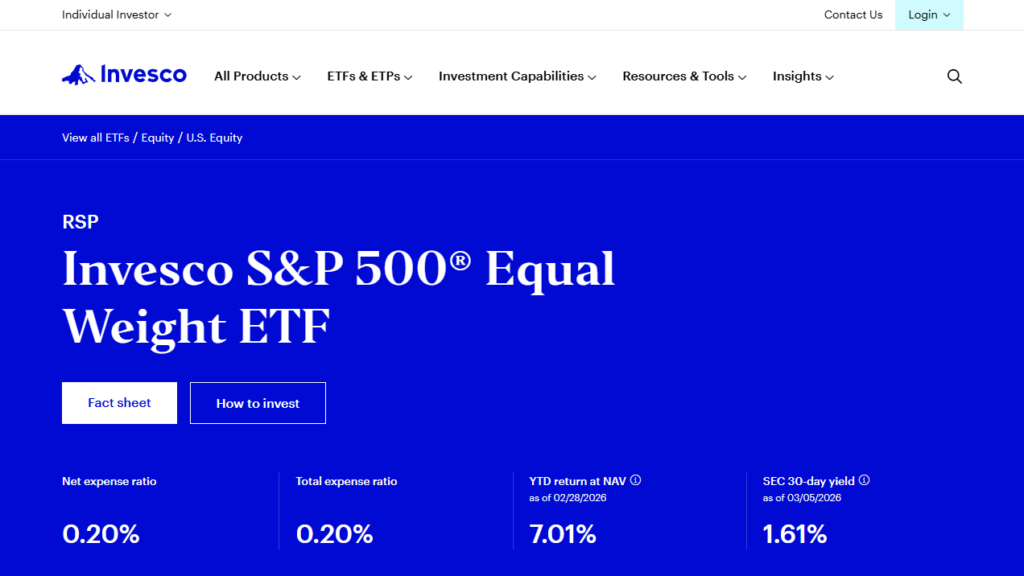
RSP takes a fundamentally different approach to S&P 500 investing. Instead of weighting companies by market capitalisation, it assigns roughly equal weight (around 0.2%) to all 500 companies in the index. Apple and a mid-cap industrial company carry the same importance in the fund.
The reason this matters is concentration. In August 2026, Nvidia, Apple, Microsoft, Amazon, and Alphabet together represented roughly 30% of a standard cap-weighted S&P 500 fund when both Alphabet share classes are included. Buying VOO or SPY therefore places a significant part of your investment in just a handful of mega-cap companies. RSP reduces that concentration by giving each S&P 500 constituent roughly equal weight. It has historically performed particularly well during periods when market leadership broadens beyond the largest companies.
Pros:
- Eliminates mega-cap tech concentration (top 5 stocks represent ~30% of standard S&P 500 ETFs)
- True equal-weight diversification across all 500 companies
- Has historically outperformed cap-weighted ETFs during certain long-term periods
- Useful hedge against tech-driven downturns
- More than $85 billion in AUM, making it well-established and liquid
Cons:
- Highest expense ratio on this list at 0.20%, significantly above cap-weighted peers
- Underperforms during strong mega-cap tech rallies
- Frequent rebalancing can create additional tax drag in taxable accounts
- Returns differ from the standard S&P 500 benchmark, which some investors find confusing
S&P 500 ETF Comparison Table
| ETF | Ticker | Share Price (approx.) | Expense Ratio | AUM | Avg. Daily Volume | Best For |
|---|---|---|---|---|---|---|
| Vanguard S&P 500 ETF | VOO | ~$710 | 0.03% | ~$997B | High | Long-term investors |
| iShares Core S&P 500 ETF | IVV | ~$773 | 0.03% | ~$887B | High | Long-term / Tax-conscious |
| SPDR S&P 500 ETF | SPY | ~$770 | 0.0945% | ~$816B | Highest | Active traders / Options |
| SPDR Portfolio S&P 500 ETF | SPYM | ~$90 | 0.02% | ~$171B | Moderate | Budget-conscious beginners |
| Invesco S&P 500 Equal Weight ETF | RSP | ~$221 | 0.20% | $85B+ | Moderate | Diversification-focused investors |
P.S. If you are looking for income focused ETFs, make sure to check out our best dividend ETFs guide.
What You Need to Know Before You Invest
Choosing between these ETFs is straightforward once you understand a few structural differences. The fees, fund types, and concentration dynamics below are what actually separate these funds in practice, not the index they track.
Is the S&P 500 Still Diversified?
This is one of the most debated questions in retail investing communities right now, and it is a fair one. Nvidia, Apple, Microsoft, Amazon, and Alphabet currently account for roughly 30% of a standard S&P 500 fund when both Alphabet share classes are included. That means a significant part of every dollar invested in VOO or SPY is concentrated in just five mega-cap companies. The S&P 500 still provides exposure to hundreds of businesses across every major sector, but its performance is increasingly influenced by a relatively small group at the top.
The fee Difference is Bigger than it Looks
A 0.06% difference in expense ratio sounds negligible, but it becomes more meaningful over several decades. Take $100,000 invested for 30 years with an assumed gross annual return of 10%. At a 0.03% expense ratio, the investment would grow to roughly $1.73 million. At SPY’s 0.0945% expense ratio, it would be closer to $1.70 million. The difference is roughly $30,000 over the period. For most long-term investors, VOO or IVV therefore have a clear cost advantage.
You Do Not Need More than One S&P 500 ETF
A recurring question on investing forums is whether to hold both VOO and SPY, or VOO and IVV together. In most cases, there is little reason to do so. They track the same companies with almost identical weightings, so combining them adds virtually no diversification. Pick one based on costs, liquidity and fund structure. If you want genuine diversification beyond the S&P 500, international equities, small-cap stocks or other asset classes are more meaningful additions than a second fund tracking the same index.
SPY's Structure is a Real Disadvantage for Long-Term Holders
SPY was created as a Unit Investment Trust in 1993. Under that structure, dividends paid by the underlying 500 companies cannot be reinvested into the fund. They accumulate in cash until the next quarterly distribution. During that wait, that cash earns nothing. For a trader holding SPY for a few days or weeks, this is irrelevant. For someone holding for 20 years, it creates a measurable performance drag versus VOO or IVV, where dividends get reinvested immediately.
Conclusion
For most investors, the choice comes down to two funds: VOO or IVV. Both charge 0.03% annually, both are open-end funds, and both closely track the actual S&P 500 index. VOO has the advantage of scale and Vanguard’s unique ownership model. IVV has a slight edge in tracking precision and daily holdings transparency.
If you trade actively or use options, SPY remains the strongest choice because of its exceptional liquidity and options market. If you are starting with less capital and do not have access to fractional shares, SPYM provides the same core S&P 500 exposure at a 0.02% expense ratio and a much lower share price.
RSP belongs in a portfolio where you want genuine equal-weight diversification and are comfortable with a higher fee and returns that differ from the headline S&P 500 number.
One ETF is enough. Pick one that fits your situation, buy regularly, and let time do the work.
Share prices and AUM figures were updated in August 2026 using data from the respective fund providers. These figures change over time and should be checked against the latest issuer data. This article is for informational purposes only and does not constitute investment advice.
Frequently Asked Questions
For long-term, buy-and-hold investors, VOO and IVV are the top picks. Both charge 0.03% annually, operate as open-end funds, and reinvest dividends automatically. Morningstar rates VOO its highest Gold Medalist. IVV offers marginally tighter tracking to the actual index and daily holdings transparency. In practice, the difference between them is minimal over time. Either will closely match the S&P 500's long-run average return of around 10% per year while keeping costs near zero. If you use Vanguard as your primary brokerage, VOO makes the most sense. If you use most other platforms, IVV is equally strong.
All three track the same S&P 500 index and hold the same 500 companies in the same proportions. The differences come down to fees, fund structure, and liquidity. VOO and IVV charge 0.03% per year. SPY charges 0.0945%, which is more than three times higher. SPY is a Unit Investment Trust, which prevents it from reinvesting dividends or lending securities. VOO and IVV are open-end funds, making them more efficient for compounding over time. SPY's one genuine advantage is liquidity: with over $62 billion in average daily dollar volume, it is the dominant instrument for active traders and anyone running options strategies.
For most retail investors, VOO is the better long-term choice. The lower expense ratio and more efficient fund structure mean more of your return stays in your account over time. If you actively trade S&P 500 ETFs, use options, or need to move large positions in and out quickly, SPY is the right tool because nothing else comes close to its liquidity and options market depth. If you are a passive investor who buys regularly and plans to hold for years, the case for paying SPY's higher fee is weak.
No, holding VOO alongside SPY or IVV gives you virtually no additional diversification because the funds own essentially the same companies at the same weightings. One S&P 500 ETF is generally sufficient. If you want to diversify beyond the S&P 500, consider an international equity ETF, a total market fund or exposure to another asset class rather than adding a second S&P 500 tracker.
Around 0.02% to 0.03% is excellent for a long-term S&P 500 ETF. SPYM charges 0.02%, while VOO and IVV both charge 0.03%.
Yes, but it is increasingly concentrated in a small number of mega-cap companies. The index still provides exposure to around 500 companies across all major US sectors.
You can buy an S&P 500 ETF through most standard brokerage accounts by searching for a ticker such as VOO, IVV, SPY, SPYM or RSP. Many brokers also allow fractional-share investing if you do not want to buy a full share.
References
- S&P 500 Index data – (S&P Dow Jones Indices)
- VOO fund data – (Vanguard)
- ETF research and fund data – (Morningstar)
- IVV fund data – (BlackRock)
- SPY fund data – (State Street Global Advisors)
- SPYM fund data – (State Street Global Advisors)
- RSP fund data – (Invesco)
