
-
Mark Verwoert
- Last updated: March 25, 2026
The information provided on MyInvestAcademy is for educational and informational purposes only and should not be construed as individualized investment, financial, legal, or tax advice. We are not financial advisors, and the content presented does not take into account your specific financial situation, risk tolerance, or investment objectives.
Income Investing 2026: The Ultimate Guide to Building a Cash-Flow Portfolio
Building wealth isn’t just about watching a number on a screen go up; it is about creating a stream of cash that lands in your account like clockwork. Whether you are decades away from leaving the workforce or counting down the final months, income investing offers a strategic path to financial stability. Instead of relying solely on selling assets to fund your life, you focus on assets that pay you just for holding them.
In this fixed income investing guide of 2026, we will share different income investing strategies for people that are building towards (early) retirement as well as people about to retire. You will learn exactly how to construct a portfolio that prioritizes cash flow, how to balance yield with safety, and which platforms offer the best tools to execute your strategy.
Table of Contents
What is Fixed Income Investing?
Fixed income investing is a strategy focused on preserving capital and income generation. Ideally, it involves investing in assets that provide a steady stream of cash flow at regular intervals. While the term traditionally referred strictly to bonds-where the income (interest) was “fixed” at a specific rate-modern investors use the term more broadly to describe any investment strategy where the primary goal is reliable, recurring payouts rather than just capital appreciation. This approach shifts the focus from “how much is my portfolio worth?” to “how much money does my portfolio pay me this month?”
Common examples of this strategy include dividend stocks and income / dividend ETFs. Dividend stocks represent shares in companies that distribute a portion of their profits to shareholders, effectively rewarding you for being a partial owner. Income ETFs (Exchange Traded Funds) bundle hundreds of these dividend-paying stocks or bonds into a single basket, offering instant diversification. While these are the most popular entry points, there are more advanced strategies involving real estate and bond structures which we will discuss later in this guide.
For Whom is Income Investing Suitable?
This strategy is not reserved solely for retirees looking to replace their salary. In fact, prioritizing cash flow can be a powerful accelerator for investors at every stage of their financial journey. By focusing on assets that generate returns regardless of market sentiment, you build a safety net that reduces reliance on favorable market conditions when you need cash.
Income investing is suitable for:
Retirees: Individuals who need to replace their monthly paycheck with investment income to cover living expenses without depleting their principal balance too quickly.
FIRE (Financial Independence, Retire Early) Seekers: Aggressive savers who want to build a “passive paycheck” that covers their basic needs, allowing them to retire decades ahead of schedule.
Conservative Investors: Those with a lower risk tolerance who prefer the tangible return of regular cash payments over the volatility of high-growth speculative stocks.
Compounders: Younger investors who do not need the income today but reinvest every cent of dividends and interest to accelerate the compounding effect, turning a small portfolio into a massive income engine over time.
Top 5 Best Income Investing Strategies
There is no “one size fits all” approach to generating cash flow. The best income investing strategies depend entirely on your timeline, risk tolerance, and tax situation. Below, we break down the five most effective methods used by professional investors to generate consistent returns.
1. Dividend Yield Investing
This strategy is the classic approach for investors who need their portfolio to pay the bills right now. It prioritizes maximizing current cash flow over future growth, making it a favorite among retirees.
What is Dividend Yield Investing?
Dividend yield investing is the most straightforward form of generating cash flow from the stock market. The primary metric here is the “dividend yield”—the percentage of a company’s share price that it pays out in dividends each year. Investors utilizing this strategy actively seek out companies with high yields, often ranging from 4% to 8% or more. These are typically mature, slow-growing companies in sectors like utilities, telecommunications, or energy, where there is little need for massive reinvestment into the business, allowing them to return the bulk of their profits to shareholders.
Pros
Immediate Income: You generate significant cash flow right away, which is ideal for those currently living off their portfolio.
Tangible Returns: You get paid regardless of whether the stock price goes up or down.
Value Discipline: High yields often signal that a stock is undervalued relative to its cash flow.
Lower Volatility: High-yield sectors (like utilities) tend to be less volatile than the broader tech-heavy market.
Psychological Ease: Receiving regular payments helps investors stay the course during bear markets.
Cons
Yield Traps: A suspiciously high yield can indicate a company in distress that is about to cut its dividend.
Low Growth: Companies paying out all their cash rarely see significant stock price appreciation.
Tax Inefficiency: High dividends can create a substantial tax drag if held in a standard brokerage account.
Expert Tip
Never judge a stock by its yield alone. Always check the “Payout Ratio”- the percentage of earnings paid out as dividends. If a company is paying out more than 80% of its earnings (or 100%!), that dividend is at high risk of being cut. A healthy payout ratio for most stocks is between 40% and 60%. Ofcourse, there are exceptions like REITS who payout the majority of their profits in dividend in exchange for tax benefits.
2. Dividend Growth Investing
Perfect for long-term wealth builders, this strategy focuses on companies that consistently raise their payouts. It is designed to protect your future purchasing power against inflation rather than providing maximum income today.
What is Dividend Growth Investing?
Unlike yield investing, dividend growth investing focuses on companies with a history of increasing their payouts every year, even if the current yield is low (often 1% to 2.5%). These are typically high-quality companies with strong competitive advantages—often referred to as “Dividend Aristocrats” or “Dividend Kings.” The goal is not massive income today, but a paycheck that grows faster than inflation, protecting your purchasing power over decades.
Pros
Inflation Hedge: As the company raises dividends, your income stream keeps up with or exceeds the cost of living.
Capital Appreciation: These companies are often growing earnings, leading to rising stock prices alongside rising dividends.
Safety: Companies with 25+ years of dividend hikes usually have robust, recession-resistant business models.
Compound Effect: Reinvesting growing dividends creates a “snowball effect” that accelerates wealth building.
Lower Cut Risk: These companies prioritize maintaining their streak, making a dividend cut less likely than with high-yield stocks.
Cons
Low Starting Yield: You need a larger portfolio to generate significant income immediately compared to yield investing.
Overvaluation: Popular dividend growth stocks often trade at premium valuations (high P/E ratios).
Patience Required: This strategy takes 5-10 years to truly outperform high-yield strategies.
Expert Tip
Look for the “Chowder Rule” score. Add the current dividend yield to the 5-year dividend growth rate. If the total is 12 or higher (for example, a 3% yield + 9% annual growth), it is generally considered a strong candidate for a dividend growth portfolio.
3. Income ETFs
If you prefer a hands-off approach, Income ETFs offer instant diversification across hundreds of dividend-paying assets with a single trade. This eliminates the need to research individual companies while still providing a steady paycheck.
What are Income ETFs?
For investors who prefer a “set it and forget it” approach, Income Exchange Traded Funds (ETFs) are the solution. Instead of picking individual stocks, you buy a single fund that holds hundreds or thousands of income-generating assets. These can be “Dividend Appreciation” ETFs, “High Yield” ETFs, or even “Multi-Asset” income funds that mix stocks and bonds. They automatically rebalance and handle the complex selection process for a small annual fee.
Pros
Instant Diversification: You eliminate the risk of a single company blowing up your portfolio.
Low Maintenance: No need to read quarterly earnings reports or analyze balance sheets.
Liquidity: You can buy and sell them instantly during market hours, just like stocks.
Transparency: You can see exactly what the fund holds every single day.
Automatic Rebalancing: The fund manager removes “losers” and adds “winners” automatically.
Cons
Expense Ratios: You pay an annual management fee (ranging from 0.06% to 0.75%) which eats into returns.
Average Returns: You will never beat the market; you will simply match the average of the index.
Lack of Control: You cannot exclude specific companies you might dislike for ethical reasons.
Expert Tip
Check the “SEC 30-day Yield” rather than the “Trailing 12-month Yield” when analyzing an ETF. The SEC yield is a more accurate standardized measure of what the fund is earning right now, giving you a realistic expectation of future income.
4. Real Estate Investment Trusts (REITS)
REITs allow you to tap into the lucrative cash flow of commercial real estate without the headaches of being a landlord. Because these companies must distribute most of their income by law, they often offer some of the highest yields in the market.
What are REITs?
REITs allow you to invest in large-scale real estate—shopping malls, apartment complexes, data centers, and hospitals—without becoming a landlord. By law, REITs must distribute at least 90% of their taxable income to shareholders in the form of dividends. This corporate structure results in yields that are typically much higher than standard stocks, making them a cornerstone of many income portfolios.
Pros
High Yield Potential: Yields of 5% to 10% are common due to the 90% payout requirement.
Inflation Protection: Real estate rents and property values generally rise with inflation.
Diversification: Real estate often moves independently of the tech or industrial stock sectors.
Tangible Assets: You own a slice of physical properties that have intrinsic value.
Liquidity: Unlike owning a rental property, you can sell your REIT shares in seconds.
Cons
Interest Rate Sensitivity: When interest rates rise, borrowing costs for REITs go up, often hurting their profitability.
Taxation: REIT dividends are often taxed as ordinary income, not the lower “qualified dividend” rate.
Sector Risk: Specific types of real estate (e.g., office buildings post-pandemic) can suffer long-term declines.
Expert Tip
Always analyze FFO (Funds From Operations) rather than “Earnings Per Share” (EPS) for REITs. Real estate depreciation distorts EPS, making it look like the company is earning less than it actually is. FFO is the true measure of a REIT’s cash flow ability.
Bond Laddering
This conservative technique is designed to minimize interest rate risk while providing a predictable, steady stream of income repayments. It ensures you always have access to cash without being forced to sell assets at a loss.
What is Bond Laddering?
Bond laddering is the truest form of “investing in fixed income.” Instead of buying one bond that matures in 10 years, you buy a series of bonds with different maturity dates—for example, one maturing in 1 year, another in 2 years, another in 3, and so on. As each bond matures, you reinvest the principal into a new long-term bond at the end of the ladder. This strategy manages interest rate risk and ensures you have regular access to cash without having to sell bonds at a loss.
Another method that’s increasing in popularity is the barbell investment strategy. This bond strategy ignores the middle ground and focuses on short (e.g. 6 months to 2 years) and long-term bonds (e.g. 10 or 20 years). This method is a lot more hands on and aggresive and therefore isn’t for everyone. Always consult with a professional before making financial decisions.
Pros of Bond Laddering
Capital Preservation: Bonds are generally safer than stocks, prioritizing the return of your money over return on money.
Predictable Cash Flow: You know exactly how much you will be paid and when.
Rate Risk Mitigation: If rates rise, you can reinvest maturing bonds at higher rates. If rates fall, you still hold older bonds paying higher yields.
Liquidity: You have a bond maturing regularly, providing cash if needed without selling long-term assets.
Customization: You can build ladders with municipal bonds (tax-free), corporate bonds, or Treasuries.
Cons of Bond Laddering
Lower Returns: Over the long term, bonds historically underperform stocks significantly.
Inflation Risk: Fixed coupon payments lose purchasing power if inflation spikes.
Complexity: Building and maintaining a ladder requires more active management than buying an ETF.
Expert Tip
Consider using “Target Maturity ETFs” to build your ladder. These are funds that act like bonds-they mature in a specific year and pay out the cash. It simplifies the process of laddering significantly compared to buying individual corporate bonds.
Fixed Income Investing Strategies Compared
To help you visualize which path fits your financial profile, we have compared the five strategies below.
| Strategy | Primary Goal | Risk Level | Income Potential | Mgmt. Effort | Best For |
| Dividend Yield | Immediate high income | Medium | High | Medium | Retirees needing cash now |
| Dividend Growth | Future income & growth | Low-Medium | Low (start) / High (later) | Medium | Early retirees / Savers |
| Income ETFs | Diversified income | Low-Medium | Medium | Low | Passive investors |
| REITs | Real Estate exposure | Medium-High | Very High | High (analysis) | Diversifying portfolios |
| Bond Laddering | Safety & Capital Pres. | Low | Low-Medium | High | Conservative savers |
Best Brokers for Fixed Income Investing
Choosing the right platform is just as vital as choosing the right asset. Fees, access to bond markets, and interest on uninvested cash can significantly impact your total return. Below are the best brokers for fixed income investing. We have thoroughly tested all platforms for months, executing trades, testing withdrawal times, and analyzing fee structures to keep this list updated weekly.
Interactive Brokers - Best income investing broker with diverse financial products
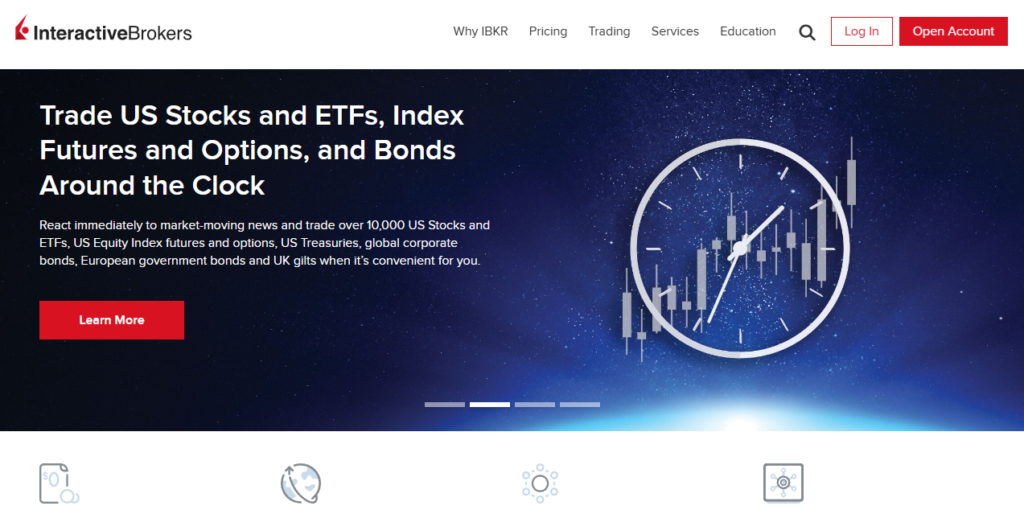
Interactive Brokers (IBKR) is the professional’s choice and stands out as the most robust platform for serious fixed income investors. Unlike most modern apps that only offer stocks, IBKR provides direct access to a vast universe of over 1 million bonds globally, including US Treasuries, municipal bonds, and corporate bonds, often with no mark-ups.
Pros
Vast Bond Selection: Unrivaled access to global bond markets (Treasuries, Corporate, Muni).
High Interest on Cash: Pays highly competitive market rates (up to ~4.8% as of late 2025/2026 data) on idle cash balances.
Low Commissions: Extremely low trading fees (e.g., 0.2 basis points for Treasuries).
Global Access: Trade on 150+ markets in 33 countries.
Advanced Tools: Professional-grade bond scanners and risk analysis tools.
Cons
Complex Interface: The platform can be intimidating and difficult to navigate for beginners.
Inactivity Fees (Legacy): While mostly removed for the “Lite” version, Pro accounts have complex fee structures.
Minimums: To access the best bond pricing, larger order sizes are sometimes required.
Expert Verdict
We consider Interactive Brokers the undisputed king for “true” fixed income investing. If your strategy involves buying individual bonds or building a bond ladder, no other broker offers the same transparency and inventory. For dividend investors, the learning curve is steep, but the execution quality and low margin rates make it the best choice for large portfolios.
eToro - Low commission (sometimes 0%) fixed income broker
eToro is widely known for social trading, but it has become a strong contender for income investors who prefer simplicity. While it lacks individual bond trading, it excels in offering commission-free access to dividend stocks and a wide range of Income ETFs.
Pros
0% Commission: No trading fees on stocks and ETFs (in most jurisdictions).
Social Trading: You can see and copy the portfolios of successful income investors.
Fractional Shares: Reinvest small dividend amounts easily by buying fractions of shares.
User-Friendly: One of the most intuitive interfaces on the market.
CopyPortfolios: Access managed income portfolios without management fees.
Cons
No Individual Bonds: You cannot buy specific bonds, only bond ETFs.
Withdrawal Fees: A flat $5 fee applies to withdrawals.
Currency Conversion: High fees if depositing heavily in non-USD currencies.
Expert Verdict
eToro is an excellent entry point for newer investors focusing on dividend stocks and ETFs. The “CopyTrader” feature is unique, allowing you to automate your income strategy by mimicking veteran investors. However, if you want to buy actual US Treasuries or corporate debt, you will need to look elsewhere.
WeBull - Diversified fixed income product broker
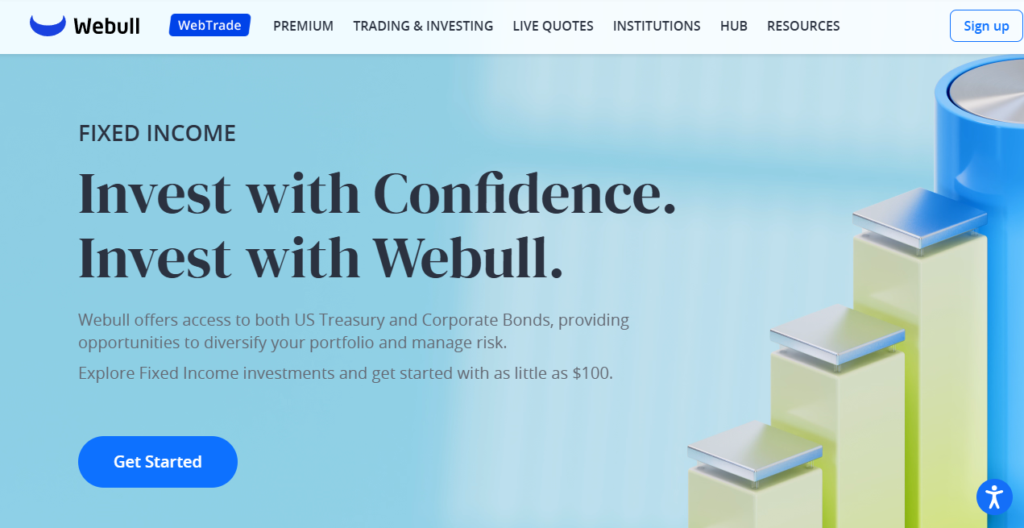
WeBull bridges the gap between a simple mobile app and a pro-level platform. It appeals to income investors by offering zero commissions and high yields on uninvested cash. Recently, WeBull expanded to include treasury trading, making it a viable “lite” option for fixed income.
Pros
Zero Commissions: No fees for trading stocks, ETFs, or options.
Cash Management: Competitive APY (around 3.6% – 4.0% depending on account status) on uninvested cash.
Treasury Access: Unlike many apps, WeBull allows trading of US Treasury bonds.
Great Mobile App: Powerful charting and analysis tools that work well on mobile.
IRA Support: Offers Traditional, Roth, and Rollover IRAs for tax-advantaged income investing.
Cons
Limited Bond Market: No corporate or municipal bonds; only Treasuries.
Customer Support: Can be slow to respond compared to premium brokers.
Data Overload: The interface can be cluttered with technical data not relevant to passive income investors.
Expert Verdict
WeBull is a fantastic “middle ground” broker. It is perfect for an investor who wants the 0% fees of a neo-broker but also wants to dabble in US Treasuries for safety. It is arguably the best mobile-first experience for managing an income portfolio.
Robinhood - User-friendly income investing broker
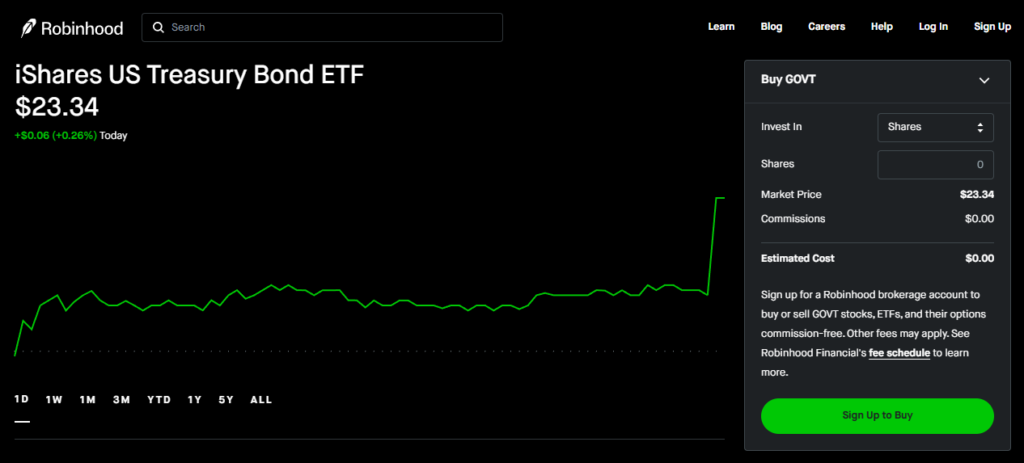
Robinhood revolutionized investing with its simplicity, and for income investors, its “Gold” program is the main attraction. The platform strips away all complexity, making it incredibly easy to buy dividend stocks and see your payments roll in.
Pros
High Cash Sweep Rates: Robinhood Gold members earn high APY (currently ~3.35% as of early 2026) on uninvested cash.
Simplicity: The easiest interface to use, period.
No Fees: 0% commissions on equity trades.
Dividend Reinvestment (DRIP): simple, automatic toggles to reinvest dividends.
Gold Match: Offers a match on IRA contributions for Gold members (terms apply).
Cons
Monthly Fee: To get the high interest rate, you must pay for Robinhood Gold ($5/month).
No Bonds: Zero access to individual bonds.
Limited Research: Very basic data on dividend history or payout ratios.
Expert Verdict
Robinhood is the best “parking spot” for cash and simple dividend strategies. If you want a place where your uninvested money earns a solid return while you wait for dividend stock opportunities, the Gold program is hard to beat. Just do not expect deep fixed income tools.
Plus500 - International income broker
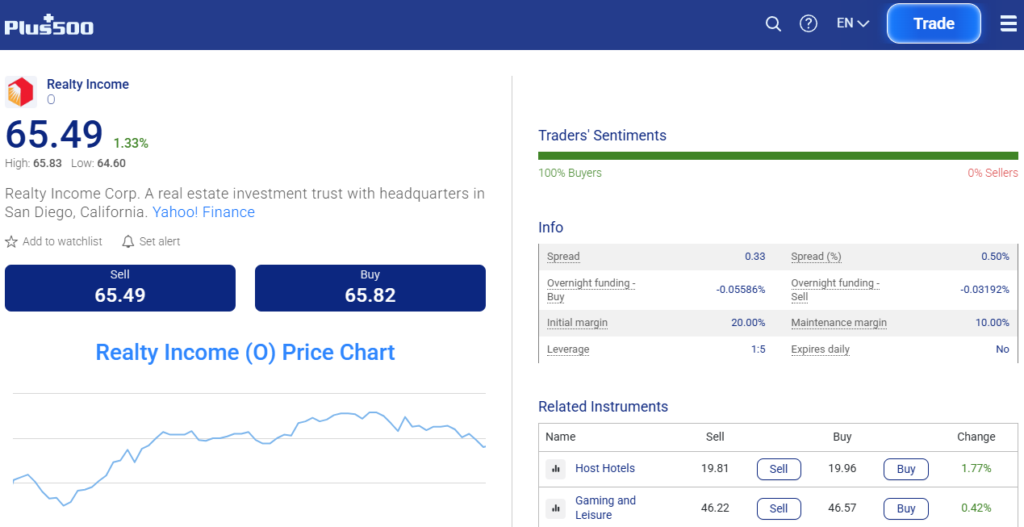
Plus500 is a global powerhouse, primarily known for CFDs (Contracts for Difference), but in select regions, it offers “Plus500 Invest,” a share dealing platform. For international traders who are active and understand the risks of derivatives, it provides a highly efficient platform.
Pros
Global Reach: Available in over 50 countries with localized support.
Advanced App: highly rated mobile application with reliable execution.
Tight Spreads: Competitive pricing on international assets.
Dividend Adjustments: On CFDs, you receive positive adjustments for dividends (though you don’t own the stock).
Regulated: Heavily regulated in top-tier jurisdictions (UK, Australia, etc.).
Cons
CFD Focus: Primarily a derivative broker; you often do not own the underlying asset, which adds risk.
Overnight Fees: Holding CFDs long-term incurs funding costs that can wipe out dividend income.
Not for Passive Investors: Requires active monitoring of margin and position limits.
Expert Verdict
We recommend Plus500 primarily for active traders rather than long-term “buy and hold” income investors. While you can profit from dividend adjustments, the costs of holding positions overnight (CFDs) usually make it unsuitable for a traditional retirement portfolio. Use this only if you are utilizing their specific “Invest” platform where available, or if you are hedging an existing portfolio.
Conclusion
Building a portfolio focused on income investing is one of the most reliable ways to secure your financial future. Whether you choose the stability of bond ladders, the growth potential of dividend stocks, or the hands-off ease of ETFs, the goal remains the same: creating a revenue stream that supports your lifestyle without requiring you to sell your assets. By prioritizing cash flow, you insulate yourself from market volatility and gain the freedom to focus on life, not stock charts.
When it comes to executing these strategies, the choice of broker is paramount. For true fixed income investing involving bonds and a professional-grade toolset, Interactive Brokers is the clear #1 choice. Their transparent pricing on bonds, high interest on idle cash, and unmatched global access make them the superior platform for anyone serious about preserving and growing their wealth through income.
Disclaimers
The information provided on MyInvestAcademy is for educational and informational purposes only and should not be construed as individualized investment, financial, legal, or tax advice. We are not financial advisors, and the content presented does not take into account your specific financial situation, risk tolerance, or investment objectives.
Income investing and investing in fixed income involve significant risks, including the potential loss of principal and the risk that companies may cut or suspend dividend payments at any time. Past performance is not indicative of future results. Market conditions can change rapidly, and interest rate fluctuations can significantly impact the value of bonds and REITs.
Furthermore, this content is not intended as individual tax advice. Tax laws regarding dividends, capital gains, and retirement accounts (like the 401k or IRA) vary by jurisdiction and are subject to change. The tax treatment of investment income depends on your personal circumstances and the laws of your specific country or state. You should always consult with a qualified tax professional or certified financial planner before implementing any investment or tax strategy discussed in this guide. Use of this website constitutes your agreement that MyInvestAcademy and its authors bear no liability for any financial losses or tax consequences resulting from your use of the information provided herein.
Frequently Asked Questions about Income Investing
The primary risk of investing in income ETFs is that their value can fluctuate with market interest rates and economic conditions. If interest rates rise, the share price of bond-heavy ETFs typically falls; similarly, dividend ETFs can suffer if the underlying companies cut payouts during a recession.
Yes, investing in a traditional 401(k) directly reduces your taxable income for the year in which you contribute. The money is taken out of your paycheck pre-tax, lowering your total tax bill immediately, though you will pay taxes on withdrawals in retirement.
You typically need a portfolio worth 25 times your annual expenses to live off dividends comfortably, assuming a 4% yield. For example, if you need $40,000 a year, you would need a portfolio of roughly $1,000,000 invested in assets yielding 4%.
No, a very high dividend yield (often above 8-9%) is frequently a warning sign that the company is in financial trouble or the stock price has crashed. Sustainable income investing focuses on the safety of the payout, not just the size of the yield.
Fixed income specifically refers to debt securities like bonds that pay a set interest rate, whereas passive income is a broader term covering any money earned with little effort. All fixed income is passive income, but not all passive income (like rental properties or royalties) is fixed income.
References
U.S. Securities and Exchange Commission (SEC): Mutual Funds and ETFs – A Guide for Investors. Available at: https://www.sec.gov
Internal Revenue Service (IRS): 401(k) Plans – Contribution Limits and Tax Treatment. Available at: https://www.irs.gov
