
-
Mark Verwoert
- Last updated: March 25, 2026
Best Investing Podcasts 2026
Whether you’re building your first portfolio or refining a strategy you’ve spent years developing, the best investing podcasts can help you learn from experienced investors, stay current on market trends, and sharpen your decision-making – all from your commute, gym, or couch.
In this guide, we’ll share the top investing podcasts for different experience levels and investment styles, from beginners learning the basics to experienced investors seeking expert insights and market analysis. We’ve evaluated each show based on host credentials, content quality, episode consistency, and how useful the information is for real-world investing decisions.
Quick Overview - Top Investment Podcasts
| Podcast | Host(s) | Episode Total | Best For |
|---|---|---|---|
| In The Money | Amber Kanwar | 100+ | Self-directed stock investors seeking portfolio manager insights |
| Richer, Wiser, Happier | William Green | 50+ | Long-term investors who value investing philosophy |
| The Investor’s Podcast (We Study Billionaires) | Stig Brodersen, Clay Finck, Kyle Grieve & others | 1,150+ | Intermediate investors studying billionaire strategies |
| Animal Spirits | Ben Carlson & Michael Batnick | 450+ | Market-aware investors who enjoy conversational analysis |
| Planet Money | NPR rotating hosts | 1,700+ | Beginners who want to understand economics and markets |
| The Motley Fool Money | Rotating Motley Fool analysts | 2,000+ | Stock-focused investors who want daily market coverage |
| BiggerPockets Money Podcast | Mindy Jensen & Scott Trench | 580+ | FIRE-minded investors focused on financial independence |
Top 7 Best Investing Podcasts
Below is our breakdown of the seven best investing podcasts available right now. Each one serves a different type of investor, so we’ve included detailed information to help you find the right fit for your goals and listening style.
1. In The Money with Amber Kanwar

In The Money with Amber Kanwar is a video podcast that delivers institutional-level investing insights to everyday investors. Each episode features Amber sitting down with a top portfolio manager to discuss market conditions, answer audience-submitted questions, and share specific stock picks through the show’s “Pro Picks” segment. The podcast fills a gap between retail-focused content and the kind of analysis usually reserved for high-net-worth clients at wealth management firms. If you want to hear directly from the professionals who manage money for a living, this show puts you in the room with them.
Podcast details
- Host(s) background: Amber Kanwar is a Canadian business journalist who spent over a decade as a host on BNN Bloomberg, Canada’s flagship business channel. She has also appeared as a contributor on CTV and Bloomberg in the US. She has interviewed hundreds of portfolio managers, CEOs, and political leaders throughout her career. She owns the show independently through her media company, AK Media, and personally invests in stocks – a detail she discloses at the start of each episode for transparency.
- Launch year: 2025
- Episode frequency: Twice weekly (Tuesday and Thursday mornings)
- Average episode length: 30–50 minutes
- Best for: Self-directed investors who want actionable stock ideas from professional portfolio managers
- Key topics:
- Portfolio manager interviews with specific stock recommendations
- Market outlook and sector analysis from institutional investors
- Audience Q&A with professional money managers
- Pro Picks – condensed top 3 stock ideas from each guest
Pros
- Every episode features a professional portfolio manager sharing their actual best ideas, not just general commentary
- Amber’s journalism background means she stress-tests each guest’s thesis rather than accepting claims at face value
- The Pro Picks segment distills each episode’s key stock ideas into a quick-reference format
- Independently owned with a clear editorial independence pledge – no parent company pushing products
- Twice-weekly release schedule provides fresh content without overwhelming listeners
Cons
- Skews toward Canadian markets and Canadian-listed stocks, which may limit relevance for US-only investors
- As a newer podcast (launched in 2025), it has a smaller back catalog compared to long-running shows
- Some episodes assume a working knowledge of portfolio construction and market terminology
2. Richer, Wiser, Happier Podcast
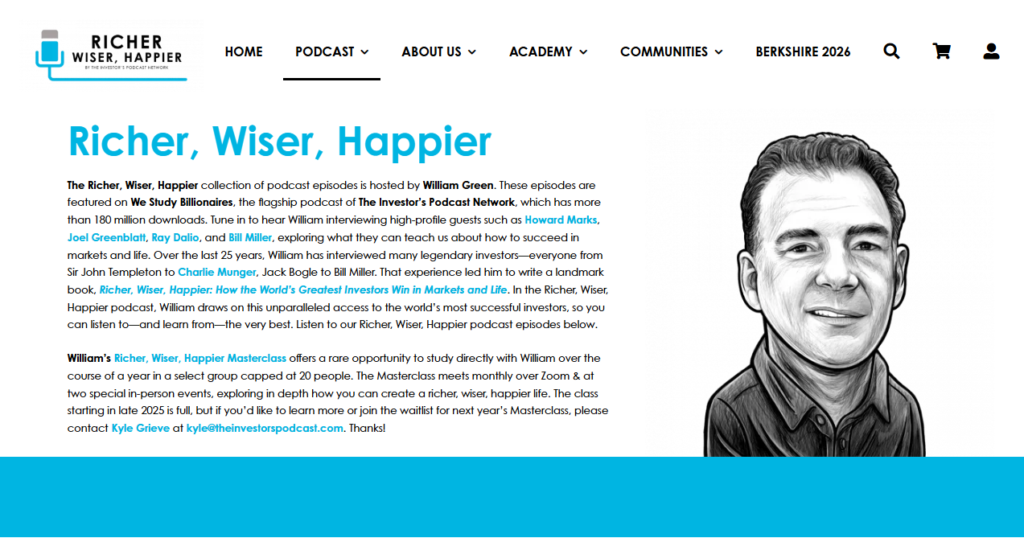
Richer, Wiser, Happier is a podcast series hosted by William Green as part of The Investor’s Podcast Network. Rather than chasing weekly market headlines, this show takes a deeper approach – featuring long-form interviews with legendary investors about the principles and mental frameworks behind their success. If you’re the kind of investor who’d rather read Warren Buffett’s annual letters than check stock prices every morning, this podcast was designed for you.
Podcast details
- Host(s) background: William Green is a financial journalist and author of the bestselling book Richer, Wiser, Happier: How the World’s Greatest Investors Win in Markets and Life. Over 25 years, he has interviewed investors like Sir John Templeton, Charlie Munger, Jack Bogle, and Howard Marks. He studied at Oxford University and holds a Master’s degree from Columbia University’s Graduate School of Journalism.
- Launch year: 2021 (as a series within the We Study Billionaires feed)
- Episode frequency: Approximately twice per month
- Average episode length: 60–90 minutes
- Best for: Patient, long-term investors who value investing wisdom and philosophy
- Key topics:
- Investing philosophies of the world’s top money managers
- Decision-making frameworks and cognitive biases
- Risk management and portfolio construction principles
- The intersection of wealth, happiness, and personal growth
Pros
- Access to conversations with investors who collectively manage hundreds of billions of dollars
- Focuses on timeless investing principles rather than short-term market noise
- William Green’s interviewing style draws out insights that guests rarely share elsewhere
- Episodes remain relevant for years – there’s no expiration date on good investing philosophy
- Part of The Investor’s Podcast Network, which has surpassed 180 million downloads
Cons
- Not for listeners who want specific stock picks or trade ideas
- Episodes run long, which may not suit listeners with limited time
- Published less frequently than weekly shows, so new content arrives slowly
Tip:
Start with William Green’s interviews with Howard Marks and Joel Greenblatt. These episodes distill decades of professional investing experience into frameworks you can immediately apply to your own portfolio analysis.
3. The Investor's Podcast (We Study Billionaires)
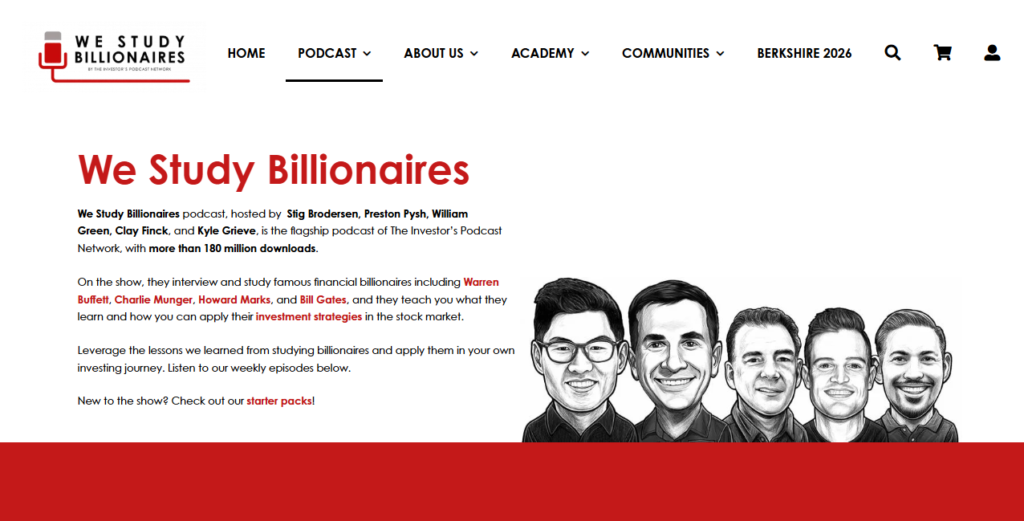
We Study Billionaires is the flagship show from The Investor’s Podcast Network and one of the largest stock investing podcasts in the world, with over 180 million downloads. The show studies the investment strategies of billionaires like Warren Buffett, Ray Dalio, and Howard Marks, then teaches listeners how to apply those approaches. With multiple hosts covering value investing, book reviews, and macro analysis, the podcast delivers a well-rounded investing education across its extensive catalog of episodes.
Podcast details
- Host(s) background: The show is hosted by a team: Stig Brodersen (co-founder, CFA charterholder and experienced value investor), Clay Finck and Kyle Grieve (research analysts who break down individual stocks and investing books), William Green (financial journalist and author), and Preston Pysh (co-founder who now leads the Bitcoin Fundamentals series).
- Launch year: 2014
- Episode frequency: Multiple times per week
- Average episode length: 45–75 minutes
- Best for: Intermediate investors who want to study proven investment strategies in depth
- Key topics:
- Value investing analysis and stock breakdowns
- Investing book reviews and key takeaways
- Billionaire investment strategy case studies
- Macro-economic trends and their impact on portfolios
Pros
- Massive back catalog with over 1,150 episodes, creating a complete self-directed investing education
- Multiple hosts bring diverse perspectives – from deep value to growth investing
- Starter Packs help new listeners find the most relevant episodes for their experience level
- Companion newsletter (The Intrinsic Value Newsletter) provides additional weekly insights
- High-caliber guest lineup including many of the same investors featured in finance textbooks
Cons
- The breadth of content can feel overwhelming for new listeners trying to figure out where to start
- Some series within the feed (like Bitcoin Fundamentals) may not interest all investors
- The depth of analysis assumes some baseline investing knowledge
4. Animal Spirits
Animal Spirits is a weekly show from The Compound where Ben Carlson and Michael Batnick discuss what they’ve been reading, researching, and thinking about in the markets. Named after the John Maynard Keynes term describing how human emotions drive economic decisions, the podcast blends market commentary with personal finance, behavioral investing, and pop culture. The conversational format makes it feel like eavesdropping on two knowledgeable friends talking about money – informed but never stuffy.
Podcast details
- Host(s) background: Ben Carlson is the Director of Institutional Asset Management at Ritholtz Wealth Management and author of several investing books including A Wealth of Common Sense. Michael Batnick is the Managing Partner and Director of Research at Ritholtz Wealth Management and writes the popular blog The Irrelevant Investor.
- Launch year: 2017
- Episode frequency: Weekly (new episodes every Wednesday, plus bonus Talk Your Book episodes)
- Average episode length: 50–70 minutes
- Best for: Intermediate to advanced investors who enjoy conversational, data-driven market commentary
- Key topics:
- Weekly market trends and what’s driving them
- Behavioral finance and investor psychology
- Personal finance decisions in the context of broader markets
- Housing, retirement planning, and consumer economics
Pros
- The natural chemistry between Ben and Michael makes complex topics genuinely engaging
- Both hosts work as actual financial advisors, grounding their commentary in real client experience
- Covers a wide range of topics beyond just stocks – housing, retirement, spending, and behavioral patterns
- Consistent weekly schedule with a reliable Wednesday morning release
- Transparent about their own investing decisions and biases
Cons
- The casual, conversational format means some topics get surface-level treatment
- Talk Your Book episodes are essentially sponsored conversations with asset managers, which some listeners skip
- Assumes familiarity with basic market concepts – not the best entry point for complete beginners
5. Planet Money
Planet Money is NPR’s twice-weekly podcast that uses narrative storytelling to explain how the economy works. While it’s not a traditional investing podcast, it consistently earns a spot among the best investment podcasts because of how effectively it builds economic literacy – the foundation that every good investment decision rests on. Through investigative journalism and creative reporting, Planet Money makes topics like inflation, trade policy, and market bubbles genuinely interesting even to people who have never opened a brokerage account.
Podcast details
- Host(s) background: Planet Money features a rotating team of NPR journalists including Alexi Horowitz-Ghazi, Amanda Aronczyk, Erika Beras, Kenny Malone, Jeff Guo, and others. The show’s executive producer is Alex Goldmark. The team includes Peabody Award-winning journalists with deep expertise in economic reporting.
- Launch year: 2008
- Episode frequency: Twice weekly
- Average episode length: 20–30 minutes
- Best for: Beginners and anyone who wants to understand the economic forces behind investment markets
- Key topics:
- How economic policies affect everyday financial decisions
- The mechanics behind inflation, interest rates, and trade
- Investigative stories about industries, companies, and economic trends
- Historical economic events and what they teach us about today’s markets
Pros
- Storytelling-first approach makes economics accessible without dumbing anything down
- Short episodes that fit easily into a commute or lunch break
- Peabody Award-winning journalism with rigorous fact-checking standards
- Builds the kind of big-picture economic understanding that improves all investment decisions
- Companion daily show, The Indicator, provides even more frequent content on economic data
Cons
- Doesn’t provide specific investment advice or stock picks
- Some episodes cover topics only loosely related to personal investing
- The narrative format means it takes longer to get to the core point compared to straight analysis shows
6. The Motley Fool Money
Motley Fool Money is a daily podcast from the team behind one of the internet’s longest-running financial media companies. Each weekday episode features a rotating panel of Motley Fool analysts breaking down the day’s biggest business news, individual stock earnings, and market trends. Weekend episodes offer longer-form interviews and investing education segments. For investors who want to stay plugged into what’s happening in the stock market every single day, this is one of the most reliable finance podcasts available.
Podcast details
- Host(s) background: The show uses a rotating roster of Motley Fool analysts and hosts including Dylan Lewis, Emily Flippen, Tyler Crowe, Andy Cross, Robert Brokamp, Matt Frankel, and others. The Motley Fool was founded in 1993 by brothers David and Tom Gardner and has built a reputation for long-term, buy-and-hold investing education over more than 30 years.
- Launch year: 2009
- Episode frequency: Daily (weekdays), with weekend bonus episodes
- Average episode length: 20–40 minutes (weekday); 45–60 minutes (weekend)
- Best for: Stock-focused investors who want consistent daily market coverage
- Key topics:
- Daily earnings analysis and stock-specific commentary
- Long-term investing strategies and portfolio management
- Industry trend analysis across tech, healthcare, consumer, and more
- Weekend deep dives into financial planning and retirement
Pros
- Daily episodes keep you consistently informed about market developments
- Rotating analyst panels bring diverse viewpoints on the same stocks and trends
- Decades of institutional knowledge behind every analysis
- Weekend episodes with Robert Brokamp add strong personal finance and retirement content
- The show discusses individual companies by name with specific investing analysis
Cons
- The volume of daily episodes can lead to content fatigue
- Some analyst opinions may conflict with each other across episodes, which can be confusing for beginners
- Motley Fool’s paid stock-picking services are occasionally referenced, which may feel like upselling
7. BiggerPockets Money Podcast
BiggerPockets Money Podcast is a twice-weekly show built around the FIRE (Financial Independence, Retire Early) movement. Hosts Mindy Jensen and Scott Trench interview real people about their financial journeys – from paying off debt on a teacher’s salary to building million-dollar portfolios through index funds and real estate. The show is practical, numbers-driven, and focused on the full financial picture rather than just stock picking. If your investing goal is building wealth that eventually replaces your paycheck, this podcast speaks directly to that ambition.
Podcast details
- Host(s) background: Mindy Jensen is a real estate investor, personal finance writer, and community manager at BiggerPockets. Scott Trench is the former CEO of BiggerPockets who stepped down to focus full-time on financial education content, and is the author of Set for Life: Dominate Life, Money, and the American Dream.
- Launch year: 2018
- Episode frequency: Twice weekly (Tuesdays and Fridays)
- Average episode length: 40–60 minutes
- Best for: Investors pursuing financial independence and early retirement through diversified strategies
- Key topics:
- FIRE strategies across different income levels and life stages
- Real listener case studies with detailed financial breakdowns
- Tax optimization for early retirees and high savers
- Real estate investing as part of a broader wealth-building plan
Pros
- Features real people’s financial stories with specific numbers, budgets, and strategies
- Covers the full spectrum of wealth-building – not just stock investing but also real estate, side hustles, and tax strategy
- Twice-weekly episodes with a consistent release schedule
- Honest about the challenges and trade-offs involved in pursuing financial independence
- Accessible for listeners at any income level – guests range from teachers to tech workers
Cons
- Heavily focused on the FIRE community, which may not appeal to all investors
- Doesn’t go deep on individual stock analysis or market commentary
- Some episodes can feel repetitive if you’re already well-versed in FIRE principles
Conclusion: The Best Investing Podcast for You
Regularly listening to quality podcasts about investing helps you absorb market knowledge, learn from experienced professionals, and stay informed about economic shifts – all without carving out extra time in your schedule. The best investment podcasts turn your commute, workout, or downtime into ongoing financial education. Over time, this consistent exposure to different investing perspectives builds the kind of pattern recognition and analytical thinking that leads to better portfolio decisions.
If you’re just starting your investing journey, Planet Money stands out as the best first step. It doesn’t assume any prior knowledge, uses engaging storytelling to explain how markets and economies actually work, and builds the foundational understanding you’ll need before diving into more advanced shows. Once you’re comfortable with the basics, you can layer in podcasts like The Motley Fool Money for daily stock analysis or We Study Billionaires for deeper investment strategy – but getting the economic fundamentals right first will make everything else click faster.
Tip: If you like podcasts, make sure to check out our best investing podcast list.
Frequently Asked Questions about Investing Podcasts
Planet Money is the best investing podcast for beginners because it explains economic concepts through storytelling without assuming any prior financial knowledge. The 20–30 minute episodes cover topics like inflation, interest rates, and market mechanics in a way that's both educational and entertaining. BiggerPockets Money is another strong option for beginners specifically interested in building wealth and pursuing financial independence, as it features real people sharing step-by-step breakdowns of their financial strategies.
Two to three hours per week is enough to stay well-informed without experiencing information overload. That translates to roughly three or four episodes from different shows, giving you a mix of daily market updates and deeper strategic content. The key is consistency over volume - listening to one quality episode regularly will build more knowledge over time than binge-listening to a dozen shows in one sitting and then dropping off.
Investing podcasts and books serve different purposes, and the most effective approach is using both. Podcasts excel at keeping you current on market developments, introducing you to new ideas, and fitting into time you'd otherwise spend doing nothing productive. Books provide deeper, more structured knowledge on specific topics like valuation methods, portfolio theory, or investing history. Think of podcasts as your ongoing education and books as your foundational coursework.
You should treat investing podcasts as educational resources, not personalized financial advice. Reputable shows like the ones listed in this guide feature credentialed hosts and transparent disclosures, but no podcast host knows your specific financial situation, risk tolerance, or goals. Use podcasts to learn frameworks, discover new ideas, and understand how experienced investors think - then do your own research before making any investment decisions. Be especially cautious of podcasts that promise guaranteed returns or push specific products aggressively.
The vast majority of investing podcasts are completely free to listen to on platforms like Spotify, Apple Podcasts, and YouTube. All seven podcasts in this guide are available at no cost. Some shows offer optional premium tiers - for example, Planet Money+ provides ad-free episodes for a monthly fee, and The Investor's Podcast Network has a premium membership. However, the free versions of these shows contain the full core content, and you can build a thorough investing education without spending anything on podcast subscriptions.
