
-
Mark Verwoert
- Last updated: August 18, 2026
Educational Disclaimer: The content on myinvestacademy.com is for educational and informational purposes only. We are not licensed financial advisors, and nothing in this article should be interpreted as professional investment, legal, or tax advice. Investing involves risk of loss. Always consult with a professional before making financial decisions.
5 best gold ETFs to buy in 2026
Gold ETFs make it easy to add physical gold exposure to a portfolio without buying, storing or insuring bullion yourself. The main challenge is choosing between funds that often look very similar, but differ in fees, liquidity, structure and how the underlying gold is held.
Key takeaways
The best gold ETF depends on how you plan to invest. For most long-term investors, we think SPDR Gold MiniShares Trust (GLDM) offers the strongest overall balance of cost, scale and simplicity.
- Best overall: GLDM
- Lowest cost: IAUM
- Best for liquidity and active trading: GLD
- Best bullion-focused trust: PHYS
- Best for responsible sourcing: SGOL
Our ranking focuses on products that provide direct exposure to physical gold. Gold mining ETFs are excluded because they invest in mining companies rather than bullion and therefore have a different risk and return profile.
Best gold ETFs at a glance
The five products below all provide physical gold exposure, but they are not interchangeable. The right choice depends largely on whether you prioritize low fees, trading liquidity or the way the bullion is structured and held.
| Our pick | Fund | Ticker | Annual fee | Assets | Physical gold | Best for |
|---|---|---|---|---|---|---|
| Best overall | SPDR Gold MiniShares Trust | GLDM | 0.10% | $27.6B | Yes | Most long-term investors |
| Lowest cost | iShares Gold Trust Micro | IAUM | 0.09% | $6.4B | Yes | Fee-conscious investors |
| Best for liquidity | SPDR Gold Shares | GLD | 0.40% | $131.9B | Yes | Active traders and large orders |
| Best bullion-focused trust | Sprott Physical Gold Trust | PHYS | 0.39% MER | $15.1B | Yes | Investors who value its physical-bullion structure |
| Best for responsible sourcing | abrdn Physical Gold Shares ETF | SGOL | 0.17% | $7.9B | Yes | Investors who prioritize sourcing standards |
Fund size changes with the gold price and investor flows, so these figures should be viewed as a snapshot rather than a permanent ranking factor.
The fee difference between IAUM and GLDM is also tiny. On a $10,000 investment, the difference between a 0.09% and 0.10% annual fee is roughly $1 per year. That is why we consider more than cost alone.
5 best gold ETFs for 2026
Each fund in our Top 5 has a different reason for making the list. We are not simply ranking the largest products or automatically putting the cheapest option first.
1. GLDM: Best gold ETF overall
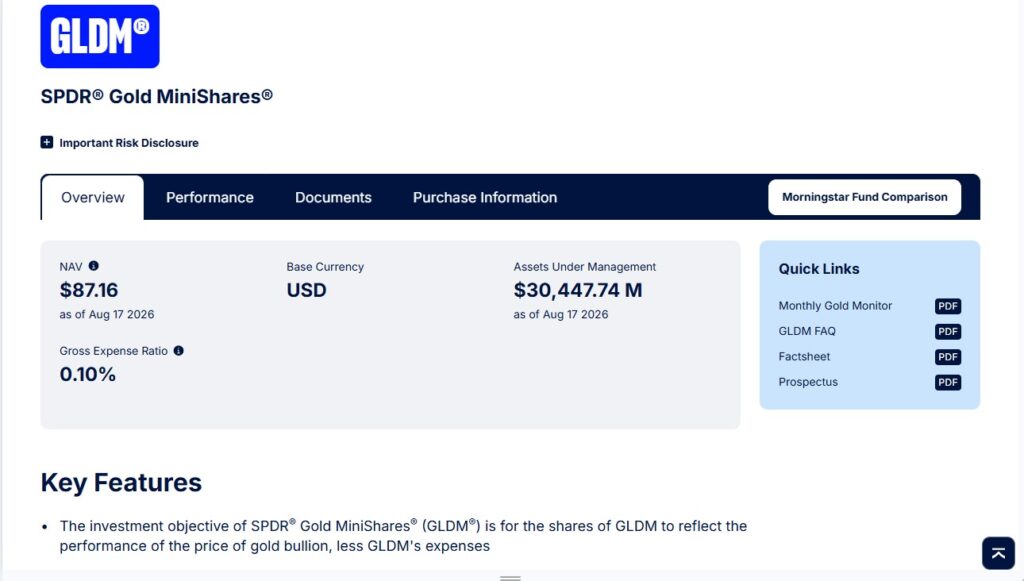
Ticker: GLDM
Issuer: World Gold Council / State Street marketing agent
Expense ratio: 0.10%
Assets under management: approximately $27.6 billion
Inception date: June 25, 2018
Gold custodian: JPMorgan Chase Bank
Backing: Physical gold
GLDM gets our top spot because it combines very low costs with substantial scale and a straightforward physical-gold structure. The trust aims to reflect the performance of gold bullion after expenses and charges just 0.10% per year.
IAUM is technically cheaper, but only by one basis point. We do not think that difference is large enough to outweigh GLDM’s greater size and longer trading history for most investors.
There is one situation where we would clearly prefer GLD: frequent trading. GLD offers deeper liquidity and a much more developed options market. For an investor building a long-term gold allocation, however, we think GLDM offers the better overall balance.
Best for: Investors looking for an established, low-cost vehicle for long-term gold exposure.
Pros
- Low 0.10% annual expense ratio
- Substantial assets under management
- Direct physical-gold exposure
- Lower long-term cost than GLD
- More established than some newer low-cost alternatives
Cons
- IAUM is marginally cheaper
- GLD offers deeper liquidity for active traders
Our verdict
GLDM does not lead every individual category, but that is exactly why it works so well as an all-round choice. Costs are very low, the fund has meaningful scale and its structure is easy to understand.
2. IAUM: Best low-cost gold ETF
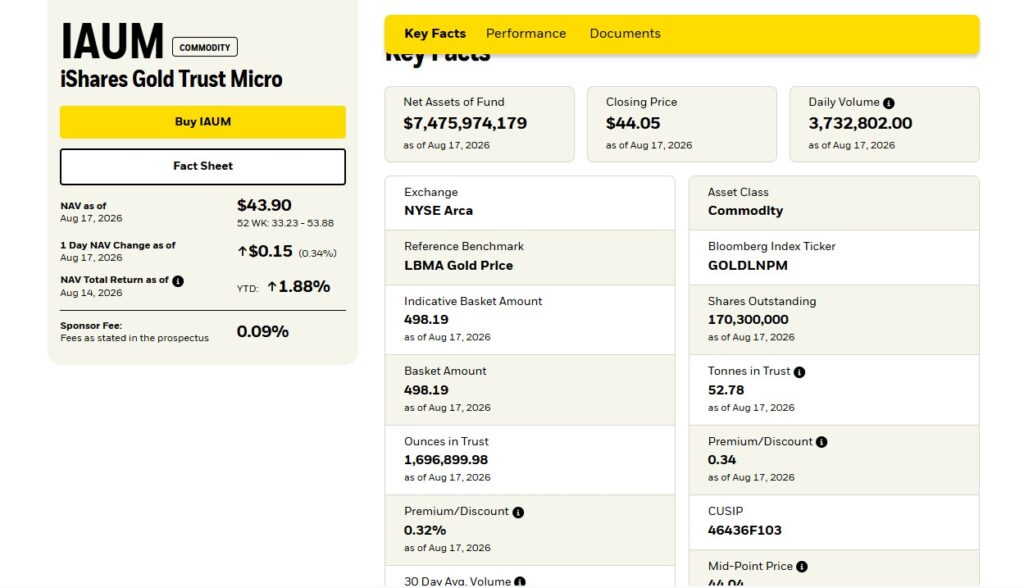
Ticker: IAUM
Issuer: iShares
Sponsor fee: 0.09%
Net assets: approximately $6.4 billion
Inception date: June 15, 2021
Reference benchmark: LBMA Gold Price
Backing: Physical gold
If your main priority is keeping annual fund costs as low as possible, IAUM is difficult to beat. The iShares Gold Trust Micro currently charges a sponsor fee of just 0.09%.
That makes it marginally cheaper than GLDM, although the practical difference is small. On a $100,000 position, the gap between a 0.09% and 0.10% fee amounts to roughly $10 per year.
IAUM has also grown into a substantial product, so investors are not sacrificing scale simply to save on fees. We still give GLDM the overall edge because it is larger and has a somewhat longer operating history.
Best for: Buy-and-hold investors who want physical gold exposure at the lowest ongoing fee among our five picks.
Pros
- Very low 0.09% sponsor fee
- Physical gold exposure
- Competitive liquidity
- Backed by a major ETF provider
Cons
- Smaller than GLDM
- Shorter operating history
- Cost advantage over GLDM is only one basis point
Our verdict
IAUM is our preferred choice for investors who put fees first. It is a particularly strong option for new investors who want straightforward physical gold exposure without paying more than necessary.
3. GLD: Best gold ETF for liquidity and active trading
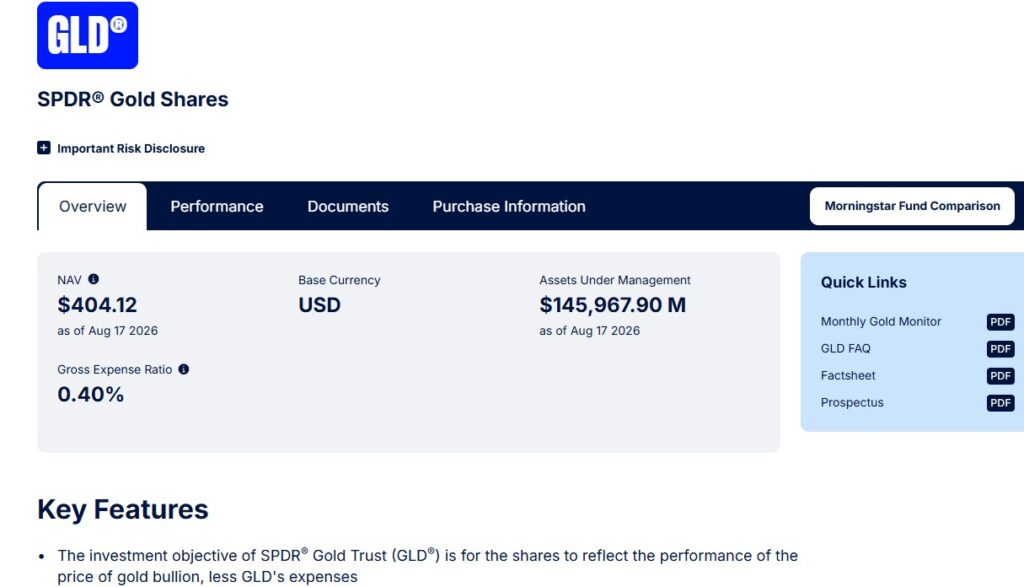
Ticker: GLD
Issuer: World Gold Council / State Street marketing agent
Expense ratio: 0.40%
Assets under management: approximately $131.9 billion
Inception date: November 18, 2004
Gold custodians: HSBC Bank and JPMorgan Chase Bank
Backing: Physical gold
GLD is still the name many investors associate with gold ETFs. Launched in 2004, it has an enormous asset base, deep trading liquidity and one of the most established options markets in the category.
Those advantages matter most to investors who trade regularly or place large orders. Tight spreads and deep trading volume can reduce execution costs enough to justify paying a higher annual fee.
For an ordinary buy-and-hold investor, the 0.40% expense ratio is much harder to justify. GLDM costs 0.10% and provides exposure to the same underlying metal, so long-term investors should have a clear reason before paying four times as much.
Best for: Active traders, options users and investors placing large transactions where liquidity matters.
Pros
- Exceptional trading liquidity
- Very large asset base
- Long operating history
- Active options market
- Broad institutional participation
Cons
- 0.40% annual expense ratio
- Less attractive for simple long-term exposure
Our verdict
GLD remains one of the strongest gold trading vehicles available. We would choose it for liquidity, not because it offers better underlying gold exposure than the cheaper alternatives.
PHYS: Best for investors who prioritize a bullion-focused trust structure
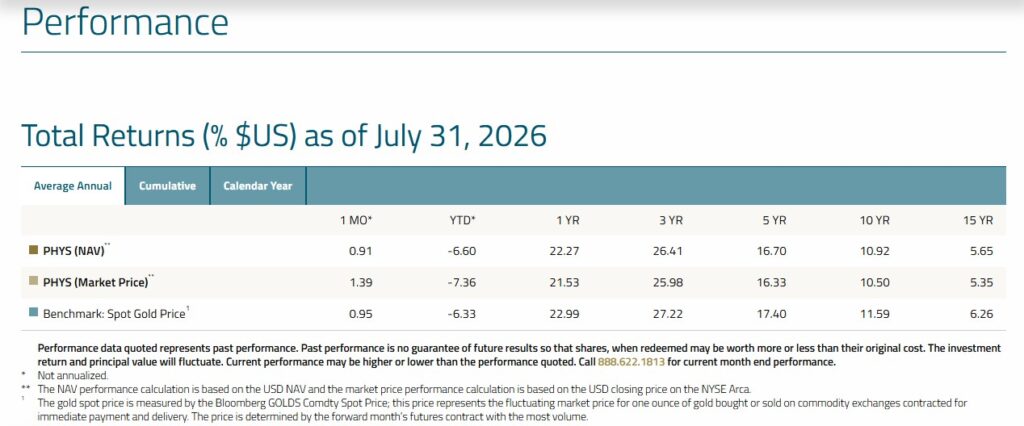
Ticker: PHYS
Structure: Closed-end trust
Manager: Sprott Asset Management
Management expense ratio: 0.39%
Net asset value: approximately $15.1 billion
Inception date: February 25, 2010
Bullion custodian: Royal Canadian Mint
Backing: Fully allocated physical gold
PHYS is the outlier in our comparison, which is one of the main reasons it deserves a place. Sprott Physical Gold Trust is a closed-end trust that invests substantially all of its assets in physical bullion held through the Royal Canadian Mint.
Sprott states that the gold is fully allocated, and PHYS includes a mechanism that allows eligible unitholders to redeem for physical bullion under specific conditions. That should not be confused with buying a few coins and asking your broker to ship them home. The redemption requirements make it impractical for many smaller retail investors.
Its closed-end structure also means PHYS can trade at a premium or discount to net asset value. Combined with a 0.39% management expense ratio, that makes PHYS less attractive if your only goal is obtaining the cheapest possible gold-price exposure.
Best for: Investors who place more weight on trust structure, allocated bullion and physical-redemption features than on the lowest annual fee.
Pros
- Fully allocated physical bullion
- Royal Canadian Mint custody
- Physical-redemption mechanism
- Substantial scale
- Distinct structure from conventional gold ETFs
Cons
- Higher ongoing costs
- Can trade at a premium or discount to NAV
- Physical redemption is impractical for many smaller investors
Our verdict
PHYS solves a different problem from GLDM or IAUM. Its appeal lies in how the bullion is held and how the trust is structured rather than low-cost index-like exposure.
5. SGOL: Best gold ETF for responsible sourcing
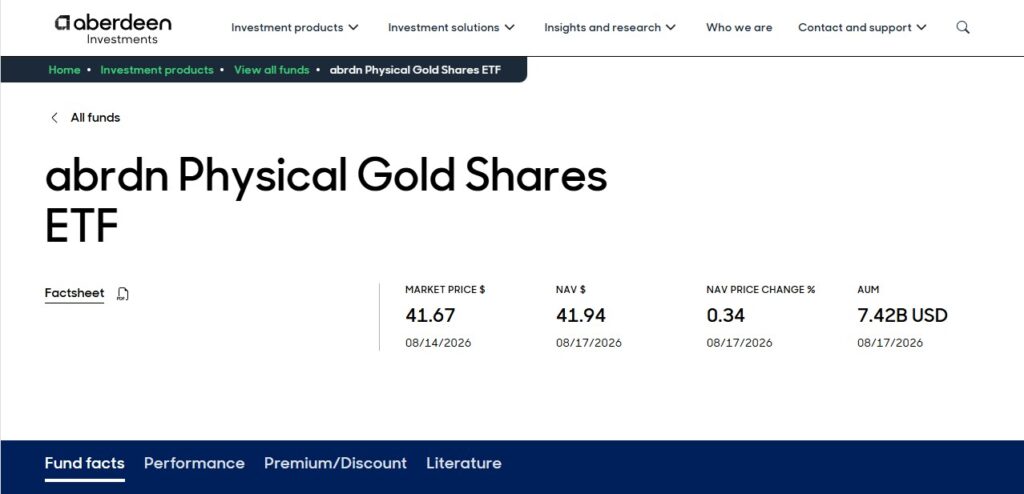
Ticker: SGOL
Issuer: abrdn
Expense ratio: 0.17%
Net assets: approximately $7.9 billion
Launch date: September 9, 2009
Custodian: ICBC Standard Bank
Vault location: London
Backing: Allocated physical gold
SGOL provides direct physical gold exposure, but its sourcing policy gives it a clearer identity than simply being another low-cost fund. The trust seeks to hold responsibly sourced gold in line with standards connected to the London Bullion Market Association’s Responsible Gold Guidance.
Those standards address issues such as supply-chain due diligence, money laundering, human-rights abuses and environmental considerations. They should not be treated as a guarantee that every bar has a completely issue-free history, but they do add another layer of scrutiny to how the bullion is sourced.
SGOL’s 0.17% expense ratio is higher than GLDM and IAUM but still well below GLD and PHYS. That makes the additional cost relatively modest for investors who place meaningful weight on sourcing standards and bullion transparency.
Best for: Investors who want physical gold exposure and place additional weight on responsible-sourcing policies
Pros
- Allocated physical gold
- Competitive 0.17% expense ratio
- Established operating history
- Responsible-sourcing policy
- Independent bullion inspections
Cons
- More expensive than GLDM and IAUM
- Responsible-sourcing frameworks cannot eliminate every supply-chain concern
Our verdict
SGOL offers a genuine reason to choose something other than the biggest or cheapest product. If responsible sourcing is part of your investment criteria, its slightly higher annual fee may be worth considering.
How we chose the best gold ETFs
A ranking based purely on past returns would tell us very little because most of these products are designed to provide exposure to the same underlying asset.
Instead, we focused on the factors that can meaningfully change the investor experience.
Cost
Annual fees matter because physical gold does not generate earnings that can offset fund expenses. Over long holding periods, ongoing charges gradually reduce returns.
We did not automatically rank the cheapest fund first. A one-basis-point fee difference is much less important than a major difference in liquidity or structure.
Liquidity
Liquidity becomes more important as trading frequency and position size increase.
A long-term investor making a few purchases each year may reasonably prioritize lower ongoing fees. An active trader can care much more about spreads, trading depth and options availability.
That distinction is the main reason GLD remains in our Top 5 despite its substantially higher expense ratio.
Fund size and history
Assets under management are not a quality score, but size can indicate market adoption and contribute to stronger trading liquidity.
Operating history provides another useful reference point. A newer fund is not automatically inferior, but an established track record can matter when comparing products that otherwise look very similar.
Gold custody and fund structure
We also looked at how the gold is held, which institution serves as custodian and whether the product introduces structural characteristics investors should understand.
This is where PHYS and SGOL become useful additions to the comparison. PHYS offers a different closed-end trust structure, while SGOL places greater emphasis on allocated bullion and responsible sourcing.
We excluded leveraged and inverse products because they are designed for different trading objectives. Gold mining ETFs were excluded because they own equities rather than physical bullion.
What is a physical gold ETF?
A physical gold ETF gives investors market exposure to gold without requiring them to personally buy and store individual bars or coins.
The fund or trust holds physical bullion, while investors buy exchange-traded shares whose value is designed to follow the underlying gold price after expenses.
One share does not usually represent exactly one ounce of gold. Each product has its own share structure, and ongoing expenses can gradually reduce the amount of gold represented by each share.
Why investors use physical gold ETFs
Convenience is one of the main attractions. Shares can generally be bought and sold through a normal brokerage account during market hours.
Investors do not need to arrange private storage, insurance or a future sale to a bullion dealer. The trade-off is that you own shares in a vehicle (ETF) that holds gold rather than personally taking possession of the metal.
For investors whose main priority is direct ownership of bullion, physical gold deserves a separate comparison.
Physical gold ETFs vs gold mining ETFs
Both investments are linked to the gold market, but their risk and return profiles can be very different.
A physical gold product mainly gives you exposure to bullion. A gold mining ETF owns shares in companies that extract and sell gold.
Why gold mining ETFs behave differently
The gold price still matters for miners, but it is only part of the equation.
Mining-company returns can also depend on:
- Production costs
- Energy prices
- Reserve quality
- Management decisions
- Debt levels
- Political and geographic risks
- Broader stock-market conditions
A mining company can therefore perform poorly while gold prices rise. Strong operating leverage can also cause miners to outperform bullion during favorable periods.
That is why we do not include mining funds in this Top 5. Investors who specifically want equity exposure to producers should compare the best gold mining ETFs separately.
How to choose the best gold ETF
The best gold ETF is not automatically the one with the lowest fee. How you intend to use the fund matters just as much.
For a long-term allocation, costs generally deserve more weight. For frequent trading, liquidity can become more important.
Compare expense ratios
IAUM currently charges 0.09%, GLDM 0.10%, SGOL 0.17% and GLD 0.40%.
Those differences become more meaningful as the investment amount and holding period increase. At the same time, there is little reason to obsess over a one-basis-point gap.
Choosing IAUM over GLDM solely to save 0.01% ignores other useful factors such as size, history and trading conditions.
Look at liquidity
The expense ratio is only one cost.
Every time you trade, the difference between the highest price a buyer is willing to pay and the lowest price a seller will accept creates a bid-ask spread. Smaller spreads generally reduce the friction involved in entering or exiting a position.
This is where GLD earns its place. Its enormous scale and trading activity make it particularly attractive for active traders.
Check how the gold is held
“Gold ETF” does not describe one universal legal structure.
Before investing, check:
- Who acts as custodian
- Whether the bullion is allocated
- How creation and redemption work
- Whether the product is an ETF, trust or closed-end trust
- Whether investors have any physical-redemption rights
Do not assume that “physically backed” means your broker can simply send you a gold bar.
Consider fund size and operating history
Fund size should not determine the decision on its own.
GLD’s enormous asset base does not automatically make it a better long-term investment than GLDM. It does, however, contribute to GLD’s exceptional trading liquidity.
Operating history can serve as another useful reference point when two otherwise similar funds are being compared.
Match the fund to your investment style
For a long-term investor, we would place more weight on low fees and a straightforward physical-gold structure.
For an active trader, liquidity can justify paying more. Investors particularly concerned with bullion custody and trust structure may find PHYS more interesting.
Someone who wants responsible sourcing to play a role in fund selection may prefer SGOL. There is no reason to pretend all of these investors should choose the same product.
Gold ETF vs physical gold
Both routes provide exposure to the same precious metal, but the ownership experience is fundamentally different.
ETFs prioritize convenience and tradability. Physical bullion prioritizes direct ownership.
| Gold ETF or trust | Physical gold | |
| How you buy | Brokerage account | Bullion dealer |
| Storage | Handled within the fund or trust | Investor responsibility |
| Trading | During exchange hours | Depends on dealer and market |
| Ongoing cost | Fund or trust expenses | Storage and insurance may apply |
| Physical possession | Usually no | Yes |
| Convenience | High | Lower |
| Structural considerations | Fund, custodian and market structure | Dealer, storage and authenticity |
A gold ETF is generally easier to integrate into an investment portfolio. You can buy a precise dollar amount, rebalance the position and sell it through a normal brokerage account.
Physical gold offers something an exchange-traded security cannot: direct possession of the underlying asset.
Neither option is automatically better. The relevant question is why you want to own gold and which form of ownership best fits that objective.
See our full physical gold vs gold ETF comparison for a deeper look at costs, storage, liquidity, ownership and risk.
How to buy a gold ETF
Buying a gold ETF works much like buying a stock. You need a brokerage account that gives you access to the exchange where the product trades.
The fund choice should come before the order itself. Compare fees, structure and liquidity, then verify the ticker before placing a trade.
Buying a gold ETF step by step
The process itself is straightforward once you know which fund you want to own.
- Choose a regulated broker
- Fund your brokerage account
- Search for the ETF or trust using its ticker
- Verify that you have selected the correct security
- Review the current bid and ask prices
- Place your order
- Monitor the position as part of your overall portfolio
A limit order can give you more control over the price you pay, particularly when the market is moving quickly.
The final question is position size. Start with the role you want gold to play in your portfolio, then determine an allocation that fits that objective.
Investors who do not yet have a brokerage account can compare the best stock brokers before choosing a gold ETF.
Are gold ETFs a good investment?
Gold ETFs can be useful portfolio tools, but they solve a specific problem.
Gold does not generate earnings, pay interest or produce cash flow. Your return largely depends on changes in the market price of gold, minus the costs of the investment vehicle.
Why investors hold gold ETFs
The investment case for gold often centers on diversification, inflation protection and preserving purchasing power.
One of the main reasons investors hold gold is as a hedge against inflation and currency debasement. Fiat currencies can lose purchasing power over time as prices rise and the money supply expands. Gold has a limited physical supply and is not issued by a government or central bank, which is why some investors use it as a store of value when they are concerned about the long-term purchasing power of paper currencies.
That does not mean gold will reliably rise every time inflation increases. Its price can behave very differently over shorter periods.
Other potential advantages include:
- Easy access through a brokerage account
- No personal bullion storage
- High liquidity
- Straightforward portfolio rebalancing
- Potential protection against long-term loss of purchasing power
- Exposure to an asset that can behave differently from stocks and bonds
Gold can also become more attractive during periods of monetary uncertainty, falling confidence in currencies or concerns about government debt and central-bank policy.
Risks of investing in gold ETFs
Convenience does not remove investment risk.
Potential disadvantages include:
- Gold prices can fall sharply
- Gold can underperform productive assets for long periods
- Physical gold produces no cash flow
- Fund expenses reduce returns over time
- Different products introduce different structural and custody considerations
Putting too much of a portfolio into bullion can also mean giving up capital that could otherwise be invested in businesses, bonds or other return-producing assets.
The more useful question is therefore not simply whether gold ETFs are good investments. It is whether gold has a useful role in your portfolio and which vehicle provides that exposure with the fewest unnecessary compromises.
Which gold ETF is best in 2026?
For most long-term investors, GLDM is our preferred gold ETF in 2026.
Its 0.10% expense ratio is close to the lowest available, while its size and operating history give it a more balanced profile than simply choosing whichever fund happens to be cheapest today.
IAUM is the stronger choice when minimizing annual fees is the priority. GLD remains difficult to beat for active trading and liquidity.
PHYS deserves consideration when trust structure, allocated bullion and redemption features matter more than having the lowest ongoing cost. SGOL stands out for investors who want responsible sourcing to play a more prominent role in their decision.
All five products provide exposure to physical gold, but they solve slightly different problems. Choosing the right one comes down to understanding which differences actually matter for the way you intend to invest.
Frequently asked questions about gold ETFs
We rank GLDM as the best gold ETF for most long-term investors in 2026. It combines a low 0.10% expense ratio with substantial assets under management and direct physical-gold exposure.
Of the five products in our comparison, IAUM has the lowest current headline fee at 0.09%.
GLDM, IAUM, GLD and SGOL are all structured to provide exposure backed by physical gold.
PHYS also holds physical bullion, but it uses a closed-end trust structure rather than a conventional ETF structure.
Gold ETFs remove some of the practical risks associated with personally storing bullion, but they are not risk-free investments.
Gold prices can fall significantly, and investors should also understand the legal, custody and trading structure of the product they choose.
Physical gold itself does not produce income. Physically backed gold products therefore generally do not have business earnings or interest income from which to fund a regular dividend. Their main purpose is to provide exposure to changes in the value of gold.
Gold is often used as a long-term hedge against inflation and declining purchasing power because its supply is limited and it is not issued by a central bank.
A gold ETF is generally easier to buy, sell and rebalance and removes the need to personally arrange storage.
A physical gold ETF is designed to provide exposure to bullion prices.
A gold mining ETF owns shares in mining companies. Its returns therefore depend not only on the gold price, but also on factors such as production costs, management quality and stock-market conditions.
Disclaimer
This article is for informational and educational purposes only and should not be considered personalized financial, investment, tax or legal advice.
Gold ETFs and other investment products can rise or fall in value, and past performance does not guarantee future results. Always conduct your own research and consider your financial situation, investment objectives and risk tolerance before investing.
