
-
Mark Verwoert
- Last updated: August 29, 2026
Disclaimer: This guide is for educational purposes only and does not constitute investment, financial or tax advice. Gold prices, dealer premiums, tax rules and individual circumstances can change, so always verify current information before making an investment decision.
How to Buy Physical Gold in 2026
How to buy physical gold is simple. Buying the right product at the right price takes more thought. You need to compare coins and bars, dealer premiums, payment costs, storage and resale options. This guide explains how to buy physical gold in the US without overpaying or overlooking costs that matter later.
Key takeaways
- Bullion coins usually offer better divisibility and recognition, while larger bars tend to have lower premiums
- Physical gold normally trades above the spot price because manufacturing, distribution and dealer margins have to be covered
- Compare total delivered prices for identical products and identical payment methods
- Check the dealer’s buyback policy before buying, not when you are ready to sell
- Storage and insurance should be arranged before valuable bullion is delivered
- Standard bullion and collectible coins are different markets and should not be valued in the same way
How to buy physical gold: the short answer
For most private investors, the process can be reduced to eight practical steps:
- Decide how much of your portfolio you want to allocate to physical gold
- Choose between bullion coins, bars or a combination of both
- Check the current gold spot price
- Compare the same product across several reputable dealers
- Calculate the total delivered price, not just the advertised premium
- Review payment, shipping and insurance conditions
- Arrange secure storage before the gold arrives
- Keep invoices and understand how you would sell the gold again
The most important comparison is not simply the price of one ounce of gold. It is the total cost of acquiring, holding and eventually selling that ounce.
A dealer offering the lowest advertised price can still be more expensive if payment surcharges, shipping or a poor buyback spread are added later.
Gold coins or gold bars: which should you buy?
Coins and bars both provide direct ownership of physical gold, but they behave differently when you buy, store and resell them.
The main trade-off is between flexibility and cost efficiency.
| Factor | Gold coins | Gold bars |
|---|---|---|
| Typical premium | Usually higher | Usually lower at larger sizes |
| Recognition | Very high for major sovereign coins | High for established refiners |
| Ease of resale | Very high | High |
| Divisibility | Excellent | Depends on bar size |
| Storage efficiency | Good | Very good |
| Cost per ounce | Usually higher | Often lower |
| Best suited to | Flexibility and partial resale | Larger, cost-conscious purchases |
When gold coins make more sense
Bullion coins are often the easiest entry point for private investors because widely traded coins are instantly recognizable to bullion dealers.
Examples include:
- American Gold Eagle
- Canadian Gold Maple Leaf
- British Britannia
- South African Krugerrand
- Austrian Philharmonic
Recognition matters because resale is part of the investment.
If you own ten individual one-ounce coins and later need to liquidate 20% of the position, you can sell two coins and keep the remaining eight. The same flexibility does not exist if the entire investment is stored in one large bar.
Coins therefore tend to work well for investors who value optionality, even if the purchase premium is somewhat higher.
When gold bars make more sense
Bars can be more cost-efficient because larger products typically require less manufacturing, handling and packaging relative to the amount of gold they contain.
That does not mean the largest bar available is automatically the best choice.
Consider an investor who wants to own 10 ounces of gold.
They could buy:
| Structure | Number of pieces | Flexibility when selling |
| 10 × 1 oz coins | 10 | Very high |
| 10 × 1 oz bars | 10 | Very high |
| 2 × 5 oz bars | 2 | Moderate |
| 1 × 10 oz bar | 1 | Low |
The 10-ounce bar may offer the lowest acquisition cost per ounce, but it creates an all-or-nothing resale decision.
For larger portfolios, a mix of products can therefore make more sense than choosing only the cheapest option.
If you are still determining the appropriate size of the position itself, our guide to how much gold and silver to hold in a portfolio looks specifically at allocation rather than product selection.
What does physical gold actually cost?
The gold spot price is the starting point, not the final retail price.
A physical bullion purchase can involve four separate cost layers:
| Cost | What it represents |
| Spot price | Current market value of the underlying gold |
| Dealer premium | Manufacturing, distribution, inventory and dealer margin |
| Transaction costs | Payment fees and potentially shipping |
| Ownership costs | Storage and insurance |
A useful way to think about acquisition cost is:
Total acquisition cost = bullion price + payment fees + shipping + immediate storage costs
The number worth comparing across dealers is therefore the final amount paid for a fixed quantity of gold.
Understanding the gold spot price
The spot price represents the current wholesale market value of gold and changes throughout the trading day.
Retail bullion products are priced in relation to spot, but they cannot normally be purchased by private investors at exactly the wholesale reference price.
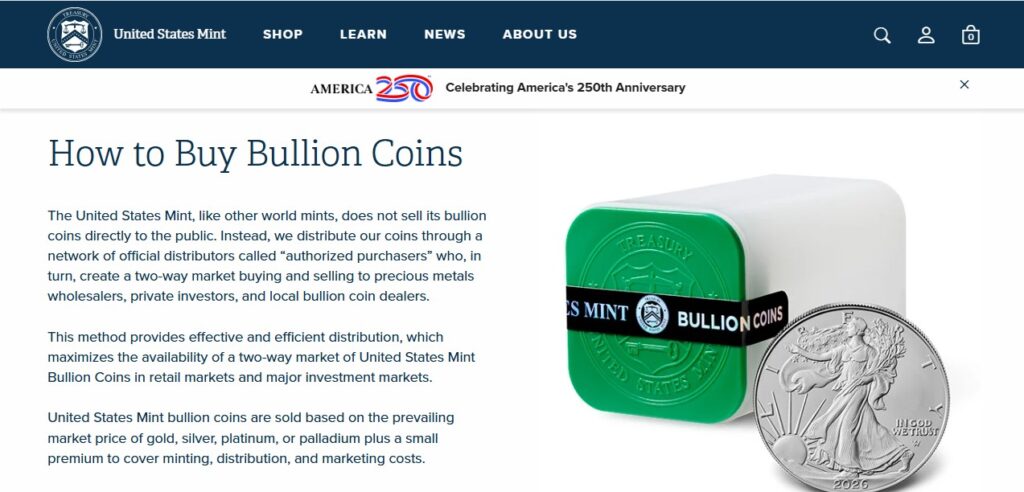
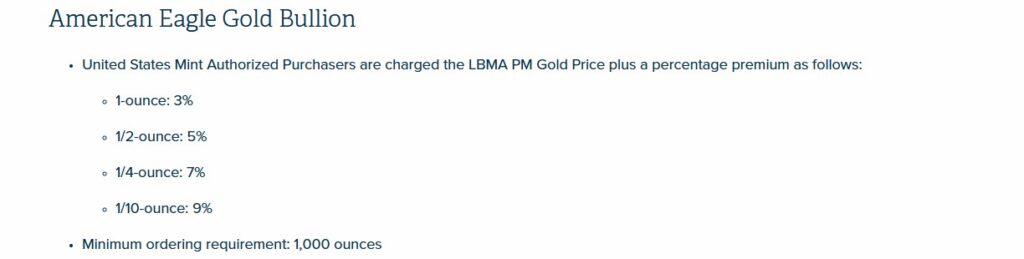
The U.S. Mint, for example, distributes bullion coins at prices that incorporate the prevailing metal value plus premiums related to production, distribution and marketing.
How dealer premiums work
For example, gold trades at $3,000 per ounce.
Dealer A offers a one-ounce bullion coin for $3,135.
The dollar premium is:
$3,135 – $3,000 = $135
The percentage premium is:
$135 ÷ $3,000 = 4.5%
Dealer B offers the same coin for $3,105, apparently making it the cheaper option.
However, Dealer B charges a 2.5% card fee while Dealer A accepts an ACH payment without an additional surcharge.
| Dealer A | Dealer B | |
| Advertised bullion price | $3,135 | $3,105 |
| Payment fee | $0 | $77.63 |
| Shipping | $0 | $0 |
| Final purchase cost | $3,135 | $3,182.63 |
| Effective premium over $3,000 spot | 4.5% | 6.1% |
The cheaper product listing has become the more expensive transaction.
This is why dealer premiums should never be compared without checking the payment method and final checkout price.
Can you buy physical gold at the spot price?
Normally, not on a sustainable retail basis.
Bullion coins and bars have to be manufactured, transported, insured, held as inventory and sold by a dealer. Those costs create a difference between the wholesale metal price and the price paid by a retail investor.
Deals advertised as “gold at spot” can occasionally exist as promotions, but they should be examined in context.
Check:
- Which product is included
- Whether there is a quantity limit
- Whether another purchase is required
- Which payment methods qualify
- Whether shipping is charged
- Whether the seller is reputable
The more useful question is not “Can I buy gold at spot?” but “What is the lowest reasonable all-in premium for the product I actually want?”
Real cost of owning physical gold
Most comparisons stop at the purchase premium. Investors should also consider what happens when the gold is sold.
Physical bullion has a buy price and a sell price.
Consider the following hypothetical transaction.
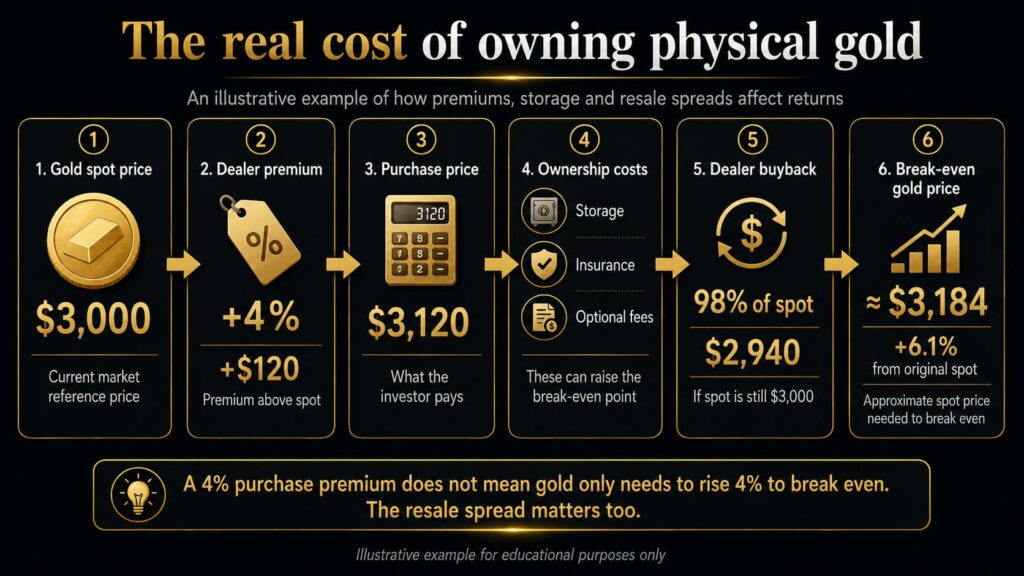
Example: buying and selling one ounce of gold
| Item | Amount |
| Gold spot price at purchase | $3,000 |
| Purchase premium | 4% |
| Amount paid | $3,120 |
| Gold spot price at sale | $3,000 |
| Dealer buyback discount to spot | 2% |
| Sale proceeds | $2,940 |
| Total difference | $180 |
| Percentage loss | 5.8% |
The market price of gold has not moved, but the investor still loses $180.
The reason is simple:
$120 was paid above spot when buying
and
$60 below spot was received when selling
The combined spread is $180.
If the investor also paid $75 in annual storage costs, the total economic difference after one year would be $255.
At a constant dealer spread, gold would need to appreciate enough to overcome those costs before the investment moved into profit.
Break-even example
Assume:
- Initial spot price: $3,000
- Purchase premium: 4%
- Purchase price: $3,120
- Dealer later pays 98% of spot
- No additional storage costs
To receive the original $3,120 back:
Required spot price × 98% = $3,120
Required spot price:
$3,120 ÷ 0.98 = approximately $3,184
Gold therefore needs to rise from $3,000 to approximately $3,184 before this example reaches break-even.
That is an increase of roughly 6.1% even though the original purchase premium was only 4%.
This is why the round-trip spread is more useful than looking at the purchase premium in isolation.
Investors interested in where the underlying market may move can separately follow our regularly updated gold price forecast.
Where to buy physical gold safely
Physical gold in the United States is most commonly bought from specialist online bullion dealers or local bullion and coin dealers.
Banks are a less common retail route, while standard U.S. Mint bullion coins reach consumers through an authorized distribution system rather than being sold directly by the Mint.
Online bullion dealers
Online dealers make comparison relatively easy because investors can check several sellers without visiting multiple locations.
A good product page should make it possible to identify:
- Exact product and weight
- Purity
- Current spot price
- Dealer selling price
- Payment-method pricing
- Available inventory
- Shipping conditions
- Buyback terms
Online purchases do introduce delivery risk, which makes insured shipping and seller reputation particularly important.
For expensive purchases, check what happens if the parcel is lost and at what point responsibility transfers from the seller to the buyer.
Local gold and coin dealers
Local dealers allow the buyer to speak to someone directly, inspect inventory and take possession immediately.
That can be useful, but physical proximity should not replace due diligence.
Ask the dealer for:
- Exact weight and purity
- Price relative to spot
- Total transaction price
- Buyback price for the same product
- Any testing or authentication procedures
If the dealer cannot clearly explain how the price was calculated, that is information in itself.
Can you buy gold from a bank?
Some banks globally offer physical precious metals, but it is not a standard service at most U.S. retail banks.
For U.S. investors, dedicated precious-metal dealers are generally the more common route.
A bank offering investment products or gold-related securities should also not be confused with a bank selling physical bullion that the customer can take possession of.
Can you buy gold directly from the U.S. Mint?
Standard U.S. Mint bullion coins are not sold directly to retail investors by the Mint.
The Mint sells bullion through a network of Authorized Purchasers. These firms distribute products into the broader wholesale and retail market.
That means an investor wanting an American Gold Eagle normally buys through a bullion dealer or another secondary seller.
The Mint does separately sell certain collectible products directly to consumers, but these should not be confused with investment bullion.
How to choose a reputable gold dealer
A bullion purchase combines two risks:
- Paying too much
- Buying from the wrong seller
Price comparison solves only the first.
Before paying a dealer, verify the business itself.
| Check | What to look for |
| Business identity | Verifiable company name, address and contact details |
| Price transparency | Clear relation between product price and spot |
| Fees | Payment and shipping costs disclosed before checkout |
| History | Established operating record |
| Reviews | Independent reviews across more than one platform |
| Shipping | Insured delivery terms |
| Buyback | Clearly explained resale process |
| Products | Recognized bullion from established mints/refiners |
| Sales behavior | No pressure to make an immediate decision |
| Returns/cancellations | Clear written policy |
Consumer-protection agencies such as the CFTC have repeatedly warned precious-metal buyers about high-pressure sales tactics, unsolicited approaches and businesses that are difficult to verify.
Be careful with high-premium collectible coins
Investment bullion and collectible coins are not the same thing.
With bullion, the underlying gold value is the dominant component of the price.
With numismatic coins, the buyer may also be paying for:
- Rarity
- Historical significance
- Condition
- Grading
- Collector demand
Those factors can be legitimate, but they require specialist knowledge.
Suppose gold is worth $3,000 per ounce.
One bullion coin might cost $3,150.
A collectible coin containing a similar amount of gold could theoretically be offered at $4,500 because the seller attributes another $1,350 of value to rarity or collectibility.
The investor is no longer simply making a bet on gold. They are also making a bet on the numismatic premium.
For someone whose objective is straightforward gold exposure, that additional valuation risk is usually unnecessary.
How to compare gold dealer prices
Use a standardized comparison.
Do not compare one dealer’s American Gold Eagle with another dealer’s generic bar and conclude that one seller is cheaper.
Choose the exact product first.
For example:
Product: 1 oz American Gold Eagle
Then compare:
| Cost component | Dealer A | Dealer B | Dealer C |
| Product price | $ | $ | $ |
| Payment fee | $ | $ | $ |
| Shipping | $ | $ | $ |
| Insurance | $ | $ | $ |
| Total delivered price | $ | $ | $ |
| Premium over spot | % | % | % |
| Current buyback offer | $ | $ | $ |
| Round-trip spread | % | % | % |
This gives a far better picture than sorting dealers from lowest to highest advertised selling price.
Calculate the premium yourself
Use:
Premium % = (final bullion price – spot value) ÷ spot value × 100
If a one-ounce product costs $3,150 when gold is $3,000:
($3,150 – $3,000) ÷ $3,000 × 100 = 5%
For fractional products, first calculate the gold content correctly.
A smaller coin may have a lower absolute dollar premium but a substantially higher percentage premium.
How to buy physical gold online
Once the product and dealer have been selected, the online purchase itself should be straightforward.
1. Set the investment amount
Decide on the dollar allocation before browsing dealer inventory. Otherwise it is easy to let product availability or sales messaging determine how much you invest.
2. Select the bullion product
Choose the form, weight and quantity. Check that you are looking at standard bullion if bullion is what you intend to buy.
3. Check spot and calculate the premium
Record the current spot price and calculate how far above it the product trades. This creates a reference point for comparing other dealers.
4. Compare at least several sellers
Use the same:
- Product
- Quantity
- Payment method
- Delivery assumptions
A comparison only works when the transaction is genuinely equivalent.
5. Check the buyback price
Even if you have no intention of selling soon, check what the dealer currently pays for the product. That number helps reveal the full market spread.
6. Review shipping and insurance
For larger orders, confirm whether:
- Delivery is insured
- A signature is required
- Tracking is available
- Packaging is discreet
- Claims procedures are documented
7. Complete payment
Use the dealer’s official payment process. Different payment methods may have different settlement times and prices, so verify the final amount before confirming.
8. Save the documentation
Keep:
- Order confirmation
- Invoice
- Payment record
- Product description
- Serial numbers where applicable
- Delivery documentation
These records can later be relevant for tax, insurance and resale purposes.
What to check when your gold arrives
Do not simply put an unopened package into storage.
Check the order when it arrives.
Confirm that:
- The products match the invoice
- The stated weight is correct
- The expected quantity is present
- Mint or refinery markings match the order
- Assay packaging is intact where relevant
- Serial numbers correspond with documentation where applicable
- The parcel shows no signs of tampering
For standard bullion purchased from a major dealer, extensive authentication may not be necessary on every transaction.
The risk changes when buying from an individual or unfamiliar source.
Professional bullion verification
Professional bullion verification can involve:
- Precise weighing
- Dimensional measurement
- Magnetic testing
- Electrical conductivity testing
- Ultrasound
- X-ray fluorescence analysis
An investor does not need to own all of this equipment, but should understand that professional verification goes beyond simply looking at a coin.
Where should you store physical gold?
Storage changes the economics and risk profile of owning bullion.
The three common options are home storage, a bank safe deposit box and professional vault storage.
| Factor | Home safe | Safe deposit box | Professional vault |
| Immediate access | Excellent | Limited | Limited |
| Physical security | Setup dependent | High | Very high |
| Direct possession | Yes | Yes, but off-site | Usually no immediate possession |
| Ongoing cost | Low after safe purchase | Annual fee | Annual fee |
| Insurance | Must verify | Must verify | Often available/included |
| Suitable for larger holdings | Depends on setup | Moderate | Strong |
Home storage
Home storage gives the owner immediate access and removes reliance on a third-party custodian.
It also concentrates theft risk at home.
For a meaningful holding, the calculation should include:
- Cost of a suitable safe
- Installation
- Insurance
- Accessibility
- Fire resistance
- Privacy
The value of the bullion should also be checked against insurance policy limits. Precious metals and other valuables can have lower coverage limits than ordinary household contents.
Safe deposit box
A bank safe deposit box moves the physical asset away from the home.
The primary disadvantages are restricted access and the need to verify insurance separately.
Money deposited in a bank account and bullion stored inside a safe deposit box are not the same thing. Do not assume protections applying to deposits automatically apply to the contents of a box.
Professional vault storage
Professional storage is particularly relevant as holdings become larger.
Before using a vault provider, understand whether the gold is:
Allocated
Specific gold is identified as belonging to the client
or
Unallocated
The client has a claim relating to gold rather than ownership of specifically identified bars or coins
Other questions include:
- Is the gold independently audited?
- Who provides insurance?
- Can the owner request physical delivery?
- What does withdrawal cost?
- Are storage fees fixed or percentage-based?
- In which jurisdiction is the gold stored?
These details matter more than a small difference in annual storage fees.
Should you insure physical gold?
Insurance becomes more important as the size of the holding increases.
A homeowner’s policy may cover some valuables but still impose limits that are far below the market value of a significant bullion position.
For example, an investor holding $50,000 of gold should not assume that a general household policy automatically provides $50,000 of precious-metal protection.
Ask the insurer specifically about bullion.
For professional vault storage, determine whether insurance is:
- Included in the quoted storage fee
- Provided by an external insurer
- Based on full replacement value
- Subject to exclusions
Keep purchase documentation because ownership and value can be difficult to establish after a loss without records.
How to sell physical gold
Recognized bullion products tend to have wider resale markets because dealers know exactly what they are buying.
Potential buyers include:
- Online bullion dealers
- Local bullion dealers
- Coin shops
- Precious-metal buyers
- Private buyers
The highest quoted price is not necessarily the best route if the transaction introduces greater fraud, payment or personal-safety risk.
Calculate the resale spread
For example:
- Spot price: $3,500
- Dealer offers 99% of spot for a recognized one-ounce coin
- Another buyer offers 97% of spot
The difference is:
| Buyer A | Buyer B | |
| Spot value | $3,500 | $3,500 |
| Percentage of spot offered | 99% | 97% |
| Cash proceeds | $3,465 | $3,395 |
| Difference | $70 |
On one ounce the difference is $70.
On 20 ounces, the same pricing difference becomes $1,400.
Liquidity therefore matters increasingly as the size of the position grows.
Why recognizable bullion can be easier to sell
Mainstream bullion products have several advantages in the resale market:
- Dealers already know their specifications
- Wholesale markets exist for common products
- Authentication procedures are standardized
- Prices can be referenced easily
- Buyer demand tends to be broader
A small saving on an obscure product may not be worthwhile if the exit market is substantially weaker.
How is physical gold taxed in the US?
Physical gold receives specific treatment under U.S. federal tax rules.
The IRS includes gold bullion and certain coins within the collectibles rules for capital gains.
For long-term gains, collectibles can be subject to a maximum federal rate of 28%.
This is often misunderstood.
It does not mean every long-term gain on physical gold is automatically taxed at 28%. The actual treatment depends on the investor’s tax position, and a taxpayer whose applicable rate is lower does not simply get pushed to 28% because the asset is gold.
Short-term gains can be treated differently, while state-level taxation may also apply.
Keep accurate records of:
- Purchase date
- Purchase price
- Dealer fees
- Quantity
- Sale date
- Sale proceeds
Tax treatment can change and individual circumstances vary, so current IRS guidance or qualified tax advice should be used for personal tax decisions.
Note: this is purely for educational purposes. Nothing here is financial advice.
Does the IRS know when you buy gold?
There is no universal reporting rule that can be summarized as “all gold purchases are reported” or “gold purchases are private”.
Reporting requirements depend on factors such as the transaction structure, payment method, product and later sale.
The more important point for the investor is that tax obligations do not disappear simply because a dealer does or does not file a particular form.
Maintain records and report taxable transactions according to the rules that apply to your situation.
Physical gold vs a gold ETF
Physical bullion and gold ETFs can both provide exposure to gold, but the ownership experience is very different.
| Factor | Physical gold | Gold ETF |
| Direct ownership | Yes | Ownership of fund shares |
| Personal storage | Required | No |
| Insurance | Potentially required | Handled within fund structure |
| Trading | Dealer-based | Stock exchange |
| Purchase friction | Higher | Low |
| Ongoing cost | Storage/insurance possible | Expense ratio |
| Rebalancing | Less convenient | Easy |
| Direct possession | Possible | No |
| Typical use | Direct ownership and diversification | Efficient portfolio exposure |
An investor who simply wants price exposure may find an ETF easier to buy, hold and rebalance.
Physical gold becomes more compelling when direct ownership itself is part of the objective.
We examine this decision separately in our comparison of physical gold vs gold ETFs.
Common mistakes when buying physical gold
The most expensive mistakes are usually avoidable. Below you will find common mistakes when buying physical gold from newsletter readers and others who reach out to us.
Looking only at the headline premium
A dealer may advertise a low premium over spot, but that does not automatically mean the total purchase is cheap. Payment surcharges, shipping costs and insurance can push the final price above a competing offer. Compare the total delivered cost for the same product and payment method. The effective premium after all transaction costs is the number that matters.
Buying a collectible when you wanted bullion
Collectible and numismatic coins can carry premiums that are driven by rarity, condition and collector demand rather than gold content alone. That creates an additional source of valuation risk for an investor who simply wants exposure to physical gold. A coin containing $3,000 worth of gold may trade for substantially more if a dealer assigns a high collectible value to it. If your objective is bullion exposure, make sure most of the purchase price can be explained by the underlying gold value.
Ignoring the resale market
The cost of buying gold should be considered together with the price you are likely to receive when selling it. Widely recognized bullion coins and bars generally have broader dealer markets and more transparent buyback pricing. An obscure product may appear cheaper at purchase but attract a larger discount when you want to exit. Checking current buyback prices before buying gives you a better idea of the potential round-trip spread.
Buying fractional gold without comparing percentage premiums
Fractional coins and small bars make it possible to invest smaller amounts and provide more flexibility when selling. The downside is that manufacturing and distribution costs are spread over less gold, which can result in a much higher premium per ounce. A quarter-ounce coin should therefore not be compared with a one-ounce coin using the dollar premium alone. Calculate the premium as a percentage of the underlying gold value before deciding which size offers the better trade-off.
Failing to arrange storage before buying
Storage should be part of the purchase plan, especially when the order is worth several thousand dollars or more. Leaving bullion in an ordinary drawer or temporary hiding place creates unnecessary theft and insurance risk. Decide in advance whether the gold will be kept in a secure home safe, bank safe deposit box or professional vault. The cost and accessibility of that storage option should also be included in the overall ownership calculation.
Assuming insurance is automatic
Physical gold is not always fully covered by standard home insurance or by the security arrangement where it is stored. Some policies place specific limits on precious metals, while safe deposit boxes may not include insurance for their contents at all. Professional vault providers can include insurance, but the level of coverage and exclusions still need to be checked. Confirm the actual insured value rather than assuming the entire holding is protected.
Investing more because gold feels safe
Physical gold removes some forms of financial counterparty exposure, but it does not remove investment risk. The gold price can fall, remain flat for long periods or underperform assets that generate earnings, dividends or interest. A large physical position can also become expensive to store and harder to rebalance efficiently. The allocation should therefore be based on your broader portfolio, risk tolerance and investment objectives rather than the perception that owning a tangible asset makes it risk-free.
Conclusion: buying physical gold
Physical gold is most useful when direct ownership is part of the investment objective.
It gives investors control over a tangible asset, but that control comes with additional friction. You have to compare dealer pricing, manage storage, consider insurance and eventually find a buyer.
For investors mainly seeking efficient exposure to gold prices, exchange-traded products can be cheaper and easier to rebalance. We compare several options in our guide to the best gold ETFs.
If you choose physical bullion, focus on four things: a recognizable product, a competitive all-in purchase price, secure storage and a clear resale market. Getting those four decisions right matters more than finding the absolute lowest advertised premium on the day you buy.
Frequently Asked Questions
Buy recognized bullion from an established dealer with transparent pricing, verifiable business details, clear shipping terms and a documented buyback process.
Coins usually offer better flexibility and easier resale, while larger bars often have lower premiums. The better choice depends on your budget and how important divisibility is to you.
There is no fixed premium that is always reasonable. Compare the same product across several dealers and focus on the total delivered price rather than the advertised premium alone.
It depends on the current gold price and the premium on the product. Fractional coins and small bars allow smaller purchases, but they often carry higher percentage premiums.
Yes, online bullion dealers are a common option in the US, but you should verify the seller, compare the total price and make sure delivery is insured.
Not standard bullion coins. U.S. Mint bullion products such as American Gold Eagles are distributed through Authorized Purchasers and then sold through dealers.
Buying from a reputable dealer greatly reduces the risk. Weight, dimensions, markings, serial numbers and professional testing can also be used to verify authenticity.
Common options are a secure home safe, a bank safe deposit box or professional vault storage. The best choice depends on the value of your holding, access needs and insurance.
Yes, profits can be taxable. Physical gold can fall under the IRS collectibles rules, with long-term gains potentially subject to a maximum federal rate of 28%.
Important disclaimer
The information in this guide is provided for educational and informational purposes only. It should not be considered personalized investment, financial, legal or tax advice, nor a recommendation to buy or sell gold or any other investment.
Physical gold involves risks and costs, including price fluctuations, dealer premiums, bid-ask spreads, storage, insurance and potential tax liabilities. Examples and calculations used throughout this guide are illustrative and should not be interpreted as current dealer quotes or expected investment returns.
Tax rules and reporting requirements depend on your individual circumstances and can change over time. Always check the latest guidance from the IRS and other relevant authorities, and consider consulting a qualified financial, legal or tax professional when appropriate.
MyInvestAcademy does not guarantee the accuracy of third-party prices, dealer terms or external information after publication. We periodically review our content and update material information when necessary.
References
- Buying U.S. Mint bullion coins and Authorized Purchasers – (U.S. Mint)
- Gold spot prices, premiums and bullion buyer precautions – (U.S. Mint)
- Safe deposit boxes, home safes and insurance considerations – (FDIC)
- Tax treatment of gold bullion and collectibles gains – (Internal Revenue Service)
- U.S. Mint bullion premiums and distribution structure – (U.S. Mint)
