
-
Mark Verwoert
- Last updated: August 29, 2026
Educational Disclaimer: The content on myinvestacademy.com is for educational and informational purposes only. We are not licensed financial advisors, and nothing in this article should be interpreted as professional investment, legal, or tax advice. Investing involves risk of loss. Always consult with a professional before making financial decisions.
Gold ETF vs physical gold: Which is better in 2026?
In comparing a gold ETF vs physical gold, both give you exposure to gold, but the ownership experience is very different. For most investors who simply want gold inside a portfolio, an ETF is cheaper and easier to manage. Physical gold becomes more compelling when direct ownership itself is part of the reason you are investing.
Key takeaways
Neither option is better in every situation. The right choice depends largely on whether you value efficient portfolio exposure or direct possession of the metal.
- Best for most portfolio investors: Gold ETF
- Best for direct ownership: Physical gold
- Best for liquidity and easy rebalancing: Gold ETF
- Best for holding wealth outside a brokerage account: Physical gold
- Best for small recurring investments: Gold ETF
- Best when physical possession is the goal: Physical gold
- Best if both objectives matter: Owning both can make sense
A physical gold ETF can remove much of the inconvenience of buying bullion yourself, but you still own shares in an investment vehicle rather than personally holding the metal. Products such as GLDM hold physical bullion while their shares trade on an exchange.
Gold ETF vs physical gold at a glance
The differences become clearer when you compare the two forms of gold ownership side by side. Costs matter, but ownership, liquidity and storage are just as important.
| Factor | Gold ETF | Physical gold |
|---|---|---|
| Ownership | Shares in a fund or trust | Direct ownership of bullion |
| Gold exposure | Gold price minus fund costs | Gold price minus buying, selling and ownership costs |
| How you buy | Brokerage account | Bullion dealer |
| Purchase costs | Bid-ask spread and possible commission | Premium above spot price |
| Ongoing costs | Expense ratio | Storage and insurance may apply |
| Selling costs | Bid-ask spread | Dealer buyback spread |
| Liquidity | Usually high | Depends on dealer and product |
| Storage | Managed within the fund structure | Your responsibility |
| Physical possession | Usually no | Yes |
| Rebalancing | Easy | Less convenient |
| Small recurring purchases | Easy | Often less efficient |
| Financial-system exposure | Broker, trust and custodian structure | Lower once bullion is directly held |
| Best suited to | Efficient portfolio exposure | Direct ownership |
The table also explains why asking which one is simply “safer” can be misleading. Each removes certain risks while introducing others.
What is the difference between a gold ETF and physical gold?
A physically backed gold ETF or trust holds bullion while investors trade shares through a brokerage account. GLDM, for example, holds physical gold and is designed for its shares to reflect the price of gold bullion after expenses. Its shareholders own an interest in the trust rather than taking possession of individual bars.
Physical gold removes that investment-vehicle layer. You buy coins or bars from a dealer and own the metal directly. You then become responsible for storing it securely and eventually finding a buyer when you want to sell.
For investors whose goal is simply to add gold exposure to a portfolio, the ETF structure is usually more convenient. If direct possession matters, physical bullion provides something an ETF cannot.
If you prefer the ETF route, see our comparison of the best gold ETFs for low costs, liquidity and physical backing.
Gold ETF vs physical gold: pros and cons
Both approaches solve different problems. Looking at their advantages and disadvantages separately makes it easier to understand which compromises matter to you.
Gold ETF pros and cons
A gold ETF fits naturally into a conventional investment portfolio. You can buy it alongside stocks and bonds, sell it through the same brokerage account and rebalance the position without arranging storage or transportation.
Pros
- Easy to buy and sell
- No personal bullion storage
- Suitable for small investment amounts
- Easy portfolio rebalancing
- Highly liquid products are available
- Transparent market pricing during trading hours
Cons
- Annual fund expenses
- No direct possession of bullion
- Exposure to the fund, custodian and brokerage structure
- Market price can differ slightly from underlying asset value
- Trading depends on functioning financial markets and exchanges
ETF shares trade at market prices, which can be above or below the value of the underlying assets. Brokerage commissions and fund expenses can also reduce investor returns.
Physical gold pros and cons
Physical gold gives you direct control over the asset. Once you have purchased and taken custody of the gold, there is no fund manager or brokerage account between you and the metal.
Pros
- Direct ownership
- Physical possession
- No annual ETF expense ratio
- Can be stored outside the brokerage system
- No dependence on a fund structure
- Useful when direct ownership is part of the investment thesis
Cons
- Dealer premiums when buying
- Dealer spread when selling
- Secure storage is required
- Insurance may add costs
- Harder to rebalance
- Authentication and dealer selection matter
- Small purchases can be relatively expensive
FINRA warns investors to look beyond the spot price when buying bullion. Dealers typically sell above spot and buy below it, while storage, insurance and other fees can add further costs.
Gold ETF vs physical gold costs
Comparing an ETF expense ratio with a storage fee is not enough. The more useful comparison is the total cost of ownership from the day you buy until the day you sell.
For a long holding period, even relatively small annual costs can add up. For a shorter holding period, transaction costs and dealer spreads can matter more.
Gold ETF costs
A physically backed gold ETF generally has three potential cost layers: the annual fund fee, the bid-ask spread and any brokerage charges that apply to your account.
GLDM currently lists a gross expense ratio of 0.10%. Its objective is to track gold bullion after expenses, so those ongoing costs create a small drag relative to holding the underlying metal without fund expenses.
Trading also introduces a spread between the bid and ask price. For large, liquid funds this can be small, but it is still part of the true cost of buying and selling.
Physical gold costs
Physical bullion does not charge an expense ratio, but that does not make ownership free.
A dealer normally sells coins or bars above the current spot value of their metal content. When you sell, the dealer may offer less than spot. FINRA describes the gap between those buy and sell prices as the dealer spread and recommends getting all fees and costs in writing before purchasing.
Storage can create another cost. A home safe, bank facility or specialist vault all have different trade-offs, and insurance may be worth considering depending on how and where the bullion is held.
Small coins can also carry larger percentage premiums than more standardized investment bars. This makes physical gold less efficient for investors who want to invest small amounts every month.
Gold ownership, storage and counterparty risk
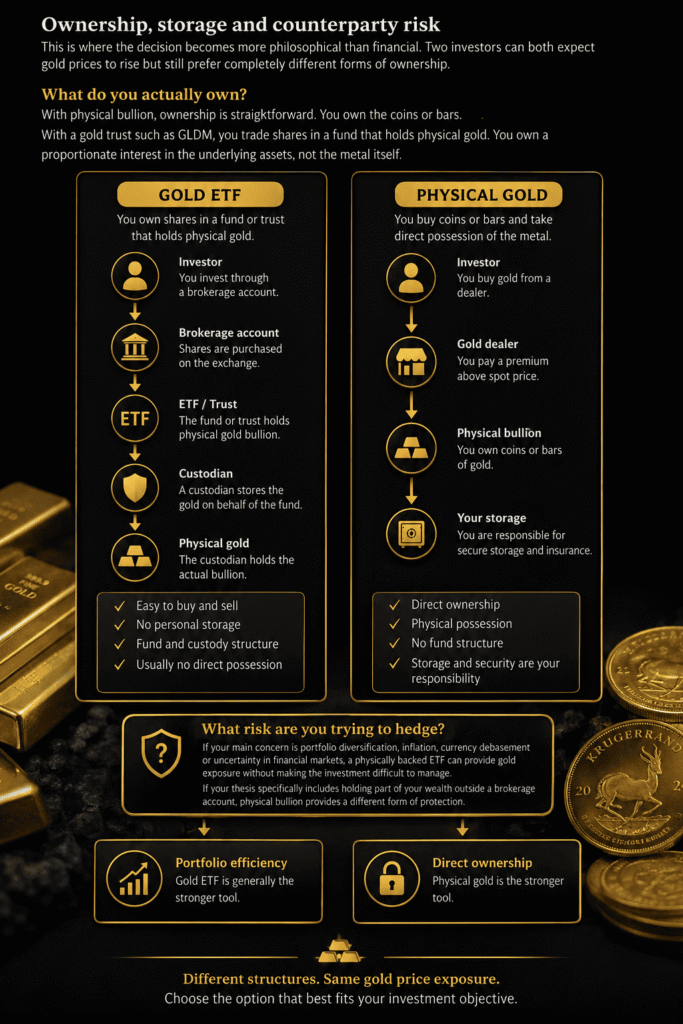
This is where the decision becomes more philosophical than financial. Two investors can both expect gold prices to rise but still prefer completely different forms of ownership.
The key question is not only why do you want gold? It is also what risk are you trying to hedge?
What do you actually own?
With physical bullion, ownership is straightforward. You own the coins or bars.
With a gold trust such as GLDM, the structure is different. GLDM is treated as a grantor trust for U.S. federal tax purposes, and its shareholders are generally treated as owning a proportionate interest in the underlying assets for tax purposes. In practical investment terms, however, retail investors trade trust shares rather than individually taking possession of the bullion.
That distinction matters most when direct control over the asset is part of your objective.
What risk are you trying to hedge?
If your main concern is portfolio diversification, inflation, currency debasement or uncertainty in financial markets, a physically backed ETF can provide gold exposure without making the investment difficult to manage.
If your thesis specifically includes holding part of your wealth outside a brokerage account, physical bullion provides a different form of protection. An ETF still depends on functioning exchanges, brokers, custodians and a legal trust or fund structure.
Physical ownership is not risk-free. It replaces some financial-system dependencies with storage, theft, loss, authenticity and resale risks. FINRA explicitly cautions that precious metals can decline in value and that physical-metal investors need to consider dealer quality and storage-related costs.
Which is easier to buy and sell?
Gold ETFs have the clear advantage when convenience and liquidity are the priority.
An investor can normally buy or sell shares through a brokerage account during market hours. ETFs also make it easy to invest a precise dollar amount, add to a position regularly or trim a gold allocation as part of a portfolio rebalance. SEC investor guidance notes that ETF shares trade on exchanges at market prices throughout the trading day.
Selling physical bullion involves another process. You need a dealer or buyer, the product may need to be verified and the price offered can differ meaningfully from the spot gold price.
For someone who expects to trade, rebalance or gradually build a position, a gold ETF is generally the more practical choice.
Do gold ETFs and physical gold have the same returns?
Both are ultimately exposed to the same underlying gold market, so their values should generally respond to changes in the gold price. Your actual investment return can still differ.
A gold ETF deducts ongoing fund expenses and introduces trading spreads. GLDM, for example, is explicitly designed to reflect the price of bullion less its expenses.
Physical bullion introduces costs in a different way. If you buy a coin above spot and later sell it below spot, gold needs to appreciate enough to overcome that round-trip spread before you make a profit. Storage and insurance can widen the difference further. FINRA specifically recommends comparing the dealer’s retail price with spot and asking what the dealer would pay if you sold the metal back immediately.
The gold-price chart is therefore not necessarily the return an individual investor receives from either structure.
How are gold ETFs and physical gold taxed?
Tax treatment depends on where you live, the type of gold you own and the legal structure of the investment. Physical bullion and gold ETFs are not automatically taxed in the same way, and even different gold funds can receive different treatment.
In the United States, gains on certain precious metals can fall under collectibles rules, while some physically backed gold trusts may receive similar treatment. Rules elsewhere can be very different. Qualifying investment gold is generally exempt from VAT in the European Union, while the United Kingdom also provides a VAT exemption for qualifying investment gold coins.
The practical takeaway is to check the rules in your country of tax residence before choosing between physical gold and an ETF. Capital gains taxes, purchase taxes, tax-advantaged accounts and the structure of the ETF can all affect your after-tax return. Tax rules change and individual circumstances differ, so consider checking with your local tax authority or a qualified tax professional before investing.
Should you buy physical gold or a gold ETF?
For most investors, the choice becomes easier once you decide what job gold is supposed to perform in the portfolio.
A gold ETF is usually the stronger tool for efficient investment exposure. Physical bullion is the stronger tool when direct ownership is itself part of the objective.
Choose a gold ETF if
A gold ETF will usually make more sense if you want to treat gold like another portfolio allocation.
Consider an ETF if:
- You mainly want exposure to the gold price
- You value high liquidity
- You want easy portfolio rebalancing
- You invest relatively small amounts
- You make recurring purchases
- You do not want to manage storage
- You already invest through a brokerage account
If that sounds like your situation, our best gold ETFs comparison covers the strongest physical-backed options in more detail.
Choose physical gold if
Physical bullion is more logical when ownership and custody are central to why you want gold.
Consider physical gold if:
- You want direct possession of the asset
- You want part of your wealth outside a brokerage account
- You are comfortable arranging secure storage
- You accept higher transaction friction
- You expect to hold for a long period
- You specifically want an asset that does not depend on a fund structure
The trade-off is convenience. You take control of the gold, but you also take responsibility for it.
Our upcoming how to buy physical gold guide covers dealers, coins, bars, premiums and storage in more detail.
Does it make sense to own both?
Yes, a gold ETF and physical bullion do not have to be mutually exclusive.
An investor might use an ETF for a liquid portfolio allocation while keeping a separate amount of bullion for direct ownership. That allows each structure to perform the job it is best suited to.
There is no universal percentage that belongs in either form. The appropriate split depends on why you hold gold, how much liquidity you need and how comfortable you are managing physical assets.
Gold ETF or physical gold: which should you choose?
For most investors who simply want gold exposure inside an investment portfolio, a low-cost physically backed gold ETF is the more practical choice. It is easier to buy, easier to sell and much simpler to rebalance.
Physical gold serves a different purpose. It makes more sense when direct possession, independent custody or holding assets outside a brokerage account are important parts of your gold thesis.
Our preference therefore depends on the goal:
- Portfolio efficiency: Gold ETF
- Direct ownership: Physical gold
- Maximum liquidity: Gold ETF
- No personal storage: Gold ETF
- Holding wealth outside a brokerage account: Physical gold
- Both objectives: Consider using both structures
The important point is not to confuse exposure to the gold price with direct ownership of gold. They can produce similar economic exposure, but they do not give you the same type of asset.
Frequently asked questions about gold ETFs vs physical gold
For most investors who want liquid gold exposure inside a portfolio, a gold ETF is more convenient and generally easier to trade.
Physical gold is better suited to investors who specifically want direct possession and are comfortable managing storage and resale themselves.
Physical gold removes much of the fund, broker and custodian structure once you take possession, but it introduces theft, loss, storage and authenticity risks. A gold ETF avoids personal storage but relies on its financial and custody infrastructure.
A gold ETF is usually more cost-efficient for investors making small or regular purchases because physically backed funds can have low annual fees and tight trading spreads.
Physically backed products such as GLDM hold bullion as their underlying asset. Other gold investment products may use futures, derivatives or mining-company shares instead, so always check the fund documentation before investing.
Ordinary retail investors generally cannot redeem a few ETF shares and receive a gold bar. Creation and redemption mechanisms are typically designed around large institutional participants.
Gold is often held by investors who want diversification and protection against a long-term loss of purchasing power, but it does not move in lockstep with inflation.
Owning both can make sense when you want two different things from your gold allocation.
An ETF can provide liquid portfolio exposure, while physical bullion provides direct ownership. Whether you need both depends on your investment objective rather than a fixed formula.
Disclaimer
This content is for informational and educational purposes only and does not constitute financial, investment, tax or legal advice. Investments can rise or fall in value, and past performance is not a guarantee of future results.
Always do your own research and consider your personal circumstances, objectives and risk tolerance before making investment decisions.
