
-
Mark Verwoert
- Last updated: August 17, 2026
Educational Disclaimer: The content on myinvestacademy.com is for educational and informational purposes only. We are not licensed financial advisors, and nothing in this article should be interpreted as professional investment, legal, or tax advice. Investing involves risk of loss. Always consult with a professional before making financial decisions. See disclaimers at the bottom of the page.
Pepperstone Review 2026: Fees, Platforms, Pros & Cons
Pepperstone is one of the more interesting brokers for active forex and CFD traders. Instead of building its proposition around long-term investing, the broker focuses heavily on execution, competitive spreads and giving traders a choice between platforms such as TradingView, MetaTrader 4, MetaTrader 5, cTrader and Pepperstone’s own platform.
In this Pepperstone review, we break down the broker’s fees, spreads, account types, minimum deposit, regulation, leverage and trading platforms. More importantly, we look at where Pepperstone actually makes sense compared with the alternatives.
Pepperstone review: Quick verdict
Our editorial rating: 4.7/5
Best for: Active forex traders, CFD day traders, scalpers and traders who want TradingView, MT4, MT5 or cTrader.
Main strengths: Competitive Razor pricing, excellent platform choice and an execution-focused trading setup.
Main drawbacks: Pepperstone is primarily built around CFDs and leveraged products, does not serve US residents and does not have the same proposition as a traditional broker for investors who want to own stocks outright.
Pepperstone is one of our stronger choices for traders whose priority is execution and platform flexibility rather than long-term investing. The Razor account is particularly compelling for frequent forex traders because it separates the raw spread from the commission instead of hiding all trading costs inside a wider spread.
The other major advantage is choice. Some brokers force you onto their proprietary platform. Pepperstone lets you choose between its own interface, TradingView, MT4, MT5 and cTrader, although platform availability differs slightly between Standard and Razor accounts.
For a discretionary forex day trader, we would look particularly closely at TradingView and cTrader. Algorithmic traders may prefer MT4, MT5 or cTrader, while newer traders may find Pepperstone’s own platform less intimidating.
Who should use Pepperstone?
Pepperstone is particularly worth considering if you:
- Actively trade forex or CFDs
- Want raw-spread pricing
- Use TradingView for technical analysis
- Already trade through MT4 or MT5
- Prefer cTrader
- Scalp or place a relatively high number of trades
- Use Expert Advisors or other automated strategies
- Want a demo account before trading live
Who should consider another broker?
Pepperstone is probably not the best fit if you:
- Live in the United States
- Primarily want to buy and hold actual shares
- Want a traditional retirement or long-term investing account
- Do not understand how leveraged CFDs work
- Are looking for a simple buy-and-hold investment app rather than an active trading platform
If your priority is trading actual exchange-listed stocks rather than CFDs, compare Pepperstone with the brokers in our guide to the best day trading platforms before opening an account.
Pepperstone pros and cons
Beneath we will highlight the pros and cons of Pepperstone. This will allow you to have a better understanding of this trading platform and whether it might be something that fits your needs.
Pros
- Razor spreads from 0.0 pips on forex
- Standard and Razor account options
- TradingView integration
- MetaTrader 4 and MetaTrader 5
- cTrader support
- Pepperstone proprietary web and mobile platform
- No traditional inactivity fee
- Demo accounts available
- Scalping and algorithmic trading are supported
- Broad international regulatory footprint
- Wide range of forex and CFD markets
Cons
- Not available to US residents
- Primarily focused on CFDs and leveraged trading
- You generally do not own the underlying asset when trading a CFD
- Costs and leverage vary by jurisdiction
- TradingView availability depends on account type and region
- The number of platform and account combinations may initially be confusing for beginners
- Overnight financing can become significant if positions are held beyond the trading day
Pepperstone at a glance
| Feature | Pepperstone |
|---|---|
| Founded | 2010 |
| Origin | Melbourne, Australia |
| Main products | Forex and CFDs |
| Main account types | Standard and Razor |
| Minimum deposit | No universal account-opening minimum, funding minimums vary |
| Razor forex spreads | From 0.0 pips |
| Razor commission | From $3.50 per lot per side on MT4/MT5 for USD-denominated accounts |
| Platforms | Pepperstone, TradingView, MT4, MT5, cTrader |
| Demo account | Yes |
| Inactivity fee | No traditional inactivity fee |
| Retail EU leverage | Up to 30:1 on major forex pairs |
| US clients | No |
| Best for | Active forex and CFD traders |
Pepperstone was founded in Melbourne in 2010 and has since expanded into a large international trading group with multiple regulated entities.
Its proposition is quite different from that of a conventional investment broker. Pepperstone is designed primarily around short-term and leveraged trading rather than passive investing.
What is Pepperstone?
Pepperstone is an Australian-founded forex and CFD broker that has built its business around active trading technology, pricing and execution.
That distinction matters.
If you open a traditional brokerage account to buy shares of Apple, Microsoft or an ETF, you generally purchase an ownership interest in the underlying security. With a CFD, you instead enter into a contract based on the movement in the underlying market’s price. You do not own the underlying asset itself.
CFDs can therefore be useful for short-term trading, going long or short and using leverage, but those same characteristics increase risk considerably.
Pepperstone offers CFDs across asset classes including forex, indices, shares, commodities, cryptocurrencies and ETFs, although the exact products available depend on your country, regulatory entity and trading platform.
That is why we see Pepperstone primarily as an active trading broker, not as a substitute for a diversified long-term investment account.
Is Pepperstone safe and legit?
Yes, Pepperstone is a legitimate regulated broker.
The Pepperstone group operates through multiple legal entities and is regulated in several jurisdictions. Regulators associated with Pepperstone include the UK’s Financial Conduct Authority, the Australian Securities and Investments Commission, the Cyprus Securities and Exchange Commission, Germany’s BaFin, the Dubai Financial Services Authority, Kenya’s Capital Markets Authority and the Securities Commission of The Bahamas.
The critical point is that your protection depends on the Pepperstone entity with which your account is registered.
Do not assume that every Pepperstone client receives identical leverage limits, investor protection, negative balance protection or compensation arrangements.
Pepperstone regulation
For European customers using Pepperstone EU Limited, the relevant entity is regulated by CySEC.
UK clients trade under an FCA-regulated entity, while Australian customers can fall under ASIC regulation.
These are meaningful protections, but regulation does not eliminate trading risk. A regulated CFD account can still lose money very quickly when leverage is used.
The regulatory entity also influences details such as:
- Maximum leverage
- Negative balance protection
- Available instruments
- Professional client classification
- Funding options
- Marketing restrictions
For that reason, we recommend checking the legal entity shown during registration rather than relying on conditions shown on a Pepperstone website for another country.
Are Pepperstone client funds segregated?
Pepperstone’s fees are competitive enough to be one of the main reasons active traders consider the broker.
The first thing to understand is that Standard and Razor accounts charge you differently.
Pepperstone spreads
On a Standard account, Pepperstone incorporates its broker markup into the forex spread and does not charge a separate commission on most forex trades.
The Razor account works differently.
Pepperstone provides raw pricing, with forex spreads advertised from 0.0 pips, and charges a separate commission. On MT4 and MT5, commissions for USD-denominated accounts start from $3.50 per standard lot per side.
A spread “from 0.0 pips” does not mean every trade will have a zero spread.
Spreads are variable and can widen around:
- Major economic announcements
- Market opens
- Low-liquidity periods
- Unexpected geopolitical events
- Central-bank announcements
- Periods of extreme volatility
That is one reason we prefer looking at total trading cost rather than choosing a broker solely because its marketing says “0.0 pips.”
Pepperstone Razor account commission
The Razor commission depends partly on the platform.
Pepperstone’s forex commission structure can differ between cTrader, TradingView, MT4 and MT5. Your account currency can also influence how the commission is displayed.
For very active traders, these differences matter.
A trader placing hundreds of transactions per month should compare the complete trading cost on the exact platform being used rather than looking only at the minimum advertised spread.
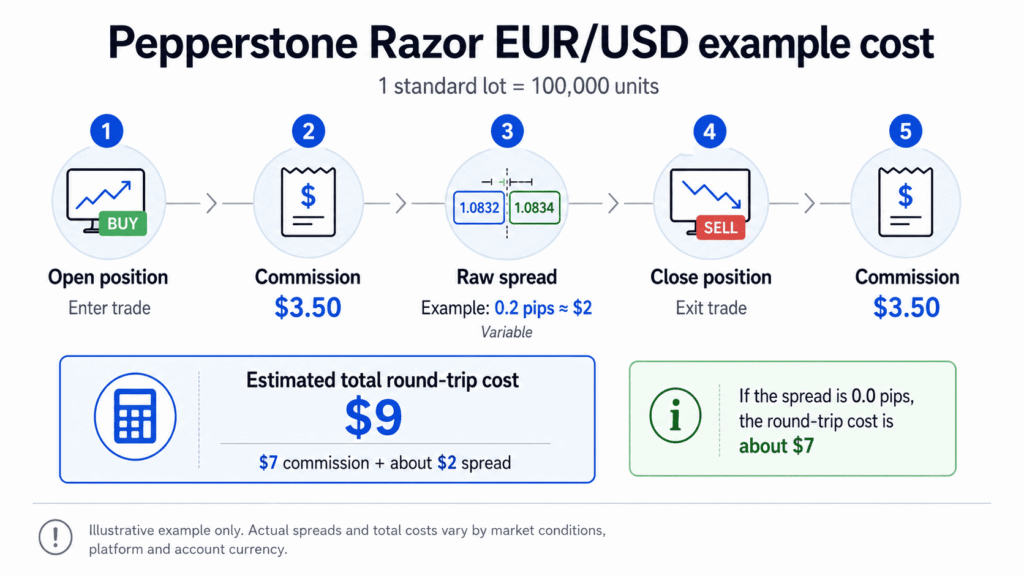
What does a Pepperstone EUR/USD trade actually cost?
Consider a one-standard-lot EUR/USD trade.
One standard lot represents 100,000 units of the base currency. For EUR/USD, one pip on a standard lot is generally worth approximately $10.
On an MT4 or MT5 Razor account with a commission of $3.50 per lot per side, the commission component would be:
- $3.50 to open
- $3.50 to close
- $7 total round-trip commission
You then add the actual spread at the time your trades execute.
If the raw EUR/USD spread happened to be 0.0 pips when entering and exiting, your commission component would therefore be approximately $7 for the complete one-lot round trip.
If the spread is 0.2 pips, that spread represents roughly another $2 on a one-standard-lot EUR/USD position.
The estimated total transaction cost would therefore be around $9 in that simplified example.
Actual costs vary because spreads are variable and execution can include positive or negative slippage.
Standard vs Razor trading costs
The Standard account can be easier to understand because there is no separate forex commission to calculate.
Razor is more transparent for traders who specifically want to see:
- Raw spread
- Broker commission
- Total round-trip cost
- Cost per lot
- Cost differences between platforms
That transparency is particularly useful for scalpers and high-frequency discretionary traders.
For this reason, Razor is our preferred Pepperstone account for active forex day trading.
Overnight fees
Pepperstone applies overnight funding, also known as swaps, to qualifying positions that remain open beyond the applicable daily rollover.
The amount depends on:
- Instrument
- Direction of the trade
- Position size
- Applicable interest rates
- Number of nights the trade remains open
For a genuine day trader who closes every position before rollover, overnight funding may rarely matter.
For swing traders or traders who occasionally hold positions for several days, it can materially change the total cost of a trade.
Pepperstone inactivity fee
Pepperstone does not currently charge a traditional inactivity fee.
That is a useful feature for traders who only participate when their strategy produces a setup or who may leave an account dormant for an extended period.
What is the Pepperstone minimum deposit?
Pepperstone does not have one universal minimum deposit that applies to every funding method and jurisdiction.
This is an area where many Pepperstone reviews oversimplify the answer.
For Pepperstone’s European entity, there is no general large minimum deposit requirement for the live account itself. Individual funding methods can still impose their own minimum transaction amounts.
So the more accurate answer is:
Pepperstone does not require a large universal minimum account deposit, but the minimum amount you can transfer may depend on your country and payment method
More importantly, the minimum amount Pepperstone allows you to deposit should not be confused with the amount you realistically need to trade responsibly.
A very small deposit may technically fund an account, but it provides extremely little room for:
- Margin requirements
- Normal market fluctuations
- Stop-loss distances
- Multiple simultaneous positions
- Sensible percentage-based risk management
The practical amount you need therefore depends much more on your trading strategy and position size than on Pepperstone’s technical funding minimum.
Pepperstone Razor account minimum deposit
There is no separate large minimum deposit simply because you choose the Razor account.
The more useful question is therefore not whether you can technically open Razor with a small account.
Instead ask:
How much capital do I need to trade my intended position size while keeping risk per trade at an acceptable percentage of my account?
Pepperstone account types
Most traders will choose between two core Pepperstone accounts:
- Standard
- Razor
The trading conditions are similar in several areas. The main difference is how forex trading costs are structured.
| Feature | Standard | Razor |
| Forex pricing | Spread markup | Raw spread + commission |
| Forex spreads | Marked up | From 0.0 pips |
| Separate FX commission | No | Yes |
| MT4 | Yes | Yes |
| MT5 | Yes | Yes |
| cTrader | Yes | Yes |
| TradingView | Depends on account and region | Available on compatible Razor accounts |
| Best for | Simpler pricing | Active and frequent traders |
Pepperstone Standard account
The Standard account is the simpler option.
Instead of showing a smaller raw spread and then charging a separate forex commission, the trading cost is incorporated into the spread.
That means there is less arithmetic required when assessing a trade.
We would generally prefer Standard for traders who:
- Place relatively few trades
- Value simplicity
- Do not need TradingView through a Razor setup
- Do not want to calculate commission separately
- Are less sensitive to small differences in transaction cost
Pepperstone Razor account
Razor is the account we find more interesting for active trading.
You get raw forex pricing and pay the broker’s commission separately.
This structure makes it easier to analyse the true transaction cost of each trade.
For scalpers and day traders who make many entries and exits, small savings in spread can become increasingly important as transaction frequency rises.
Razor is therefore particularly interesting for:
- Forex day traders
- Scalpers
- High-frequency discretionary traders
- Algorithmic traders
- TradingView users
- Traders who want transparent raw-spread pricing
Pepperstone Razor vs Standard: which should you choose?
Our rule of thumb is straightforward.
Choose Standard if: you want the simplest possible pricing structure and do not trade frequently
Choose Razor if: spreads matter to you, you trade frequently, use compatible TradingView integration or want raw-spread-plus-commission pricing
For serious forex day trading, Razor is our preference.
Pepperstone trading platforms
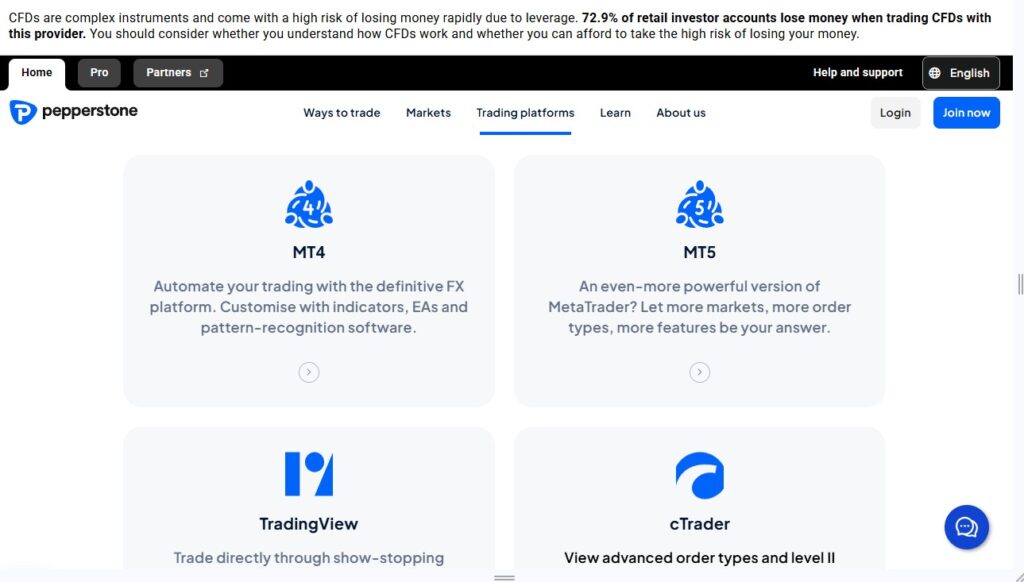
Platform choice is one of Pepperstone’s biggest strengths.
Depending on your account and region, Pepperstone supports:
- Pepperstone’s own platform
- TradingView
- MetaTrader 4
- MetaTrader 5
- cTrader
There is no universal best Pepperstone trading platform.
The right choice depends heavily on:
- How frequently you trade
- Whether you trade manually or automatically
- Your preferred charting software
- Whether you already use Expert Advisors
- Whether you scalp
- Whether you need advanced backtesting
- Whether you primarily trade on desktop or mobile
Pepperstone TradingView integration
TradingView is arguably Pepperstone’s most attractive option for discretionary technical traders.
Instead of analysing markets in TradingView and then manually recreating your trade at a separate broker, you can connect a compatible Pepperstone account and execute trades through the TradingView environment.
This combines TradingView’s charting tools with a Pepperstone trading account.
That is particularly attractive for traders who already use TradingView for:
- Technical analysis
- Watchlists
- Indicators
- Alerts
- Multi-timeframe analysis
- Chart templates
- Trading ideas
Who is TradingView best for?
We would choose TradingView if you:
- Already build your analysis in TradingView
- Use multiple charts and indicators
- Manually trade price action or technical setups
- Want cloud-based chart layouts
- Move between computers
- Want analysis and order execution in one environment
For many discretionary day traders, this is our favorite Pepperstone setup.
Pepperstone MetaTrader 4 (MT4)
MT4 remains relevant primarily because of its enormous forex ecosystem.
Its interface looks dated compared with TradingView and newer trading platforms, but that does not mean it has become irrelevant.
MT4 still has a large ecosystem of:
- Expert Advisors
- Custom indicators
- Trading scripts
- Position-management tools
- Third-party trading utilities
Pepperstone supports automated trading through MT4, making it particularly attractive to traders who already have an existing MQL4-based system.
If your entire strategy and toolset already run in MT4, there may be little reason to migrate purely for cosmetic reasons.
For a new trader starting from scratch, however, we would normally compare MT5, cTrader and TradingView before automatically choosing MT4.
Pepperstone MetaTrader 5 (MT5)
MT5 is the more capable MetaTrader platform.
It adds features such as additional order functionality, more timeframes, MQL5 programming and a more advanced strategy-testing environment.
That makes MT5 our preferred MetaTrader choice for someone who does not have legacy MT4 indicators or Expert Advisors tying them to the older platform.
Who is MT5 best for?
MT5 makes particular sense for:
- Algorithmic traders
- Expert Advisor users
- Traders who want to backtest strategies
- Traders who want a broader feature set than MT4
- Existing MetaTrader users who want a more modern environment
If you are completely new to MetaTrader, we would generally start by evaluating MT5 before deciding whether there is a specific reason to use MT4.
Pepperstone cTrader
cTrader sits somewhere between the technical flexibility of MetaTrader and the more modern trading experience many discretionary traders expect.
We particularly like the fit between cTrader and short-term forex trading.
Its interface feels more purpose-built for active order placement than MetaTrader’s older interface, while cTrader’s automation capabilities give systematic traders another route beyond MetaTrader’s Expert Advisor ecosystem.
Who is cTrader best for?
Consider cTrader if you:
- Actively day trade forex
- Scalp
- Dislike MetaTrader’s older interface
- Want automation possibilities
- Prefer a platform built around active trading
- Want an alternative to the MetaTrader ecosystem
For an active forex trader deciding between Pepperstone’s platforms, our shortlist would be cTrader versus TradingView for discretionary trading and cTrader versus MT5 for automation.
Pepperstone trading app
Pepperstone also offers its own web platform and mobile app.
That is important because not every customer needs MetaTrader or cTrader.
Pepperstone’s proprietary interface provides a more straightforward route for traders who want access to the broker’s markets without first learning a specialized third-party platform.
Our preference would still be TradingView or cTrader for intensive technical day trading, but Pepperstone’s own platform can lower the learning curve for newer users.
Mobile trading is particularly useful for:
- Monitoring open positions
- Checking market movement
- Adjusting stop losses
- Closing positions
- Managing watchlists
- Reacting when away from a desktop
We would still prefer a desktop trading environment for serious multi-chart analysis and rapid intraday execution.
Which Pepperstone platform is best?
| Trading style | Our preferred Pepperstone platform |
| Technical day trader | TradingView |
| Forex scalper | cTrader |
| Algorithmic trader | MT5 or cTrader |
| Existing EA user | MT4 or MT5 |
| Beginner | Pepperstone platform |
| Multi-chart discretionary trader | TradingView |
This is one area where Pepperstone has a genuine advantage.
You are not forced to make one proprietary platform work for every trading style.
Pepperstone leverage explained
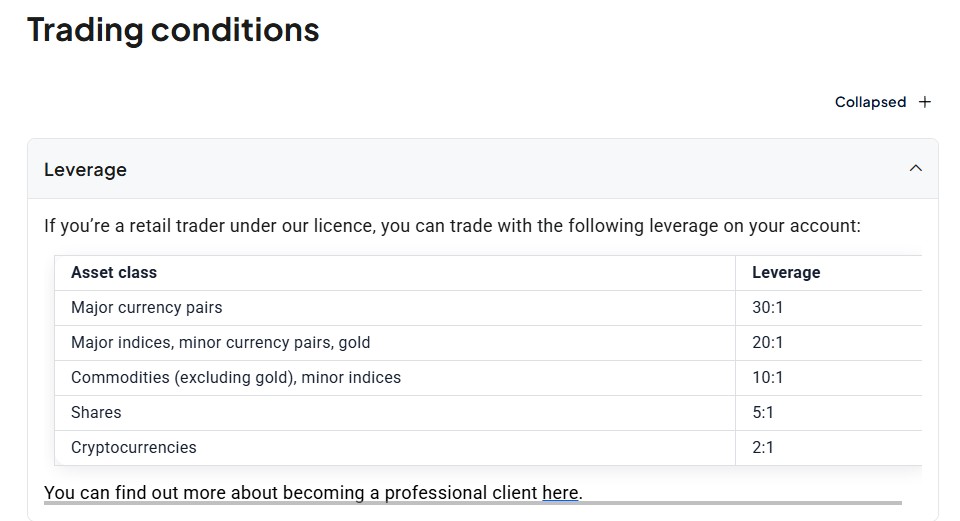
Leverage lets you control a position larger than the capital you put up as margin.
For example, 30:1 leverage means that every €1 of required margin can theoretically control €30 of market exposure.
That magnifies both gains and losses.
The maximum Pepperstone leverage depends heavily on your jurisdiction and whether you are classified as a retail or professional client.
What is Pepperstone's maximum leverage?
For retail traders under European regulation, leverage is generally capped at levels such as:
| Asset | Maximum EU retail leverage |
| Major forex pairs | 30:1 |
| Minor forex pairs | 20:1 |
| Major indices | 20:1 |
| Gold | 20:1 |
| Other commodities | 10:1 |
| Minor indices | 10:1 |
| Shares | 5:1 |
| Cryptocurrencies | 2:1 |
Professional clients and clients trading through other Pepperstone entities may have access to substantially higher leverage.
This is why claims such as “Pepperstone offers 1:500 leverage” need context.
That level may be available to certain traders or under particular entities, but it does not mean every Pepperstone client can trade at 1:500.
Is higher Pepperstone leverage better?
Not necessarily.
High leverage reduces the margin needed to open a position, but it does not reduce the economic size of that position.
A trader who focuses only on the margin requirement can quickly create much more market exposure than the account can comfortably support.
For day trading, we care much more about:
- Risk per trade
- Stop distance
- Total position exposure
- Correlated open positions
- Maximum daily loss
- Account drawdown
than about using the maximum leverage Pepperstone makes available.
Leverage is a tool. It should not determine your position size.
Pepperstone demo account
Pepperstone offers demo accounts, making it possible to explore supported trading platforms before putting real capital at risk.
That is useful for more than beginners.
We would also use a Pepperstone demo account when:
- Moving from MT4 to MT5
- Testing cTrader for the first time
- Connecting Pepperstone to TradingView
- Testing a new Expert Advisor
- Checking position sizing
- Learning the order-entry interface
- Experimenting with a different trading workflow
A demo account is particularly useful for becoming familiar with order types before trading real money.
Pepperstone demo vs live trading
Do not confuse good demo performance with proof that a strategy will perform equally well with real money.
A demo environment is useful for learning execution and testing platform functionality, but it cannot reproduce every aspect of live trading.
Differences can include:
- Slippage
- Liquidity
- Execution conditions
- Emotional pressure
- Decision-making under real financial risk
A demo also cannot replicate the psychological impact of losing actual money.
Use it to learn the software and validate mechanics.
Do not use profitable demo results as evidence that a trading strategy is guaranteed to remain profitable in a live account.
What can you trade with Pepperstone?
Pepperstone offers a broad CFD range covering many of the markets active traders typically look for.
Forex
Forex remains the core reason we would choose Pepperstone.
The combination of Razor pricing, multiple trading platforms and support for automation is particularly well suited to active currency trading.
Available markets include major, minor and other forex pairs, with leverage depending on region and client classification.
For active forex traders, the most important Pepperstone features are:
- Raw-spread Razor pricing
- MT4
- MT5
- cTrader
- TradingView
- Automated trading
- Scalping support
Index CFDs
Pepperstone offers index CFDs, allowing traders to take positions on broad equity markets rather than individual companies.
For day traders, index CFDs can be attractive because indices often have:
- Strong liquidity
- Defined active trading sessions
- Frequent intraday movement
- Clear reactions to macroeconomic releases
- Exposure to an entire market through one instrument
Popular index trading strategies often focus on the opening hours of major US and European sessions.
Share CFDs
Share CFDs let you speculate on a stock’s price without owning the underlying shares.
This distinction is crucial.
If your objective is to build a long-term portfolio and obtain actual ownership of securities, use a broker designed for real share investing.
If your objective is short-term speculation on whether a share price will rise or fall, Pepperstone’s share CFDs may be relevant.
Share CFDs can also allow traders to speculate on falling prices without borrowing the underlying shares in the traditional way.
Commodities
Pepperstone supports commodity CFDs covering markets such as gold, oil and other commodities.
Gold is particularly relevant to active traders because it can experience substantial intraday movement around:
- Inflation reports
- Employment data
- Central-bank announcements
- Interest-rate expectations
- US dollar movements
- Geopolitical developments
Commodity trading can also involve substantial volatility, so position sizing remains important.
Cryptocurrency CFDs
Cryptocurrency CFDs are available in eligible jurisdictions.
These products give traders exposure to cryptocurrency price movements without requiring them to manage coins in a crypto wallet.
However, they remain derivatives rather than direct cryptocurrency ownership.
That means you are trading the price movement rather than buying cryptocurrency to transfer, hold or use on a blockchain.
Availability and leverage depend on jurisdiction.
Is Pepperstone good for day trading?
Yes. Pepperstone is one of the brokers we would seriously consider for forex and CFD day trading.
Three things stand out.
- First, Razor pricing is designed for traders who care about transaction cost.
- Second, Pepperstone offers a wider choice of serious trading platforms than many competing brokers.
- Third, it supports the tools active traders typically look for, including TradingView, MetaTrader, cTrader and automated trading.
That combination is why we include Pepperstone among our preferred day trading platforms.
There is one major qualification.
Pepperstone is particularly strong for forex and CFD day trading, not necessarily for every definition of day trading.
Pepperstone for forex day trading
This is where Pepperstone makes the most sense.
A forex day trader can combine:
- Razor raw spreads
- Transparent commissions
- Short-term charting
- cTrader
- TradingView
- MT4 or MT5
- Automated strategies
- Hedging
- Relatively small minimum trade sizes on many instruments
That is a much more coherent proposition than trying to make Pepperstone into a long-term investment broker.
The biggest appeal is flexibility.
A technical discretionary trader can use TradingView, a scalper can use cTrader and an algorithmic trader can build around MetaTrader or cTrader.
Does Pepperstone allow scalping?
Yes, Pepperstone allows scalping.
The Razor account is the logical starting point because every fraction of a pip becomes more important as trade frequency rises.
Scalpers should pay particular attention to:
- Average spread rather than minimum spread
- Commission
- Slippage
- Order execution
- Platform speed
- Trading-session liquidity
Execution still cannot be guaranteed at the exact price you see on screen.
During fast markets, orders may experience positive or negative slippage.
Pepperstone for algorithmic trading
Pepperstone is also strong for systematic traders.
MetaTrader supports Expert Advisors, MT5 provides a more advanced strategy-testing environment and cTrader supports algorithmic trading through its automation tools.
That gives systematic traders considerably more freedom than brokers that only offer a closed proprietary platform.
The best choice depends on your existing technology stack.
If your strategies are written in MQL4, MT4 remains the obvious choice.
For newer MetaTrader development, MT5 may make more sense.
If you prefer the cTrader ecosystem, Pepperstone gives you that option as well.
Pepperstone for stock day trading
This is where we would be more selective.
Pepperstone gives you access to share CFDs, but that is not the same proposition as a broker built around exchange-listed equities.
If your definition of stock day trading means actively trading actual US stocks through a dedicated equities broker, Pepperstone would not be our first choice.
A dedicated stock broker may provide features such as:
- Direct ownership of shares
- Broader US equity coverage
- Exchange-specific order routing
- Dedicated stock scanners
- Options trading
- Extended-hours stock trading
- Market-depth tools
If you specifically want to speculate on share prices through CFDs and you live in an eligible country, the proposition is different.
Pepperstone deposits and withdrawals
Pepperstone supports several funding methods, although availability varies by region.
Depending on the entity, funding options can include:
- Bank transfer
- Debit cards
- Credit cards
- Digital wallets
- Local payment methods
The exact options visible in your account depend on your country and Pepperstone entity.
How long do Pepperstone withdrawals take?
Pepperstone withdrawal times depend on the payment method.
Electronic payment methods can often be processed relatively quickly, while bank transfers may take several business days before funds appear in your account.
The total withdrawal time can depend on:
- Pepperstone’s processing time
- Payment method
- Your bank
- Intermediary banks
- Currency conversion
- Weekend or holiday timing
This means a broker can process a withdrawal on its side before the money actually appears in your bank account.
Pepperstone withdrawal fees
Pepperstone generally does not add a fee to many common deposit and withdrawal methods.
International bank transfers can be an exception, and intermediary banks may impose their own charges.
Currency conversion can also create an indirect cost if the withdrawal currency differs from your receiving account.
Always check the current funding conditions for your Pepperstone entity before making a large withdrawal.
Pepperstone copy trading
Pepperstone also offers copy-trading options, although this is not the main reason we would choose the broker.
Depending on platform and region, traders can use supported copy-trading solutions linked to a Pepperstone account.
The principle is simple.
You select another trader or strategy provider and allow qualifying trades to be replicated in your own account.
That can be convenient, but copy trading does not remove trading risk.
Before following another trader, look at more than headline return.
Relevant metrics include:
- Maximum drawdown
- Length of track record
- Number of trades
- Position sizing
- Use of leverage
- Average holding period
- Largest losing trade
- Performance consistency
A strategy provider’s historical performance tells you what happened in the past, not what will happen after you start following the strategy.
Can you use Pepperstone in the USA?
No, Pepperstone does not currently accept US residents through the entities covered in this review.
This is particularly important because people in the United States still search for Pepperstone and Pepperstone reviews.
If you are a US trader, Pepperstone should therefore not be on your shortlist.
You will need a broker that is authorised to serve US residents and provides the products you actually want to trade.
For US-based day traders, the best alternative also depends on whether you want to trade:
- Stocks
- Options
- Futures
- Forex
- Cryptocurrency
- Other leveraged products
Pepperstone’s strengths do not change the fact that account eligibility comes first.
Pepperstone vs other trading platforms
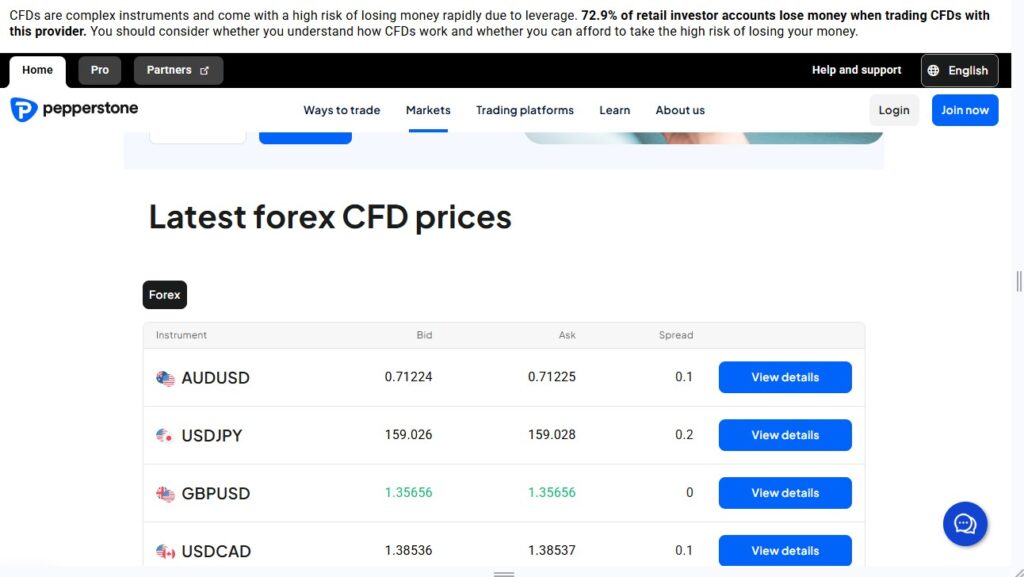
So how does Pepperstone perform when we compare it to our other hand-tested platforms like IC Markets, XTB, and others? Below you will find a small summary per comparison.
Pepperstone vs IC Markets
Pepperstone and IC Markets are natural competitors because both appeal strongly to active forex and CFD traders.
Both provide access to major third-party platforms and both compete heavily on trading costs.
We would not choose between them based purely on a headline “spreads from 0.0 pips” claim.
Instead compare:
- Exact commission for your chosen platform
- Average spread on the pairs you actually trade
- Regulatory entity
- Funding methods
- TradingView setup
- cTrader setup
- MetaTrader support
- Withdrawal conditions
- Execution during the hours you trade
The winner can change depending on your platform and trading style.
A cTrader scalper may care about different factors than a TradingView swing trader.
For that reason, Pepperstone vs IC Markets deserves its own detailed comparison rather than a simplified winner inside this review.
Pepperstone vs XTB
Pepperstone and XTB serve somewhat different types of traders.
Pepperstone is the more specialized choice for traders who prioritize forex, raw spreads and third-party trading platforms such as TradingView, MT4, MT5 and cTrader.
XTB centres much more of its experience around its proprietary platform and, in supported regions, also offers access to actual stocks and ETFs alongside CFDs.
Our preference therefore depends on the objective.
Choose Pepperstone if your priorities include:
- Forex trading
- Scalping
- Raw spreads
- Algorithmic trading
- MT4
- MT5
- cTrader
- TradingView
Consider XTB if your priorities include:
- A polished proprietary platform
- Combining trading and investing
- Access to actual stocks in eligible regions
- Access to actual ETFs in eligible regions
- A more integrated single-platform experience
You can read our full XTB review for a deeper look at that platform.
Pepperstone review: final verdict
Pepperstone earns a 4.7/5 editorial rating from us because it knows exactly what type of trader it wants to serve.
It is not trying to be a retirement broker, robo-advisor and options platform at the same time.
Its strength is active trading.
The Razor account provides a logical pricing model for frequent forex traders. TradingView, MT4, MT5 and cTrader give you considerably more platform freedom than most proprietary-only brokers.
Pepperstone also avoids a traditional inactivity fee and lets prospective clients experiment with demo accounts before committing real capital.
For us, the strongest Pepperstone setups are:
- Razor + TradingView for discretionary technical trading
- Razor + cTrader for active forex and scalping
- Razor + MT5 for traders who put more emphasis on automation
- MT4 for traders who already depend on existing MQL4 Expert Advisors
The biggest limitation is equally clear.
Pepperstone is a CFD-focused broker, not an all-purpose investment account.
US residents cannot use it, and investors who mainly want to own stocks or ETFs should compare other brokers.
But if you are an eligible forex day trader, scalper or active CFD trader, Pepperstone deserves a place near the top of your shortlist.
For more alternatives, see our comparison of the best day trading platforms.
Frequently Asked Questions
Yes, Pepperstone is a well-established regulated broker with a particularly strong proposition for active forex and CFD traders. Its main advantages are competitive Razor pricing and support for TradingView, MT4, MT5 and cTrader.
Pepperstone operates through regulated entities and keeps eligible client money separate from corporate funds under applicable regulatory frameworks.
Yes, Pepperstone was founded in Melbourne in 2010 and operates through multiple regulated entities internationally.
There is no single universal account-opening minimum that applies to every Pepperstone customer.
The Standard account incorporates its broker charge into the forex spread.
Razor uses raw spreads from 0.0 pips plus a separate commission.
Other possible costs include overnight funding and certain payment or banking charges.
Pepperstone advertises raw forex spreads from 0.0 pips on Razor accounts.
Actual spreads are variable and can be wider depending on liquidity, market conditions and the instrument being traded.
You should therefore compare average trading costs rather than assuming every trade will execute with a zero spread.
The Razor account uses raw-spread-plus-commission pricing for forex rather than incorporating the entire broker charge into a wider spread.
Yes, Pepperstone supports TradingView integration on compatible accounts and in eligible jurisdictions.
How we reviewed Pepperstone
For this Pepperstone review, we evaluated the broker across the factors that matter most to an active trader:
- Trading costs and spreads
- Standard versus Razor pricing
- Trading-platform choice
- Forex and CFD market access
- Regulation and client protection
- Leverage
- Account funding
- Withdrawals
- Demo trading
- Suitability for day trading
- Suitability for scalping
- Suitability for algorithmic trading
Disclaimer (general & CFDs)
MyInvestAcademy provides educational and informational content only. Nothing in this Pepperstone review should be interpreted as personal investment advice, a recommendation to trade, or an invitation to open an account with Pepperstone or any other broker.
Pepperstone does not currently accept residents of the United States through the entities covered in this review. If you are based in the US, references to Pepperstone’s products, platforms, pricing or trading conditions are provided for informational purposes only. US traders should use brokers and financial products that are legally available in their jurisdiction.
Particular caution is required when considering contracts for difference (CFDs). CFDs are leveraged derivative products that allow you to speculate on price movements without owning the underlying asset. Leverage can increase potential profits, but it also magnifies losses and can cause you to lose money rapidly.
When you trade a CFD on a stock, index, commodity, cryptocurrency or other market, you are generally not buying or owning the underlying asset. Instead, you enter into a contract with the broker based on the difference between the opening and closing price of your position.
CFD trading can involve costs and risks including:
- Rapid losses caused by leverage
- Variable spreads
- Trading commissions
- Overnight financing charges
- Slippage during volatile markets
- Margin calls and forced position closures
- Differences in investor protection between jurisdictions
- The possibility of losing your entire trading capital
The regulatory protections, leverage limits, products and account conditions available through Pepperstone vary depending on your country, regulatory entity and whether you are classified as a retail or professional client.
Always check which Pepperstone legal entity would hold your account and review its current regulatory disclosures, risk warnings, fees and product documentation before depositing money or placing a trade.
Past performance, historical returns, demo-account results and the performance of other traders do not guarantee future results.
Only trade CFDs if you understand how they work, understand the risks associated with leverage and can afford to lose the money you put at risk.
