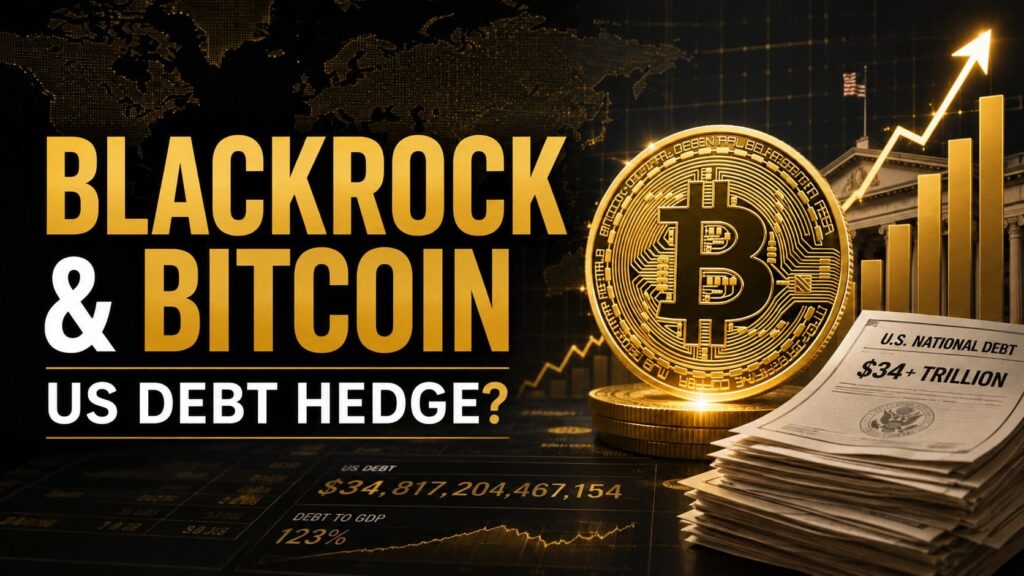
BlackRock says Bitcoin could hedge rising U.S. debt risks
BlackRock has strengthened its long-term case for Bitcoin, arguing that the cryptocurrency could provide investors with protection against one of the biggest risks facing the U.S. economy: persistent government deficits and the potential debasement of the dollar.
In research published on August 17, 2026, BlackRock described Bitcoin as an emerging global monetary alternative that could act as a hedge when rising government debt puts pressure on traditional currencies.
What BlackRock actually said about Bitcoin and debt
The distinction is important. BlackRock did not say Bitcoin can solve America’s debt problem, nor did it describe Bitcoin as a replacement for U.S. Treasury bonds.
Instead, its argument is that continuously rising debt and fiscal deficits can ultimately weaken confidence in fiat currencies.
BlackRock wrote:
“A potential hedge against ongoing fiat debasement amid rising government debt and persistent fiscal deficits.”
The statement appeared in BlackRock’s latest Bitcoin research, Re-Underwriting Bitcoin: Still a Portfolio Diversifier, published by Robert Mitchnick, Head of BlackRock’s Digital Assets Business.
Why U.S. debt matters for Bitcoin
Only 21 million Bitcoin can ever exist. Governments, by contrast, can issue additional debt while central banks control the supply of fiat currency. That difference has helped create Bitcoin’s reputation as a form of digital scarcity.
The theory is that investors may increasingly look for assets outside the traditional monetary system if government debt continues rising and concerns around currency debasement increase.
That does not mean Bitcoin automatically rises whenever U.S. debt increases. Interest rates, liquidity, ETF flows and investor sentiment remain major short-term price drivers.
Our updated Bitcoin price prediction for 2026, 2027 and 2030 looks at how those factors could influence BTC over different time horizons.
BlackRock's Bitcoin thesis compared
BlackRock’s latest research places Bitcoin somewhere between a traditional risk asset and a monetary hedge.
| Characteristic | Bitcoin | U.S. Treasuries | U.S. dollar |
|---|---|---|---|
| Supply | Capped at 21 million BTC | New debt can be issued | Money supply can expand |
| Yield | None | Interest income | Depends on cash instrument |
| Government backing | No | Yes | Yes |
| Volatility | Very high | Generally low | Relatively low |
| Potential debasement hedge | BlackRock sees potential | Limited | Asset being debased |
| Main risk | Price volatility | Inflation and interest rates | Loss of purchasing power |
This is why describing Bitcoin simply as an “alternative to U.S. debt” would be misleading.
BlackRock is presenting it more as an alternative monetary asset that may perform differently when investors become concerned about debt, deficits or the long-term purchasing power of fiat money.
Larry Fink had already warned about the U.S. dollar
The latest research is not an isolated change in BlackRock’s thinking.
CEO Larry Fink raised the same issue in his 2025 annual chairman’s letter, linking America’s growing debt burden directly to the potential rise of Bitcoin and other digital assets.
Fink wrote:
“America risks losing that position to digital assets like Bitcoin.”
He argued that if deficits continue expanding, investors could eventually begin viewing Bitcoin as safer than the dollar.
That is a remarkable shift from the way Bitcoin was viewed by large financial institutions only a few years ago.
BlackRock also sees Bitcoin as a portfolio diversifier
The asset manager’s August 2026 research found that Bitcoin has maintained relatively distinctive portfolio characteristics over longer periods despite often behaving like a risk asset during market sell-offs.
BlackRock’s historical analysis found that a 1% to 2% Bitcoin allocation would have improved the risk-adjusted returns of a traditional 60/40 portfolio over the previous ten years. The company therefore continues to see a measured Bitcoin position as a potential strategic diversifier.
Historical results do not mean the same allocation will improve future returns. Bitcoin remains capable of extremely large drawdowns.
BlackRock is making a bigger argument about Bitcoin
The most significant part of BlackRock’s latest research may therefore be the language it uses.
Bitcoin is no longer being discussed purely as a speculative technology investment. The world’s largest asset manager is increasingly analysing it alongside questions such as government debt, monetary credibility, portfolio diversification and currency debasement.
That does not establish Bitcoin as a safe haven comparable with gold, nor does it mean investors should replace Treasury bonds with Bitcoin.
But it does strengthen one of the central long-term Bitcoin narratives: an asset with a fixed supply could become more attractive if confidence in unlimited government borrowing and fiat currencies weakens.
Larry Fink’s earlier warning about the dollar and BlackRock’s August 2026 research now point in broadly the same direction.
For investors, the question is no longer whether major financial institutions take the Bitcoin monetary thesis seriously. BlackRock clearly does.
The harder question is whether Bitcoin can actually fulfil that role when the next major fiscal or monetary stress event arrives.
This article is for educational and informational purposes only and does not constitute investment advice. Cryptocurrency is highly volatile and investors can lose all of their invested capital.