Gold price forecast: What analysts expect for the rest of 2026
Gold has rebounded sharply in August, but analysts remain unusually divided over where the precious metal will finish 2026.
On August 27, 2026, gold traded around $4,589 per ounce in early U.S. trading. That puts the metal close to several conservative year-end forecasts already, while the most bullish Wall Street targets still imply substantial upside before December.
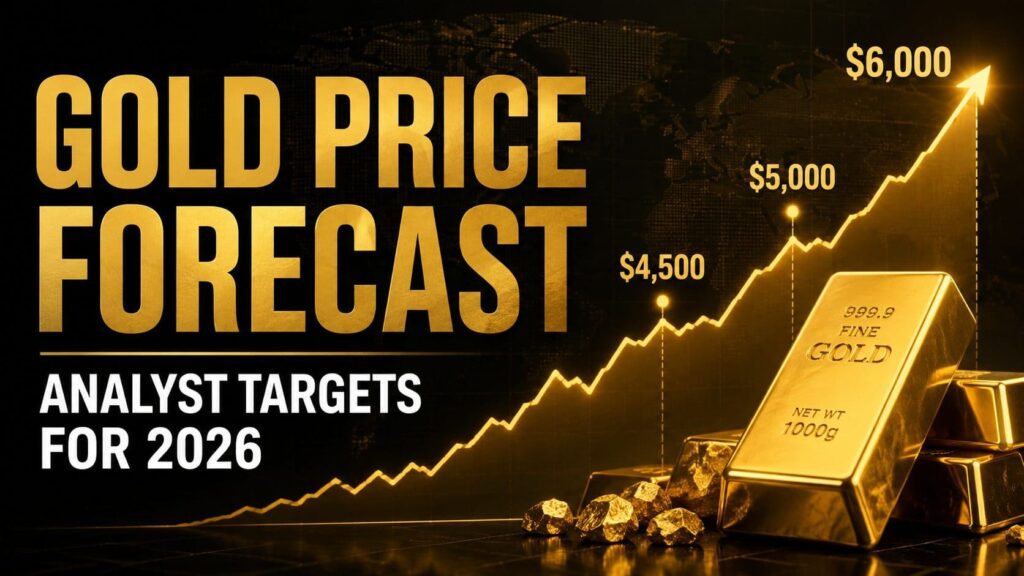
So, who is right? Current forecasts range from roughly $4,450 to $6,000 per ounce, with Federal Reserve policy, central-bank purchases and investor demand likely to determine which side comes closest.
Gold price forecasts for the rest of 2026
The table below compares some of the latest published forecasts from major banks and professional analysts.
| Analyst or institution | 2026 gold forecast | Horizon | Current view |
|---|---|---|---|
| Morgan Stanley | $4,450 | Q4 target | Cautious |
| LBMA analyst survey | ~$4,500 | Average year-end forecast | Cautious |
| UBS | $4,600 | End of 2026 | Neutral |
| Goldman Sachs | $4,900 | End of 2026 | Moderately bullish |
| Wells Fargo | $4,900-$5,100 | End of 2026 | Bullish |
| J.P. Morgan | Up to $6,000 | December 2026 | Very bullish |
The targets are not perfectly comparable. Some refer to year-end prices, while others are quarterly targets or survey averages. They nevertheless show how wide expectations remain after one of gold’s most volatile years in decades.
For our continuously updated overview, see the MyInvestAcademy gold price forecast for 2026.
Professional analysts average around $4,500
The London Bullion Market Association also points to a relatively restrained finish to the year.
In an August 11 survey of 16 professional analysts, the average year-end forecast was approximately $4,500 per ounce. Individual forecasts ranged from $3,879 to $5,100.
The same analysts expect second-half highs anywhere between $4,872 and $5,800, showing that even cautious forecasters expect considerable volatility before December.
With gold currently above the survey’s average year-end target, the consensus effectively suggests that much of the upside may already be priced in.
Morgan Stanley sees limited upside in 2026
Morgan Stanley currently sits near the cautious end of the market.
The bank had a fourth-quarter target of $4,450 per ounce, but analyst Amy Gower said on August 20 that gold had reached that level earlier than expected.
Morgan Stanley still sees a path toward more than $5,000 in 2027, supported by central-bank purchases and renewed ETF demand. But for the remainder of 2026, the bank expects volatility rather than another immediate surge.
Goldman Sachs still sees $4,900 gold
Goldman Sachs is more constructive.
The bank currently targets $4,900 per ounce by the end of 2026. That target was reduced from $5,400 in June after Goldman concluded that Federal Reserve rate cuts were unlikely this year and gold ETF inflows had weakened.
Goldman’s longer-term argument remains bullish.
Central banks continue to buy considerably more gold than before 2022, while concerns over government debt and currency diversification create structural demand that is less sensitive to short-term interest-rate movements.
At today’s price, $4,900 would still require another meaningful move higher before the end of December.
J.P. Morgan remains the major bull
J.P. Morgan stands well above most other forecasts.
In its 2026 mid-year outlook, the bank said gold could still reach $6,000 per ounce by December 2026. Gregory Shearer, J.P. Morgan’s head of Base and Precious Metals Strategy, argued that concerns about currency debasement, fiscal risk and geopolitical fragmentation remain structurally supportive.
J.P. Morgan said reaching $6,000 has become increasingly dependent on interest-rate expectations. If inflation forces the Federal Reserve to keep rates elevated or raise them again, that would make such a move considerably harder.
At roughly $4,589 today, $6,000 remains the most aggressive major-bank scenario.
Why analysts disagree so much
The difference between $4,500 and $6,000 largely comes down to what happens with U.S. interest rates.
Higher real yields make gold less attractive because the metal does not generate interest. That is why expectations of additional Fed tightening contributed to gold’s sharp correction earlier in 2026.
Concerns around U.S. government debt, Treasury-market stability and potential dollar debasement have driven investors toward hard assets again. Gold climbed more than 13% during August as those concerns intensified.
Central-bank purchases provide another layer of demand that is not purely dependent on whether the Fed moves rates by 25 basis points.
Gold could finish 2026 anywhere between consolidation and another record run
The analyst forecasts do not point to one obvious outcome.
The cautious camp sees gold ending 2026 around current levels. Morgan Stanley, UBS and the latest LBMA survey all cluster roughly between $4,450 and $4,600.
Goldman Sachs and Wells Fargo expect another move toward or above $5,000.
J.P. Morgan remains significantly more bullish, with a path toward $6,000 if monetary conditions and investment demand become supportive again.
For now, $5,000 appears to be the most important dividing line. A sustained break above it would validate the more bullish forecasts and put the January highs back into focus. Failure to regain that level would leave the more conservative $4,500-$4,900 targets looking increasingly realistic.
This article is for educational and informational purposes only and does not constitute investment advice. Gold prices can be volatile and analyst forecasts can change quickly as economic conditions develop.